Motors, compressors, and high wattage transformers don't play nice.
I've been a wireman electrician for 37 years and have wired many houses and buildings.
The National Electrical Code states.
210.52 (B) Small Appliances.
(1) Receptacle Outlets Served. In the kitchen, pantry, breakfast room, or similar area of a dwelling unit, the two or more 20-amp small-appliance branch circuits required shall serve all wall and floor receptacle, all countertop outlets, and receptacle outlets for refrigeration equipment.
The NEC is a minimum and not meant to be a design manual or written for future expansion of the system. I always put a refrigerator on its own 20A circuit because they can draw 6 to 11 amps. If your 10A microwave and 11A refrigerator are on the same circuit at the same time, for some length of time, oops trip. You are only really only supposed to load a 20A circuit to 80% which is 16A. I also always put the range exhaust hood on its own 20A circuit, you never know if a future owner, you or the wife, will want a combination microwave/exhaust hood installed. If your amplifier wasn't in one of the areas listed well that electrician/contractor was a cheater.
Another noise issue you can run into is, say if you are bi-amping and you plug one amp into an A phase circuit (1,3,5,7, etc.) and the other amp into a B phase circuit (2,4,6,8, etc.), on a single phase system not 3 phase, those A and B circuits are 180 degrees out of phase, which can create a ground loop problem and a need for one of your instrument cables to have a ground lifting device inline. I always try to plug both amps into the same circuit. On a 3-phase system A, B and C phase are out of phase by 120 degrees, you have the same problem. Try to stay on the same circuit or phase.
1 A 2 A
3 B 4 B
5 C 6 C
7 A 8 A
Etc. Etc.

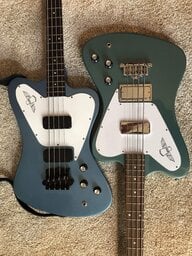




 Thanks - I'm pleased with the way it turned out.
 ) and VV with a .047 Black Beauty cap. (my finish) It rocks.