• TalkBass has been independent since 1998. Add your voice.
    Create a free account to reply to discussions, view embedded media, and browse with fewer display ads.
    Join freeLog in
    Want zero display ads or expanded classifieds tools? Compare plans.

Thunderbird Club

It's funny you should say that...

Exact same spot on my 2018: less pronounced but definitely 'rough.'

View attachment 7495686


And I remember the RH Epi I had but sold had a similar issue.

Not a flaw, then.

Just me faithfully replicating wing to body glue seams I don't actually have. 😇

Improving: base clear and color down. More clear later after it sets, then feather.

View attachment 7495701

At least color match is perfect because I decanted leftovers from the rattlecan and kept for touchups.

View attachment 7495702
Looks good! The good thing about lacquer is it's easy to blend repairs.
 
As much as I agree with the importance of pu placement 100% - pu type/brand, electronics, pu's position's - in that order. You can have the best pu position's w/a sub-standard harness and well.., it'll sound, ok. :bassist:
I’d pretty much agree with your tonal pecking order (might swap pu positions with electronics but that could honestly go either way).

I’d also throw strings (type and brand) in there as well. Maybe right between pickups and electronics. Then at the tail end add neck woods, body woods, hardware (nut, bridge, tuners), construction method (bolt on set or thru neck) and finish in that order.

And don’t forget that all assumes you don’t have any variability in amps or cabs or cables which we all know play a huge part in the sound of your bass.

Then there’s the aspect of different players and their playing styles.

And all that’s before we even consider venue acoustics and interactions with other band instruments and background noise.

Oh and don’t forget the impossible to predict issues of listener hearing quality and any conformation or other bias they might have hardwired in their brain that tells them how your tone sounds or in Wills case, what color it is.

It’s no wonder tone chasing frequently ends up being an expensive rabbit hole to run down.

My advice (as a quintessential tone chaser who build basses to achieve specific tones) play what ya got, make it sound as good as you can using your style of playing and the gear you have and in the venue you’re in. That’s gonna get you 80% there, that last 20% has financially drastically diminishing returns and largely won’t even be noticed by an audience in a typical rock, pop, or country band setting, especially if you rely on a sound man or recording engineer.

If you choose to chase down that last 20% I’d start with strings, probably the biggest bang for the buck, and once you find the right strings you’ll probably not even need to address the other tone tweak issues.
 
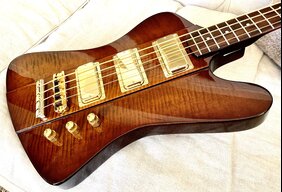
Talking about colour - this is a guitar ('66 Firebird) but the aged finish is spectacular -

I’ll be tickled pink if my Sparkling Burgundy NR reissue looks like that someday!
 
Interesting fraudulent ad on the verb (which is now owned by Servco, the majority investor in 7ender). I guess it’s ok to call a Squier (that was $199 in 2015) a Fender. I am noticing this happening more frequently since the Reverb ownership change last year.
 
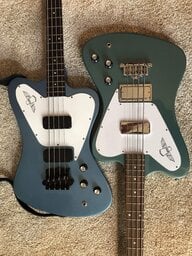
I love the Tbird+ tone. Here’s an early one of Nikki


Silversun is one of the 3 bands i associate with the "modern" T-Bird. The other's being late 90's-early 2000's Marilyn Manson (when Jeordie White was bassist), & well i can't deny that Motley Crue is in it too, even though i know he's been through many iterations of Thunderbird basses (From his 70's White bird, to the Hamers, Spectors, back to Gibson's, & now Schecter version of it).

I think most ceramic magnet pickups are built that way with the magnets under the pickup and steel pole pieces or blades. Alnico will have magnetic blades or cylinders that are the pole pieces.

This i know, was just surprised at how much difference there was between both Bird pickups. I will attest, my Epi Ungothed bird had the 60's pickups routed to match the 60's-70's birds more than the post 87-88 versions (where the neck pickup seems to move up closer to the neck). & while these TB+ might be "darker voiced" with the amount of Lows/low mids they push, they're not without any clarity. Though the 60's RI have them beat in Openness & sparkle to an extent. A little less lows than the +, but not at all lacking in that field
 
That is a beautiful guitar!
yah - very wow... here's an early SG bass with what looks to be the same aged finish. The (trans) red is a 'fugitive' colour - being thin UV rays break it down leaving the gold undercoat.

1778954224956.jpeg

1778954249593.jpeg

1778955047691.jpeg

1778954280660.jpeg
1778954304481.jpeg

1778954385675.jpeg
 
Last edited:
I’d pretty much agree with your tonal pecking order (might swap pu positions with electronics but that could honestly go either way).

I’d also throw strings (type and brand) in there as well. Maybe right between pickups and electronics. Then at the tail end add neck woods, body woods, hardware (nut, bridge, tuners), construction method (bolt on set or thru neck) and finish in that order.

And don’t forget that all assumes you don’t have any variability in amps or cabs or cables which we all know play a huge part in the sound of your bass.

Then there’s the aspect of different players and their playing styles.

And all that’s before we even consider venue acoustics and interactions with other band instruments and background noise.

Oh and don’t forget the impossible to predict issues of listener hearing quality and any conformation or other bias they might have hardwired in their brain that tells them how your tone sounds or in Wills case, what color it is.

It’s no wonder tone chasing frequently ends up being an expensive rabbit hole to run down.

My advice (as a quintessential tone chaser who build basses to achieve specific tones) play what ya got, make it sound as good as you can using your style of playing and the gear you have and in the venue you’re in. That’s gonna get you 80% there, that last 20% has financially drastically diminishing returns and largely won’t even be noticed by an audience in a typical rock, pop, or country band setting, especially if you rely on a sound man or recording engineer.

If you choose to chase down that last 20% I’d start with strings, probably the biggest bang for the buck, and once you find the right strings you’ll probably not even need to address the other tone tweak issues.

Phil Kubicki said that after the pu's/electronics - the neck was the next most important sound/tone decider. I trust he knew what he was talking about.
 
To make matters worse, he's in Delaware--same area(ish) as you, as opposed to Nevada or something. The nerve of some people.
I'll bet I'd uncover a whole enclave of these people if I dug into it! Eh, who needs the stress... Let 'em have it. Bunch a babies probably... 😅
 
Last edited:
I'll bet I'd uncover a whole enclave of these people if I dug into it! Eh, who needs the stress... Let 'em have it. Bunch a babies probably... 😅
Smart people imitate greatness.
Fools will imitate pretty much anything requiring little effort, skill or intelligence.
But let's go with smart here! :thumbsup: