Speaking of strings, I somehow snapped one of my RS66s off at the tuning peg last night. That was interesting. It was when I was retuning after adjusting the truss rod. Maybe I wound it too tight, thinking it was lower. Fun.

TalkBass has been independent since 1998. Add your voice.
Create a free account to reply to discussions, view embedded media, and browse with fewer display ads.
Join free Log in
Want zero display ads or expanded classifieds tools? Compare plans.

Oops :/Speaking of strings, I somehow snapped one of my RS66s off at the tuning peg last night. That was interesting. It was when I was retuning after adjusting the truss rod. Maybe I wound it too tight, thinking it was lower. Fun.

Speaking of strings, I somehow snapped one of my RS66s off at the tuning peg last night. That was interesting. It was when I was retuning after adjusting the truss rod. Maybe I wound it too tight, thinking it was lower. Fun.
I don't know if it could be the case for you... but when I was wrenchin' on my BlueBird, the repeated tightening and loosening of the strings was enough to cause me to pop the cores on 2 different A strings.Speaking of strings, I somehow snapped one of my RS66s off at the tuning peg last night. That was interesting. It was when I was retuning after adjusting the truss rod. Maybe I wound it too tight, thinking it was lower. Fun.
Oops :/
First time it ever happened. Not a huge deal, though, since I had a set I took off before the gig that weren't very old, so I just replaced it with a string from that set.Ugh!,
If any string i had a breaking problem with, was Roto's, have no clue why.
But again, was when i was gigging. Eeesh, that seems like eons ago.
Certainly possible that's the case. Lately I've been hearing a sort of pinging sound when tuning.I don't know if it could be the case for you... but when I was wrenchin' on my BlueBird, the repeated tightening and loosening of the strings was enough to cause me to pop the cores on 2 different A strings.
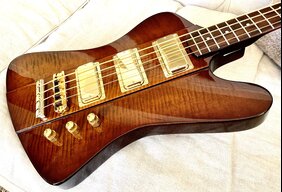
There's only 2 relatively common kinds of strings that I can think of that I haven't seen discussed in these pages. I can't speak to either one of them as they relate to bass, but I play/have played both on guitar. One is Elixer. On guitar... I absolutely hated them. On bass, I think they could have something to offer. The other is anything pure nickel (not nickel plated steel). I prefer pure nickels on my Strats & Teles. The pure nickels kinda round off the bright sharp tone inherent in these models, and wear better than NPS. If the Spector has a hot bright active sound... pure nickels might be a way to soften if up & give it a little bit of a more natural or "vintagey" kinda vibe. My knowledge of active systems is limited to that grey area between "jack" and "squat", but between you and @dukeorock maybe wunnaya will stumble into either of these & find something useful.
I have one of my Alembic basses strung up with Elixer Nanos. They're low tension strings with a micro coating of some sort. Good for slides, bending and reducing finger noise but they are much lower tension than I'd consider on a 5 string. They sound good and the new ones wear well under finger playing, not sure how they'd fair under pick usage. Would be an excellent choice for a beginner short scale bass. Very forgiving strings that do well with a light touch.I've tried the Elixer's. Didn't like em. The coating felt to rubbery, and at the time i was using them. The coating eventually started to crumble and fall off.
I was gigging back in those days. So not sure what they would be like now for me. But not likely to ever go back to them myself.
Certainly possible that's the case. Lately I've been hearing a sort of pinging sound when tuning.
In my experience... the "pinging" you're talking about, typically comes from the string kinda gettin' hung up in the nut. A buddy of mine introduced me to Guitar Grease (nut lube) (giggety). I've been usin' it for 25 years now. Pretty much takes care of the issue.Certainly possible that's the case. Lately I've been hearing a sort of pinging sound when tuning.
Are you installing them today?

Not sure if I understand what you mean by "pop the cores" but if you aren't already doing it - try following the standard stringing protocol for Black Beauties. They work best if you put a 90 degree bend in the end of the string before trimming the end to length. If done right you'll have a nice 90 degree bend at the very end of the string after cutting that you can shove in the tuning peg hole. This kink keeps the windings from unraveling or slipping on the core. It eliminates the all to common "dead string" issue that plagues Black Beauty users.I don't know if it could be the case for you... but when I was wrenchin' on my BlueBird, the repeated tightening and loosening of the strings was enough to cause me to pop the cores on 2 different A strings.

I'm sure I'll completely suck at pick, but at least I'll have an excuse - it's new to me. Can't use that excuse on my finger style playing unfortunately.

Are you installing them today?
Not sure if I understand what you mean by "pop the cores" but if you aren't already doing it - try following the standard stringing protocol for Black Beauties. They work best if you put a 90 degree bend in the end of the string before trimming the end to length. If done right you'll have a nice 90 degree bend at the very end of the string after cutting that you can shove in the tuning peg hole. This kink keeps the windings from unraveling or slipping on the core. It eliminates the all to common "dead string" issue that plagues Black Beauty users.
Playing a Thunderbird with a pick is a completely different thing.........It simply sets your tone on fire, for Rock it's simply perfect

I misspoke. It's not at the fulcrum that the core broke. I typically have 3 windings on the tuning peg. The last winding, where the string leaves the tuning peg & heads for the nut, is where they broke. In both cases, it was right by where the string begins it's turn around the peg. The only times it happened was when I'd loosened the strings, worked on the bass, then brought them back to tension, several times...Not sure if I understand what you mean by "pop the cores" but if you aren't already doing it - try following the standard stringing protocol for Black Beauties. They work best if you put a 90 degree bend in the end of the string before trimming the end to length. If done right you'll have a nice 90 degree bend at the very end of the string after cutting that you can shove in the tuning peg hole. This kink keeps the windings from unraveling or slipping on the core. It eliminates the all to common "dead string" issue that plagues Black Beauty users.
Yup. I think this is exactly my case. How do you use that wax in this case?I misspoke. It's not at the fulcrum that the core broke. I typically have 3 windings on the tuning peg. The last winding, where the string leaves the tuning peg & heads for the nut, is where they broke. In both cases, it was right by where the string begins it's turn around the peg. The only times it happened was when I'd loosened the strings, worked on the bass, then brought them back to tension, several times...
Not sure how the Lollars are wired but if they are true 4 wire (plus ground) dual coil pups you could do what I did on my FrankenGoth. I put in a toggle that takes it from dual humbuckers in series to dual single coils (one neck coil + one bridge coil) in series. Completely transforms the the bird from a Precision on steroids to a Jazz on steroids at the flick of a switch. And with the vol/vol set up you can solo or blend either coil/Humbucker to your hearts desire. I find the neck single coil solo to be exceptionally musical for chord and guitar strum type solos, almost baritone guitar sounding. Really adds a neat dimension to the bird. Very very transformational and absolutely useful in a live gig setting.I’m leaving for Texas in a few hours. Got gigs Thursday-Saturday out of state. Just gonna drop the bass off with a tech today, have him install the pickups and do a basic setup. Thinking of having him put in a push/pull on the tone pot for series/parallel
Not sure how the Lollars are wired but if they are true 4 wire (plus ground) dual coil pups you could do what I did on my FrankenGoth. I put in a toggle that takes it from dual humbuckers in series to dual single coils (one neck coil + one bridge coil) in series. Completely transforms the the bird from a Precision on steroids to a Jazz on steroids at the flick of a switch. And with the vol/vol set up you can solo or blend either coil/Humbucker to your hearts desire. I find the neck single coil solo to be exceptionally musical for chord and guitar strum type solos, almost baritone guitar sounding. Really adds a neat dimension to the bird. Very very transformational and absolutely useful in a live gig setting.
My experience with series/parallel switching isn't as good. I have a number of basses with this option but in almost every case I end up staying in series mode 90% of the time and when I do pop over to parallel mode I find I need to adjust the volume to keep my place in the mix. For me it's not very live gig friendly.