
Niente, Fratto...Was going to put the one I have on the passive side when I get home since that's the input I use exclusively. Thanks again for the insight into how these are mounted.

TalkBass has been independent since 1998. Add your voice.
Create a free account to reply to discussions, view embedded media, and browse with fewer display ads.
Join free Log in
Want zero display ads or expanded classifieds tools? Compare plans.
Niente, Fratto...Was going to put the one I have on the passive side when I get home since that's the input I use exclusively. Thanks again for the insight into how these are mounted.


while I’m waiting for my new nut!
They found a donor?
Brand new graphite.

This is Buffalo we are talking aboutAhem. And usually they use silicone for the prosthetics,


An upright is a good idea for everyone.I hate that level of variability where as you say, stuff can sound so different from day to day and try to alleviate this by keeping the controlled variables as unchanged as possible. I'm with you on the day job camp (have not been a full time music pro in over 20 years) but in my bands (2 now) we have no time between songs. Upon ending a song the drummer is already counting the next one so that leaves me no time to futz around with the settings on the amp. I have to "condense" my setup so that all it takes is a couple of small adjustments on the bass to go from "Folsom Prison Blues" to "Get into the Groove" convincingly. From your post it seems I treat my electrics more like the way you treat your upright which makes me wonder if an upright is (for me) such a good idea..
why not pull the head out of the sleeve so you can hold the back end while screwing the front in?Ciao Larry,
those are threaded and should work fine. Many manufacturers use those as they became popular when tube amps went from point to point (handbuilt) construction to PCBs. You should not have to do anything else other than gently (have to watch phrasing in this club to avoid "ehems" but am kinda hosed on this one) slide the barrel of the nut into the hole and start turning until you feel grip. Then tighten but don't over do it since the receptacle is PCB mounted and you could potentially crack the PCB (porca miseria!) which is prolly what made it fall out in the first place. Because you can't really torque them the way you would an old school panel mounted female 1/4" jack, vibration from the amp will cause these new style nuts to loosen and fall off..
cause it doesn't need it. it wouldn't hurt but it's not necessary..why not pull the head out of the sleeve so you can hold the back end while screwing the front in?

+1!! My Epiphones are great - Vintage Pro and the Jack CasadyHere here - wear the Epi badge proudly!

Uprights are great, but do take some time commitment to learn to play and a big vehicle to transport.An upright is a good idea for everyone.
I don't do much messing around on stage, either, and for the same reasons. All my experiments are done in rehearsal or on my own. I mostly change the tone and bridge pickup knobs on the bass to go from thumpy to snarling when it's called for. Hand position is another adjustment. There are no amp adjustments after sound check, ever.

I'll leave this here just to mess with everyone's head.Been away on holidays.
I have a couple of Telecaster Basses- a 69 and a 73, plus some other small headstock P Basses.
from..An upright is a good idea for everyone.
I don't do much messing around on stage, either, and for the same reasons. All my experiments are done in rehearsal or on my own. I mostly change the tone and bridge pickup knobs on the bass to go from thumpy to snarling when it's called for. Hand position is another adjustment. There are no amp adjustments after sound check, ever.
Modified Fender Telecaster Bass! Nice. Love those Seth Love Mudbuckers...I'll leave this here just to mess with everyone's head.View attachment 3157419
Got it cheap from Cowtown, the muckery was already done I cleaned up the control layout and installed the correct pg.Modified Fender Telecaster Bass! Nice. Love those Seth Love Mudbuckers...
I had one of those in the early 80's. Like yours it had a P Pup installed after market. Although it sounded HUGE, I couldn't get used to that slab body thickness, (for our "ehem" contingency) it felt mammoth strapped on..Got it cheap from Cowtown, the muckery was already done I cleaned up the control layout and installed the correct pg.
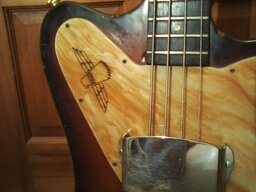
I almost always hafta bring up my volume once the gee-tar players get going. Tone on the amp stays put once I adjust it to the room. 'Course the fact I can't get to it very easily may be the determining factor.

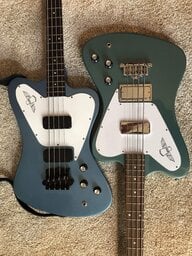
One reason I always wanted a Bird. He also played a mean P. One of my favorite songs to play back in the day was their version of There’s Gonna Be Showdown. Problem with it was getting a drummer who could play it like it was on the album.
I would sit and look at it all day. Beautiful.View attachment 3156974 Super fun amp while I’m waiting for my new nut!
As my Dad used to say, “you could cast peace messages to China with that thing.”Just saw it waiting for a repair on a bass I picked up yesterday. You don’t see those too much. 600 tube watts!