
Looks like distortion one side of that wave. Does it still need biasing?

TalkBass has been independent since 1998. Add your voice.
Create a free account to reply to discussions, view embedded media, and browse with fewer display ads.
Join free Log in
Want zero display ads or expanded classifieds tools? Compare plans.
I would argue that stock are the most popular. I think the majority are not swapping out the stock pickups.From what I’ve seen here, the most popular pickups are (in no order)
Lollar
Thunderbucker Ranch- ‘63’s &66’s
Lull
#760’s (in Epi Vintage Pros)
I can’t judge on the Lulls because I’ve never tried em. The reviews are glowing from those who have, though.
They are the most expensive option.
I have a TB ‘66 in my Cataldo NR and a pair of Lollars in my Gibson. I also tried the TB ‘63 in my Cataldo. To me, the ‘63’s sound closer to the #760’s. Think chunkier P bass. At least that’s my takeaway.
I currently have both of my T Birds strung the same (Cobalt flats) and the ‘66’s and Lollars sound extremely similar, though not exact. I could be perfectly happy either way. I’d say the Lollars are a tad smoother and punchier and the 66’s are tad more aggressive.
Just to take things (way) the other way...…….
Why do I still like this stuff? Must have been all those lead paint chips I ate as a child.

Crazy, crazy market
How do Lollars compare with stock Gibson pups?
It is impossible to change pu covers without changing the whole pickups, I suspect
I would argue that stock are the most popular. I think the majority are not swapping out the stock pickups.

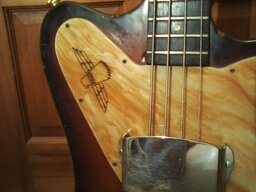
Many thanks.Beautiful bass there GonePlaid!

Agreed, but it’s worth whatever someone is willing to pay for it and this isn’t a commodity instrument like a Squire Affinity P with $800 of upgrades. It wouldn’t surprise me if the Bird sold for that much.Well...I won't buy a factory-new, high mark axe that doesn't sound, at least for my ears, in a proportional way with it's price tag
But for me, and for a lot of people living in the same part of the world where I am, the instrument "net value" is different from the value of the upgrades made to it. They might be high level upgrades, but they are subjective.
EDIT: especially modifications that are not reversible, such as moving from the 3 point bridge to the vintage 2-piece
Ummm yeah...Crazy, crazy market

good eye Pill....it's single ended so rebiasing would take an Rk tweak which is not necessary as i was driving it unrealistically hard to confirm the whopping 2.3 Watt output of the 50C5 power tube...Looks like distortion one side of that wave. Does it still need biasing?
Most of us are shallow! There’s a 2012 Gibson on local CL that I’m considering, but I find myself thinking about chroming it out!Lollars (in my opinion) have quite a bit more clarity and top end.
I meant (thought I said so) REPLACEMENT pickups. I would think many would be happy with stock pickups. They sound really cool. I happen to prefer Lollars and TB’s. On a shallow note, I also prefer chrome
Chrome tape?Most of us are shallow! There’s a 2012 Gibson on local CL that I’m considering, but I find myself thinking about chroming it out!
Might be smarter to buy another VP and pay someone to refinish it in nitro....

The common consensus here would be to buy both.Most of us are shallow! There’s a 2012 Gibson on local CL that I’m considering, but I find myself thinking about chroming it out!
Might be smarter to buy another VP and pay someone to refinish it in nitro....


I meant (thought I said so) REPLACEMENT pickups. I would think many would be happy with stock pickups. They sound really cool. I happen to prefer Lollars and TB’s. On a shallow note, I also prefer chrome
good eye Pill....it's single ended so rebiasing would take an Rk tweak which is not necessary as i was driving it unrealistically hard to confirm the whopping 2.3 Watt output of the 50C5 power tube...
Most of us are shallow! There’s a 2012 Gibson on local CL that I’m considering, but I find myself thinking about chroming it out!
Might be smarter to buy another VP and pay someone to refinish it in nitro....
I think if we took a poll the consensus would NOT be buy both. It would be find a third and buy all three.*The common consensus here would be to buy both.
I figured that was your intent, but some of us can be a little pedantic. Personally, I think the stock Gibsons sound good (good enough to not worry about replacement). On the other hand, I still am mulling what to do with the electronics in the Pro-V. TBHZs are under consideration, but still thinking.
right you are, however you gotta consider the requirements...it's gotta be mounted on a cheap, flimsy plywood case that does not allow for the rigidity of mounting a power transformer and it has to be cheap. for this reason, the mains go directly to the plate of the halfwave 35W4 rectifier tube (none of this product would comply with UL508 standards today and there's NO WAY it could be sold legally) and on to the filters. this is the reason for the 50C5 since it will produce that power at 120Vdc. a halfwave rectifier is used since the bandwidth of this very cheap amplifier will not extend down to 60Hz so hum issues can be ignored, a common technique in cheap old Chinese radios...Lots of watts there! I'm not familiar with the 50c5, but using both sides of a couple of 12AU7s, if memory serves, gives about about 5W at a plate voltage of something around 250V
right you are, however you gotta consider the requirements...it's gotta be mounted on a cheap, flimsy plywood case that does not allow for the rigidity of mounting a power transformer and it has to be cheap. for this reason, the mains go directly to the plate of the halfwave 35W4 rectifier tube (none of this product would comply with UL508 standards today and there's NO WAY it could be sold legally) and on to the filters. this is the reason for the 50C5 since it will produce that power at 120Vdc. a halfwave rectifier is used since the bandwidth of this very cheap amplifier will not extend down to 60Hz so hum issues can be ignored, a common technique in cheap old Chinese radios...
the only real isolation happens via a small transformer to the filament of the preamp tube, the filaments of the other two tubes intentionally wired in series so that if one goes the whole thing dies.....
the design very cleverly fulfills the requirements in a way that would never fly today...
View attachment 3510124
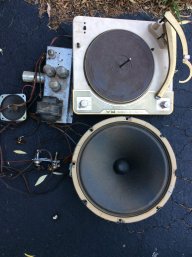
If I remember correctly, the Eddie Bauer edition was 500 watts into eight tens.right you are, however you gotta consider the requirements...it's gotta be mounted on a cheap, flimsy plywood case that does not allow for the rigidity of mounting a power transformer and it has to be cheap. for this reason, the mains go directly to the plate of the halfwave 35W4 rectifier tube (none of this product would comply with UL508 standards today and there's NO WAY it could be sold legally) and on to the filters. this is the reason for the 50C5 since it will produce that power at 120Vdc. a halfwave rectifier is used since the bandwidth of this very cheap amplifier will not extend down to 60Hz so hum issues can be ignored, a common technique in cheap old Chinese radios...
the only real isolation happens via a small transformer to the filament of the preamp tube, the filaments of the other two tubes intentionally wired in series so that if one goes the whole thing dies.....
the design very cleverly fulfills the requirements in a way that would never fly today...
View attachment 3510124


