• TalkBass has been independent since 1998. Add your voice.
    Create a free account to reply to discussions, view embedded media, and browse with fewer display ads.
    Join freeLog in
    Want zero display ads or expanded classifieds tools? Compare plans.

Thunderbird Club

Actually, I trying to hold back a serious bass boner for that gene Simmons model with flat top, modern bridge and white binding. It looks like a combo of Nikki sixx, Spector birds and his black bc rich with white binding. Unless they put out something cooler, I may be dropping way to much $ on one of those. This bird thing is really becoming an addiction. Thanks a lot guys.
For only $10,000.00 he'll sign it for you :D
 
Wishing my Thunderbird brothers and sisters a very Happy New Year...and a much more gig-friendly New Year!

View attachment 4109902

Love those chrome pups. Wish I had them but I have black :( still looks nice, though :)
Bass.jpg
 
It is, 1939, big craze among guitarists and harp players because of their simplicity of their (state of the art then) design. although negative feedback (a technique that reduces distortion) was discovered a decade before, projector and music amplifiers did not adopt it until Williamson’s papers from the late 40’s. this resulted in amplifiers that could be driven hard into distortion by how hard one played....perfect for R&R.....further, loud amplifiers were not not a requirement at the time so efficiency was not as important clearly shown by the fact the output tube complement of 6L6 biased correctly could dish out as much as 50 Watts in today’s designs but is only good for 12 Watts here. the binding you mention is part of the harness which is the heart of the whole thing before printed circuit boards established connectivity....we’ve come a loooong way...that said, simplicity can be very sexy...

Originally, 6L6s were rated at less than 20W total plate dissipation. It was later versions that could handle higher plate currents taking maximum plate dissipation up to 30W. I don't know when the newer 6L6s came into common use but it is entirely plausible that at the time of manufacture, 12 W (at specified THD) was what you could expect.
 
Originally, 6L6s were rated at less than 20W total plate dissipation. It was later versions that could handle higher plate currents taking maximum plate dissipation up to 30W. I don't know when the newer 6L6s came into common use but it is entirely plausible that at the time of manufacture, 12 W (at specified THD) was what you could expect.
The 6L6, 6L6G, and 6L6GA were rated for 19W dissipation, so in class A circuits, you would get less than half that output power per tube. But they were generally building things to last (which they usually did), and (for instance) a clean 12W was plenty for a movie projector.

The 6L6GB was rated 23W diss. The 6L6GC (late 1950s) was rated at 30W diss. I have seen photos of tubes (and amps) destroyed when someone put a lower rated tube in an amp built for higher power tubes. Thankfully, it’s usually just the tubes.
 
The 6L6, 6L6G, and 6L6GA were rated for 19W dissipation, so in class A circuits, you would get less than half that output power per tube. But they were generally building things to last (which they usually did), and (for instance) a clean 12W was plenty for a movie projector.

The 6L6GB was rated 23W diss. The 6L6GC (late 1950s) was rated at 30W diss. I have seen photos of tubes (and amps) destroyed when someone put a lower rated tube in an amp built for higher power tubes. Thankfully, it’s usually just the tubes.
:thumbsup:

I knew that plate dissipation stats had improved over the years, but I did not know when improvements were made.
 
  • Like
Reactions: dagrev and MCF
Originally, 6L6s were rated at less than 20W total plate dissipation. It was later versions that could handle higher plate currents taking maximum plate dissipation up to 30W. I don't know when the newer 6L6s came into common use but it is entirely plausible that at the time of manufacture, 12 W (at specified THD) was what you could expect.
point I was trying to make is that more (possibly twice) power could have been available had more modern design methods such as different classes (A, A/B, B) been implemented. there were no silicon diodes in 39 and selenium devices were too large at that time to warrant practical fixed bias supplies to allow for these different classes...
 
point I was trying to make is that more (possibly twice) power could have been available had more modern design methods such as different classes (A, A/B, B) being implemented. there were no silicon diodes in 39 and selenium devices were to large at that time to warrant practical fixed bias supplies to allow for these different classes...
:thumbsup:
 
  • Like
Reactions: dagrev and MCF
I would be honored :)


Yessir, it's a real nice bass. Would you happen to know if the custom shops are the base model tbirds, but just in more colors?
Nice!

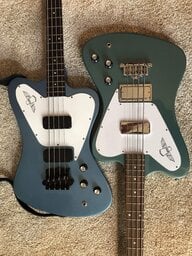
I have two of the Epi Limited Edition Custom Shop bolt-on IVs. One in Pelham Blue with the black hardware and pickups and a Silverburst with chrome hardware and pickups. There were runs with the chrome hardware and pickups in white and T.V. silver as well. Other colors with black hardware were red, ebony and white. Generally, they were well built with mahogany bodies. The tuners on my SEs are much better than the tuners on an Epi Goth that I have. Outstanding fit and finish and fretwork. Early ones were Korean, later ones Chinese.

You (or another of our brother and sisters) might want to check this out; a 2014 T.V. Silver with CHROME made in China. A nice price with case IMO and reasonable shipping.

Epiphone Thunderbird Bass 2014 TV Silver w/OHSC | 1978 Viking Studio | Reverb