• TalkBass has been independent since 1998. Add your voice.
    Create a free account to reply to discussions, view embedded media, and browse with fewer display ads.
    Join freeLog in
    Want zero display ads or expanded classifieds tools? Compare plans.

Thunderfunk amp: what is "the switch"?

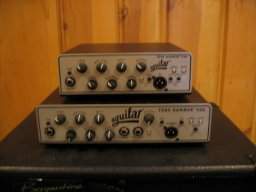
From the TFB website...


"The Switch" came about in September, 2003 when I spent some soundcheck time with LeAnn Rimes' bassist, Victor, and brought two Thunderfunk amps with me. We AB'd these two amps along with his EBS system. I had made a change to my design that I wanted to test, and the result was that the amp sounded more like the EBS... more "HiFi" and to my ears more "sterile." I decided I liked my original tone better, but then I thought, "Why not just put in a switch?"

"The Switch changes between the original High Voltage power supply that feeds the power amp, and a separate Low Voltage power supply that gives a more hifi tone. It is subtle. It's not some dramatic tone shaping circuit. It's a change in response and texture. The more sensitive your touch, and the louder you're playing (as the effect is more pronounced when the High Voltage power supply is sagging more). the more you'll hear the difference. It's NOT a two channel amp. It's NOT intended to be changed mid-song as it's not silent. It's just another option to setup the amp for use with different instruments and styles. The Switch is not a tone shifter. In the "tube" position there's more upper mid-range honk." Dave Funk

Ken Jung on "The Switch"

"Hello Dave, Just got back from a series of gigs in St. Louis. Just wanted to let you know that the amp again sounded great. I had an interesting situation on Saturday. I played with a very loud, very large (11 piece) funk/pop band in a HORRIBLE room. I was using my MTD535, which always sounds great with your amp and the Epi-410UL. In this very cavernous, boomy room, I wasn't quite getting the definition I'm used to. Since I'm a freelancer and need to really focus on playing the gig, I really didn't have a lot of time to tweak the tone significantly. As you know from our previous emails and TB posts, I always use the Switch in the down 'tube emulation off/hi fi' position, since I like a modern tone with plenty of treble response. So, after I found my tone a little thin in this horrible room... before I started messing with the parametrics (since I typically run your amp flat), I thought... well... let's set the switch to the 'up' position. It was amazing... that little bit extra mid grit and definition was enough to 'fix' the problem. In that big, boomy room... the switch 'up' ended up giving me the sound of the switch 'down' in good sounding rooms. I'm very happy with this amp! Thanks again..." Ken
 
Holy cow, that blurb from me is still on the site. That was quite a while ago.

The switch is actually very cool, and really starts to have an impact when you push the amp. It's not meant as a 'tone control', but rather as a kind of revoicing thing that most would set once for their general tone preference, and then leave alone.

Per my blurb above that is still on that site, while I prefer the SS setting, the tube setting, when pushed a bit, adds a nice complex mid sort of warmth that really punches.
 
Thanks guys, I suppose I'm just lazy and uninformed! :)
.

No, now your just lazy, but informed!

BTW I have a 550 with the switch and I do find it useful to use the switch depending on where I'm playing and what cabs I'm using.

the amp is pretty cool if you like to tweek your eq and tone. the "timbre" knob is prretty cool too! its not an amp for everybody or cover all tones, thats why I kept my Eden WT550 also!:bassist:
 
On a more practical note, the switch is for setting to the on position and then leaving it there. The SS setting is usable, but the thunderfunk really seems to come alive more when the switch is set to "tube" mode. It sounds nothing like a tube amp though. Odd choice for a name for that switch.
 
On a more practical note, the switch is for setting to the on position and then leaving it there. The SS setting is usable, but the thunderfunk really seems to come alive more when the switch is set to "tube" mode. It sounds nothing like a tube amp though. Odd choice for a name for that switch.

That's why Dave just calls it just, "the switch". It's not really an emulator, more of a warmer-upper.

If you want to cure that T-Funk GAS of yours Lorenzini, I can help :D. I actually have Ken's old amp that I'm looking to unload.
 
That's why Dave just calls it just, "the switch". It's not really an emulator, more of a warmer-upper.

If you want to cure that T-Funk GAS of yours Lorenzini, I can help :D. I actually have Ken's old amp that I'm looking to unload.

I assume that's the 440EU or whatever that model was called. That's actually a VERY good unit. It was basically one of the first 550a's that Dave built, and we did a few back and forths with it, testing different features (like various capacitors to eliminate on board preamp pops, different switch voicings, etc.). That head is a very good one.

I loved these heads so much, I kept upgrading every time there was a new one... from that one to the 550a that Burk now has to my current 550b. Nice stuff. The 750 is a little too much horse for what I do, so I stopped with the 550b.
 
I assume that's the 440EU or whatever that model was called. That's actually a VERY good unit. It was basically the one of the first 550a's that Dave built, and we did a few back and forths with it, testing different features (like various capacitors to eliminate on board preamp pops, differen switch voicings, etc.). That head is a very good one.

I loved these heads so much, I kept upgrading every time there was a new one... from that one to the 550a that Burk now has to my current 550b. Nice stuff. The 750 is a little too much horse for what I do, so I stopped with the 550b.

That's the one!
 
Not only is the extra tone option of the switch a great thing, but you have redundant power supplies. If one dies by some twist of fate (or the indicator LED for the switch dies and takes the power stage with it - which happened to me), you have another power supply available to use.

I really love that it's a change to the power stage of the amp, not just some preamp tone shaping thing. The way it reacts to different dynamic levels is fantastic stuff and needs to be played to be appreciated.