I tend to agree with longer scale length being better, but it's no magic bullet. At the store I work at, we got some Peavey 5 string in that was 34" scale, string-thru, and had a string retainer/bar across the strings at the headstock. This thing had an ubelievable sounding B string! It felt pretty good, too. I always hear that what really matters for a good B string is what is happening between the nut and bridge. But, I can't help but wonder how much string-thru and string retainers make a difference. Maybe the break angle of the string coming the nut to the tuner makes a difference? As an experiment, I put a capo behind the nut of my Washburn 5 string AB95 (bass sounds great, but B string is dull and floppy). I definitely heard positive difference to the sound of the B string.

Enjoy the benefits of a premium membership!
Upgrade Account
-
TalkBass has been independent since 1998. Add your voice.
Create a free account to reply to discussions, view embedded media, and browse with fewer display ads.
Join free Log in
Want zero display ads or expanded classifieds tools? Compare plans.
You are using an out of date browser. It may not display this or other websites correctly.
You should upgrade or use an alternative browser.
You should upgrade or use an alternative browser.
tight or floppy B-string
- Thread starter OldogNewTrick
- Start date
More options
Who Replied?
I think I remember mr. Dingwall saying that string retainers only increase the pressure strings do to the nut, nothing else. It should do something with the sound as the vibrations would transfer better. But it would not increase overall string tension or reduce floppiness, it just might improve the sound. IMO
maybe there are a lot of treads but I usually read them all. I find always interesting what people think about this.. I'm not settled at 34", but I'm trying to achieve the best possible B string at 34".. if I won't get satisfied after a couple of years, then maybe I go up to 35" or fanned fret, etc...
another factor (at least, for me) is not the B string by itself, but the whole string sets evenness.
I know that many people use light touch while others (including me) like to dig in more.. I think everyone can accomodate a slightly different technique (okay but why should, if not necessary thats another question). For me, its better to use an equally tensioned string set where all the strings are a little floppy than a good stiff set with a floppy B. I can adapt easier to the first. We could talk about floppy E strings as well, and Im sure we would, if there were only EADG stung basses
So I think, the strings play a great role in this. Neck construction and the overall construction play another BIG role..
Why Im experimenting with 34 basses at the moment: I dont want to stretch my fingers more
And I like the other four strings at 34. If I would use lets say 35, I would use the same .135 B string with a bit lighter high strings, because they would get stiffer as well on the longer scale. Unfortunately, there are much more choises for light high strings, than heavy low strings :-(
I think, it is hard to make a good-sounding, playable, long-lasting (and dont know, how many requirements are there above these) H string. I would like to talk with string manufacturers, I think, they could say many-many interesting facts on this
another factor (at least, for me) is not the B string by itself, but the whole string sets evenness.
I know that many people use light touch while others (including me) like to dig in more.. I think everyone can accomodate a slightly different technique (okay but why should, if not necessary thats another question). For me, its better to use an equally tensioned string set where all the strings are a little floppy than a good stiff set with a floppy B. I can adapt easier to the first. We could talk about floppy E strings as well, and Im sure we would, if there were only EADG stung basses
So I think, the strings play a great role in this. Neck construction and the overall construction play another BIG role..
Why Im experimenting with 34 basses at the moment: I dont want to stretch my fingers more
And I like the other four strings at 34. If I would use lets say 35, I would use the same .135 B string with a bit lighter high strings, because they would get stiffer as well on the longer scale. Unfortunately, there are much more choises for light high strings, than heavy low strings :-(
I think, it is hard to make a good-sounding, playable, long-lasting (and dont know, how many requirements are there above these) H string. I would like to talk with string manufacturers, I think, they could say many-many interesting facts on this
But it would not increase overall string tension or reduce floppiness, it just might improve the sound. IMO
and/or the feeling to the string.
I think, that may be quite enough for someone
Nope. The question for which I've read the oppinion on string retainers is exactely if they affect string tension.. They don't. String retainers do put pressure to the bond between the strings, the nut and the neck so retainers might improve sound because it transferres vibrations better. But not tension, therefore not the feel. Physics gives a +1 to that as well.and/or the feeling to the string.
I think, that may be quite enough for someone
Tension is about and only about scale, string gauge and string materials/construction type. For a given tuning, of course.
Tension is about and only about scale, string gauge and string materials/construction type. For a given tuning, of course.
Absolutely agree, it doesn't affect tension, but I think, the string breaking angle may have some effect. I should do some drawings
edit: setup has great effect on the feel, and I rank string breaking angle as a setup-thing
The "feel" is that we pick up with our hands and than process with our mind: for it to be in our hands something has to me changed about the string. Think about it. If the break angle doesn't affect tenson, what does it affect? If the break angle really changes the feel of the string it's got to change something about it first: what is that if not tension?Absolutely agree, it doesn't affect tension, but I think, the string breaking angle may have some effect. I should do some drawings
edit: setup has great effect on the feel, and I rank string breaking angle as a setup-thing
There's no answer to that question. The larger break angle makes you think that the string is tighter in some way. I mean, there's a whole lot of pressure involved. When looked at it, it seems tighter by instinct. It does to me, at least, but I know better.
Setup is important: higher action will allow you to dig in more and play harder, making you think there's more tension. But there's not, and in fact, warbly strings will warble even more when plucked hard. It's wierd, really: they feel stiffer and stronger, while having even less a clear, definite pitch.
Theoretically: imagine the nut was slippery and there was a lot of string between the nut and the tuner. 12" or so. The string would de-tune a bit when plucked as the string gets longer while being plucked. Think about it as balancing tension on both sides of the nut. The de-tune would decrease tension relative to a fixed-tune string being plucked by the same amount. In that case the bigger break angle at the nut would reduce slipperiness and there would be less de-tuning when plucked. But, 1) there isn't much string left behind the nut, even less with a retainer 2) the nut is not slippery and 3) the de-tune would be so extremely subtle, enough not to affect feel in any significant way.
There's no answer to that question. The larger break angle makes you think that the string is tighter in some way. I mean, there's a whole lot of pressure involved. When looked at it, it seems tighter by instinct. It does to me, at least, but I know better.
I know what you're talking about..
I tried to draw something with vectors, but the physics lessons were years ago
I think that if the break angle doesnt affect anything else, it still effects the force that pushes down the string to the nut. Maybe it only matters in very extreme situations (at about 0 degree which it's not practical..). my drawing says something similar to you
By the way, I cant agree with you, that the nut doesnt slip it should slip. As you know, many guitarists like to play reversed headstock guitars (I mean: reversed to a right-hand stratocaster), because it has a different feel to bending the low and high strings.
But it hasnt anything to do with break angle, but with string lenght beyond the nut.
I think you are right, it's just that I didn't think it over very vell.
Let's talk about string length behind the nut. Take a look at this:
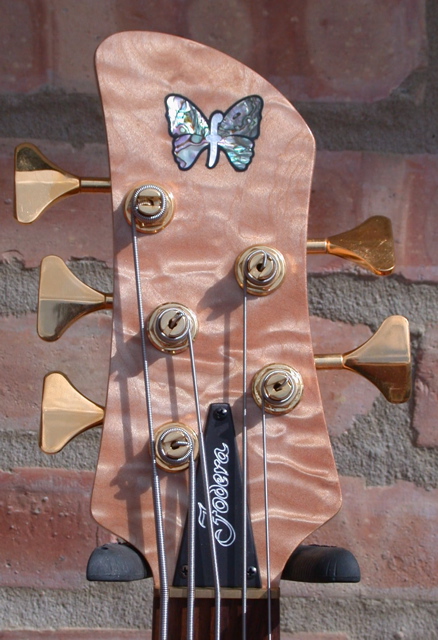
Supposedly, the extra B string length behind the nut effectivelly increases scale length, increasing tension and note definition. NO. Than take a look at it with the slippery-nut theory in mind: the extra length behind the nut would give the string more space to stretch, decreasing tension. True? Hell no.
Than look at the typical Fender-like 5 string headstock designs:
Invalid Link RemovedInvalid Link Removed
Let's ignore string retainers, for discussions sake. One might say that, on the first design, the extra behind-the-nut length would decrease tension for the D and G strings, right? Then remember which strings are the stiffest on these instruments.
Now compare the first and the second headstock design. The second has the G string tuner much closer to the nut than the first. Is the G string any tighter on one than on the other? No, again.
Now take a look at a Dingwall headstock, which uses a design close to many other basses:
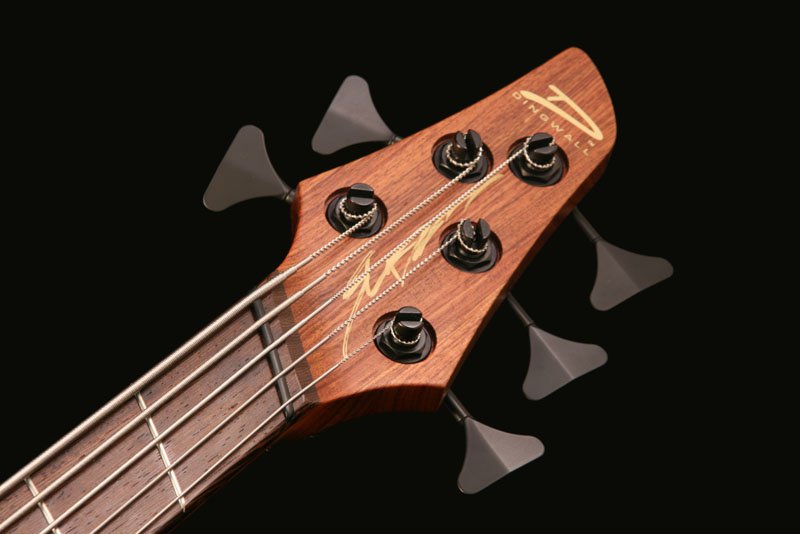
Are the middle strings any looser than any other? No. It balances perfectly, as a matter of fact.
As for reversed headstocks: people believe all sorts of stuff. It's almost voodoo, what people propose and are certain works. The regular, strat-style headstock should - by this theory - even out the tension, when you think about that. So the reversed headstock design should make the tension even less balanced! Is that happening? Hell no, again.
The evidence against any behind-the-nut mojo is overwhelming. It is important for the strings to push down on the nut so the neck is a stable vibration anchor or something like that. What goes on behind the nut makes no difference. One would do good to design the headstock so it's the smallest and lightest one can get.
Supposedly, the extra B string length behind the nut effectivelly increases scale length, increasing tension and note definition. NO. Than take a look at it with the slippery-nut theory in mind: the extra length behind the nut would give the string more space to stretch, decreasing tension. True? Hell no.
Than look at the typical Fender-like 5 string headstock designs:
Invalid Link RemovedInvalid Link Removed
Let's ignore string retainers, for discussions sake. One might say that, on the first design, the extra behind-the-nut length would decrease tension for the D and G strings, right? Then remember which strings are the stiffest on these instruments.
Now compare the first and the second headstock design. The second has the G string tuner much closer to the nut than the first. Is the G string any tighter on one than on the other? No, again.
Now take a look at a Dingwall headstock, which uses a design close to many other basses:
Are the middle strings any looser than any other? No. It balances perfectly, as a matter of fact.
As for reversed headstocks: people believe all sorts of stuff. It's almost voodoo, what people propose and are certain works. The regular, strat-style headstock should - by this theory - even out the tension, when you think about that. So the reversed headstock design should make the tension even less balanced! Is that happening? Hell no, again.
The evidence against any behind-the-nut mojo is overwhelming. It is important for the strings to push down on the nut so the neck is a stable vibration anchor or something like that. What goes on behind the nut makes no difference. One would do good to design the headstock so it's the smallest and lightest one can get.
NOOOOOO!!!!!!!!!!!!!!!!! no tension affected!!! As far as I know, people use reversed headstocks because it affects the bending of the string. It does. but not the tension.
the bendability of the string depends slightly on the lenght behind the nut, because the scale lenght is fixed, but the string slips in the nut slot(if not, there would be tuning problems, as some cheap instruments have with bad nuts), and this affects the force you need to bend a note. but this is quite off-topic
the bendability of the string depends slightly on the lenght behind the nut, because the scale lenght is fixed, but the string slips in the nut slot(if not, there would be tuning problems, as some cheap instruments have with bad nuts), and this affects the force you need to bend a note. but this is quite off-topic

Think about it folks, no extra behind the nut or behind the bridge can affect the scale length. The scale is from nut to bridge saddle and can be nothing more, well other than 0 fret in which case it's 0 fret to bridge saddle.
And remember where this all started from a feel question of tightness of the string not the tone, I think they are similar but there could be other factors for tone.
Dirk
And remember where this all started from a feel question of tightness of the string not the tone, I think they are similar but there could be other factors for tone.
Dirk

And remember where this all started from a feel question of tightness of the string not the tone, I think they are similar but there could be other factors for tone.
Dirk
Well, probably I did not put it clearly enough. My question was not about the feel (perceived tension, finger resistance), but about TONE.
The B-string is lacking definition and snap. It's by no means the worst B-string I've played but equally far from the best...
Again thanks to all, it really helps me sensitize me to what could all be at play here.

Something I don't think has been mentioned here is the action. Having a higher action on your B string will help playability because you don't have to be so gentle to keep it from clobbering the frets all the time.
Also basic ergonomics. Different basses have different right hand ergonomics. Because of this you may end up plucking the strings nearer or further from the bridge. This will have a big effect on the perceived stiffness of the string.
Also basic ergonomics. Different basses have different right hand ergonomics. Because of this you may end up plucking the strings nearer or further from the bridge. This will have a big effect on the perceived stiffness of the string.

I stick with my original statement that I hate this argument. I still hold fast to the notion that longer is not better.

String tension, which is a direct function of string gauge. Try a thicker B string.
I have to agree.
In specific, my Parker Fly 5's low B always felt "wobbly" to me even tuned to 440, so I had to special order some HEAVY guage (150's and 160's). Once I did that, the tension improved and the string felt much better with tremendous response and recovery.
I used all 5-ers on the HEDDA stuff so far with a fair amount of low B time and these were all tuned down a half step. So far, so good. Check it out and see what you think.
Link Removed
JM
Well, probably I did not put it clearly enough. My question was not about the feel (perceived tension, finger resistance), but about TONE.
The B-string is lacking definition and snap. It's by no means the worst B-string I've played but equally far from the best...
Again thanks to all, it really helps me sensitize me to what could all be at play here.
It sounds like what you would like is clearer (definition) and more (snap) upper harmonic content.
If this is the case, heavier, stiffer strings are going in the wrong direction. In most cases they are just going to choke and smear the uppermost harmonics. I recommend trying a lighter more flexible B. You'll have to play lighter and maybe raise your action, but you should improve the definition and snap.
Expect to try a few sets or combinations before you find something that works.
Sheldon, thank you very much for your input, it is most appreciated
It has actually been a learning process to define what I (do not) like.
I've tried a few string types. The bass came originally with 40/60/80/100/128 La Bella HRS, IIRC the G-string was too thin, both tactile and sounding, after some detours played several sets of D'Addario XL 45/65/85/105/130, was happy with the G string but not happy with the B (and only marginally ok with the E). In order to "eliminate" the strings as source of my dissatisfaction, I splashed for some DR Low Rider SS 45-130.
Still, the B-string lacks definition in fingerstyle and doesnt ring out slapped.
Maybe I'll try next some DR High Beams 45-125....
It sounds like what you would like is clearer (definition) and more (snap) upper harmonic content.
It has actually been a learning process to define what I (do not) like.
If this is the case, heavier, stiffer strings are going in the wrong direction. In most cases they are just going to choke and smear the uppermost harmonics. I recommend trying a lighter more flexible B. You'll have to play lighter and maybe raise your action, but you should improve the definition and snap.
I've tried a few string types. The bass came originally with 40/60/80/100/128 La Bella HRS, IIRC the G-string was too thin, both tactile and sounding, after some detours played several sets of D'Addario XL 45/65/85/105/130, was happy with the G string but not happy with the B (and only marginally ok with the E). In order to "eliminate" the strings as source of my dissatisfaction, I splashed for some DR Low Rider SS 45-130.
Still, the B-string lacks definition in fingerstyle and doesnt ring out slapped.
Maybe I'll try next some DR High Beams 45-125....
I just stumbled upon this thread and I realise Ive got here a bit late but as I have a little bit of experience, thought Id throw in my two pennies worth...
Not surprisingly given our joint experience, I find myself agreeing whole heartedly with Sheldon about string gauge. The truth is absolutely that longer scale length IS the answer to clarity in this context but so are string gauge and construction (we have always had ours made for this reason) and the resonant frequencies of the materials from which the bass is built. And its not just about low notes; half the point of having a B string is the access it gives you to patterns of notes higher up the neck and this is where the overall evenness of the string not only to its self, but also in relation to the rest of the strings, really sorts out the sheep from the goats!
Added to which, given the fundamental frequency of a B string is somewhere around 30 Hz; most back line amplification (speakers) cant come close to reproducing frequencies that low! So most of what you are hearing is the harmonic content of the note anyway - so a lighter, more flexible string can only help...
The other, less definable ingredient is the materials from which the bass is constructed. Tone of a stringed instrument is about the transmission and absorption of specific frequencies and the more to the edges of the range we move the more critical this balance becomes... So, given the relative unpredictability that comes as part of the package when working with the also wonderful properties of wood, even with a lifetime of experience (I've been doing this since 1968 and started building extended scale/low tuning instruments nearly 30 years ago), there is always going to be an element of luck!
Electronics and pickups are important but only as a conduit for the natural sound of the instrument they cant transmit what isnt there!
So, in short; the answer is undoubtedly a longer scale length, a lighter string and a well constructed instrument built from a balanced selection of materials...
Good Luck!
Chris May (Overwater Basses)
Not surprisingly given our joint experience, I find myself agreeing whole heartedly with Sheldon about string gauge. The truth is absolutely that longer scale length IS the answer to clarity in this context but so are string gauge and construction (we have always had ours made for this reason) and the resonant frequencies of the materials from which the bass is built. And its not just about low notes; half the point of having a B string is the access it gives you to patterns of notes higher up the neck and this is where the overall evenness of the string not only to its self, but also in relation to the rest of the strings, really sorts out the sheep from the goats!
Added to which, given the fundamental frequency of a B string is somewhere around 30 Hz; most back line amplification (speakers) cant come close to reproducing frequencies that low! So most of what you are hearing is the harmonic content of the note anyway - so a lighter, more flexible string can only help...
The other, less definable ingredient is the materials from which the bass is constructed. Tone of a stringed instrument is about the transmission and absorption of specific frequencies and the more to the edges of the range we move the more critical this balance becomes... So, given the relative unpredictability that comes as part of the package when working with the also wonderful properties of wood, even with a lifetime of experience (I've been doing this since 1968 and started building extended scale/low tuning instruments nearly 30 years ago), there is always going to be an element of luck!
Electronics and pickups are important but only as a conduit for the natural sound of the instrument they cant transmit what isnt there!
So, in short; the answer is undoubtedly a longer scale length, a lighter string and a well constructed instrument built from a balanced selection of materials...
Good Luck!
Chris May (Overwater Basses)

If longer is always better, someone please explain why some of these 32" scale basses have such a killer B string.


