• TalkBass has been independent since 1998. Add your voice.
    Create a free account to reply to discussions, view embedded media, and browse with fewer display ads.
    Join freeLog in
    Want zero display ads or expanded classifieds tools? Compare plans.

tight or floppy B-string

I just stumbled upon this thread and I realise I’ve got here a bit late – but as I have a little bit of experience, thought I’d throw in my two pennies worth...

Chris, thank you for chiming in, it's never too late, especially since I have not yet resolved the issue for myself.
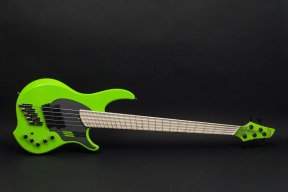
Let me just add, that I had the great pleasure of playing one your basses recently -pic in this thread- an immensely pleasurable experience :cool:

Not surprisingly given our joint experience, I find myself agreeing whole heartedly with Sheldon about string gauge. The truth is absolutely that longer scale length IS the answer to clarity in this context – but so are string gauge and construction

I hope that the Perception Custom Deluxe I played was 34" scale, the B was great :cool:
My point of reference however (probably unfair) is pic in this thread which has a very clear and precise B-string.

My fretless is also the reason I would not want to mix scales, my intonation has enough blue notes as is.... :D


So, in short; the answer is undoubtedly a longer scale length, a lighter string and a well constructed instrument built from a balanced selection of materials...

Thank you for the comprehensive answer! :bassist:

Since my bass is what it is in terms of scale and materials, I will continue to experiment with strings in the direction suggested by Sheldon and yourself.
 
Chris, nice to see you posting here.

If longer is always better, someone please explain why some of these 32" scale basses have such a killer B string.

First there has to be an agreement on what "killer" sounds and performs like. Longer is only better if you want all of the following qualities:

Clarity, definition, transparency, increased consistency of tone up the neck, a more useable tension, more stable pitch, more stable intonation.

This is not to say shorter scales are bad. Just the above criteria is where longer scales excel. YMMV
 
I think the ultimate example is a piano. Take a look inside one, the bass register strings are VERY long- this is to force a large amount of tension onto them(hundreds of pounds) in order to make them speak clearly and loudly. Length is important.
But so are stiffness, and mass, as has been mentioned already. Carbon stiffening rods, or outright carbon necks, very dense/stiff woods, definitely help IME.
 
A few thoughts. Static tension is one thing. Dynamic tension however is very different and is affected by string stiffness, neck/body/bridge stiffness (i.e. the system that supports the bridge), string elasticity (and added string length either side of the witness points which may get involved depending on the movement over the witness points), and the flow of energy between the resonant systems within the instrument (if the body sucks out the harmonic which causes the greatest movement at your plucking point then it will make the string feel stiffer!).

One of the tightest feeling basses I've ever played is my old Hohner Jack, which suffered from a not terribly resonant body (with way too much damping from the over-thick finish) plus it had effectively zero string length beyond the witness points (headless double ball-end, Steinberger bridge).

To get the balance of tone and feel I wanted from a B-string I went to a 36" scale.

Regarding the effect of scale length on tone, basically shortening the scale narrows the bandwidth, reducing the energy in the lowest and highest harmonics, whilst lengthening the scale does the reverse. Shorter B-strings can sound very warm and fat and punchy but they're not such a great choice for thunderous roar and growl. Conversely longer G-strings can be too bright for some people - the bottom is still there but there's more top as well.

Chris, I'd be interested to know your findings regarding core vs wrap diameter - I have Overwater 38-58-78-104-134 on my bass and the one tweak I'm pondering is if a thinner core but fatter wrap will increase the flexibility and thus the higher overtones on the low B without decreasing the tightness of feel.

Alex
 
A much heavier B string on a 34" scale will generally improve tension - but in my experiance the heavier the string, the less flexible it becomes and the less the B balances tonally with the other strings. Fine if you just want to drop in the odd low note - but no use at all if you want to incorporate the string into natural patterns of notes higher up the neck with any degree of evenness and clarity. The better tonal compromise is to use a lighter, more flexible string, maybe raise the action a little and modify your right hand technique to compensate.

We do use strings in excess of .140 for a low F - but again it only really works on scale lengths of 36" or over (we have gone up to 38" on occasion!) - but of course the high end starts to get a bit bright and 'fan fretting' does begin to make real sense if you can get on with it...

With regard to taper strings – I know many people like them, but depending on the degree of taper; I have always found them prone to intonation problems…

Chris
 
I am familiar with the string resonance equation. The fundamental frequency has an inverse proportional relationship to the string's length - f ~ 1/L. My low B on my upright does have a floppy issue due to its longer nut to bridge length. The fundamental frequency also has an square root inverse proportional relationship to mass - f ~ 1/(m)^0.5. Increase gauge, increase mass. Of course this is ideal conditions and does not take into consideration material issues and construction that will impact the string's overtone series response. Its dampening effect. If all things equal, increase in gauge could increase dampening of the overtones - aka less bright.

I will consider a 36 inch scale and a Novax fan fret style on the bass guitar in the future.

So my constraint is a 34 inch scale. Any recommendations on higher gauge strings? Ken Smith has a 145 gauge tapered string. Any others?
 
ok so its a little of everything...unfortunately, but everything will help. The issues with these floppy and muddy sounding b strings is mainly because most basses are simply not designed to accompany the B-string's low tone. What i did to find my solution was to look to the bass crafters who make basses made for the "extended range bass" players. Like 7, 8, 9, and even 12 string basses. Those bass companies such as Conklin, Kenneth Lawrence, and Jerzy Drozd. They all took into consideration the B, F, C#, and even low G string when making their basses also the high tone string.

But unfortunately most of their designs are in pick-ups, and scale as most of you all have talked about. But they also take into consideration the string!!! What i suggest is find some of the string types that those extended range bassist use...and use them. Also find some pick-ups that are designed for low tone strings, such as EMG or MEC.

Suggested String manufacturers:
[Invalid or Expired Link Removed]
 
I just stumbled upon this thread and I realise I’ve got here a bit late – but as I have a little bit of experience, thought I’d throw in my two pennies worth...

Not surprisingly given our joint experience, I find myself agreeing whole heartedly with Sheldon about string gauge. The truth is absolutely that longer scale length IS the answer to clarity in this context – but so are string gauge and construction (we have always had ours made for this reason) and the resonant frequencies of the materials from which the bass is built. And it’s not just about low notes; half the point of having a ‘B’ string is the access it gives you to patterns of notes higher up the neck – and this is where the overall evenness of the string – not only to its self, but also in relation to the rest of the strings, really sorts out the sheep from the goats!

Added to which, given the fundamental frequency of a ‘B’ string is somewhere around 30 Hz; most back line amplification (speakers) can’t come close to reproducing frequencies that low! So most of what you are hearing is the harmonic content of the note anyway - so a lighter, more flexible string can only help...

The other, less definable ingredient is the materials from which the bass is constructed. Tone of a stringed instrument is about the transmission and absorption of specific frequencies and the more to the edges of the range we move the more critical this balance becomes... So, given the relative unpredictability that comes as part of the package when working with the also wonderful properties of wood, even with a lifetime of experience (I've been doing this since 1968 and started building extended scale/low tuning instruments nearly 30 years ago), there is always going to be an element of luck!

Electronics and pickups are important – but only as a conduit for the natural sound of the instrument – they can’t transmit what isn’t there!

So, in short; the answer is undoubtedly a longer scale length, a lighter string and a well constructed instrument built from a balanced selection of materials...

Good Luck!

Chris May (Overwater Basses)

Sorry to dig this up after it lay dormant for a while, but I wanted to chime in, since I've always got an opinion. :p

I agree with Chris on this.

From my experiences, I've come across basses that were built specifically as an experiment, such as the famouns Stambaugh twins where the only difference between them was that one was 34" and the other was 35". There was a difference between the B strings on these basses - in fact there was a difference between all the strings on these basses. The 34" Stambaugh had a good B string whereas the 35" was a little more focused.

The thing is, if you're in the camp where adding the extra inch and ignore everything else, you're doing yourself a disservice. Between the two basses, I actually found the 34" had a "good enough" B string and was more comfortable to play. It also sounded less "twangy" on the G string.

There have been a large number of posts regarding scale length, continually since the dawn of TB! There does seem to be some consensus that scale length is but one factor, but certainly far from the single answer. Other things many have come to agree with is that the stability of the neck and neck joint are factors as well.

To add on to Chris' comments above, I noticed (supported by his actual comments which are available somewhere) that Mike Tobias has commented on the harmonic content, as well. When you look at construction of the neck joint, bolt-on necks have a perceived increase in harmonic content, which makes bolt-ons seem more focused. OTOH, neck-through basses have an increased amount of perceived fundamental content, which can make the B string sound more full.

Some luthiers have mastered their construction methods to consistently produce basses with great B strings regardless of scale length. Jerzy Drozd and Sadowsky are perfect examples! I own a 6-string Jerzy Mastery with a 34" scale that has a tremendous low B. I've never played a 5-string Sadowsky with a 35" scale, but all of those that had 34" were equally tremendous. Other highly respected luthiers produce 35" scale ERBs almost exclusively, and also with great results, such as Roscoe, MTD, and so on.

What's your preference? Mine is to find a good low B in a 34" due to playability.
 
I hate this argument that longer is better. I have seen 32" and 30" scale instruments that the B-string was just huge.

My problem is not B strings that don't sound huge enough. I have more problems with B strings that sound too huge in comparison to the E. I want a good balance of fundamental and harmonics. I found a good B string with Chromes, and even better with the DR DDTs.

I'm not a luthier, but I think a very stiff construction helps with the B. Does this mean neck-through? Graphite rods? Deep neck pocket? Maybe... But a very stiff instrument may lack in perceived attack and punch because of the increased sustain. It's always a balancing act.