I would like to see Jeff Berlin tell these guys that they are wrong
Pat Met
...I happened to read a Pat Metheny interview. The interviewer asked Pat something about his timing or how he developed his timing and Pat said that doing exercises along with a metronome was one of the things that he did.
Marcus Miller
As for time I like the metronome better than drum machine. First practice just clapping 4/4 with the metronome. The most don't realize is if you time is good the sound of the metronome should disappear, your claps should mask it out. Then speed part of your practice time counting out loud the beats; 1, 2, 3, 4. Just the beats not subdivisions, no 1 and 2 and 3 and etc. This can be tough if your playing some syncopated stuff. Take a line like Michael Jackson Billie Jean and play and count good starting point. Try just count out loud and play two eighth notes on one for one measure and second measure go up the neck and play a simple fill and back to hit those eighth notes. Yes, keep counting out loud. That kind of stuff will really development that internal metronome.
Vinnie Colaiuta
"Make the metronome your friend, not your enemy"
John Petrucci
I can't stress this enough," Petrucci says. "Using a metronome allows you to focus. You have this thing clicking, and it's unforgiving, it doesn't care what else is going on around you. 'Tick-tock, tick-tock, play-the-part, play-the-part.'
"To me, there's no question that using a metronome develops your speed and accuracy. If you're learning scales or you're jamming on parts that you can't quite pull off, it's a must.
"Using a metronome will allow you to play cleaner - and that'll make your 'feel' have more, well, 'feeling'" Dream Theater's John Petrucci"When you use a metronome, you'll start to notice where the notes are falling, if they're on the beat, behind the beat, between the beat, and so on.
Gary Willis
Try to be creative when you practice. Learn to solve your own problems, create your own exercises. Try to create music (grooves, lines, etc.) and you'll discover plenty of things to work on that directly relate to making music, not just somebody else's routine. Do it all with a metronome, but leave out the downbeats (put the metronome on 2 & 4, or upbeats).
Michael Brecker
“I have at times used a metronome on 2 and 4. I get depressed when I do it because I rush. It [playing with a metronome on 2 and 4] does help.”
Steve Vai
I want know what you guys/gals think of metronomes. I know Steve Vai swears by it, and how he spent 10hours a day using it.
Jeff Andrews
You should record yourself and work with the metronome as much as possible.
John Patitucci
Patitucci also recommends setting your metronome to about 52 bpm and playing all the E
's on the bass, and then all the F 's, etc., as shown in Ex. 2. (This exercise was introduced
by Joe Hubbard in July/Aug '93.) If you have a 5- or 6-string bass-or a 24-fret neck-be
sure to extend the range of this exercise. You can go up chromatically or use the Circle of
Fifths until you've played every note on the instrument.
"If you want to get slick with this exercise," says John, "take any arpeggio-Fm7, for
example-and during each beat play the entire arpeggio in a different place on the neck."
Ex. 3 shows all the in-position Fm7 arpeggios on the neck. (There are out-of-position
possibilities as well.) Start very slowly; consider shutting off the metronome until you
can shift from one position to the next. Once you have your shifts down, find a tempo at
which you can play comfortably, and then gradually increase the tempo.
Gary Burton
Jazz vibraphonist and longtime Berklee educator Gary Burton suggests practicing with a metronome in order to develop a steady sense of pulse.
Mike Stern
Stern is revered for his envy-inducing chops. However, rather than sit around and practice picking exercises all day long, he developed his chops by practicing tunes with a metronome, very gradually upping the speed.
John Goldsby
I think that a metronome is a useful tool when practicing; just like "play-along" CDs, "Band-In-A-Box," and drum machines.
Tom Kennedy
...Kennedy concludes, “Practice the piece slowly—preferably with an incremental metronome that puts out triplets, so you really feel the swing of it— then work your way up to tempo
Victor Wooten
Victor Wooten has a video of metronome exercises posted on the Korg site
Joe Satriani
Use a metronome! A great guitar player with poor timing and rhythm is not a great guitar player. If you do not own a metronome, buy one! If you cannot buy one, then search Google.com for the words “Free Metronome”. There are many options available. No excuses!
Lee Ritenour
The metronome is one of the most important tools in a guitarists’ arsenal. I believe that we should always rehearse with a metronome


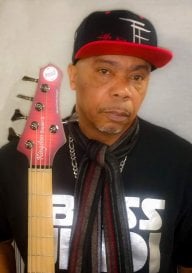
 . To all of you guys out there who want to KNOW how to slap in time and what it should sound like and how it fits in the song and moves the song etc. Listen to this OLD Tune. SILLY FIGHTING by George Duke the studio version. it's on youtube. Consider it a lesson on how to play syncopated slap bass and still keep the groove. By the way it's Louis Johnson if you can't tell. he's groovin, keeping time and still funkin it up. something many slappers can't do but need to go back and learn how to.