• TalkBass has been independent since 1998. Add your voice.
    Create a free account to reply to discussions, view embedded media, and browse with fewer display ads.
    Join freeLog in
    Want zero display ads or expanded classifieds tools? Compare plans.

Tone-glue

Nov 2, 2010
10,569
18,045
Missouri
Most of us accept that tonewood is more hype than reality. I mean sure, with the right scientific instruments differences can be measured, but by the time these planks are glued, screwed, strung-up EQ'ed and being slapped around on stage with the rest of your band It really doesn't matter sound-wise whether it's alder, ash or rare karumbajumba wood from the lost continent of Atlantis.

But if everything involving the construction of a bass contributes to its final tone, why don't luthiers hype the sonic properties of the glue that hold all those pretty tone-woods together?
 
Most of us accept that tonewood is more hype than reality. I mean sure, with the right scientific instruments differences can be measured, but by the time these planks are glued, screwed, strung-up EQ'ed and being slapped around on stage with the rest of your band It really doesn't matter sound-wise whether it's alder, ash or rare karumbajumba wood from the lost continent of Atlantis.

But if everything involving the construction of a bass contributes to its final tone, why don't luthiers hype the sonic properties of the glue that hold all those pretty tone-woods together?

Well I don't know, I'd like to find some of that wood from the lost continent of Atlantis, myself.
 
Most of us accept that tonewood is more hype than reality. I mean sure, with the right scientific instruments differences can be measured, but by the time these planks are glued, screwed, strung-up EQ'ed and being slapped around on stage with the rest of your band It really doesn't matter sound-wise whether it's alder, ash or rare karumbajumba wood from the lost continent of Atlantis.

But if everything involving the construction of a bass contributes to its final tone, why don't luthiers hype the sonic properties of the glue that hold all those pretty tone-woods together?
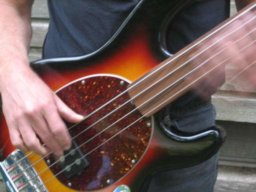
It may be that basses -and the frequency range they represent- are not as sensitive to variations in materials, but it is worth noting that in other instruments (violins and guitars in particular) wood type is a critical factor, and so is glue type.

In violins, there is nothing to hype, as it is simply unheard of for good makers to use anything other than hide glue, except for a few rebels who use Salianski Isinglas Russian Sturgeon bladder fish glue :) In acoustic guitars, hide glue is also touted by many high end makers.
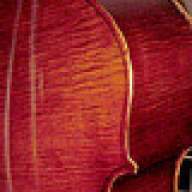
 
It may be that basses -and the frequency range they represent- are not as sensitive to variations in materials, but it is worth noting that in other instruments (violins and guitars in particular) wood type is a critical factor, and so is glue type.

In violins, there is nothing to hype, as it is simply unheard of for good makers to use anything other than hide glue, except for a few rebels who use Salianski Isinglas Russian Sturgeon bladder fish glue :) In acoustic guitars, hide glue is also touted by many high end makers.

I doubt you would hear many classical intrument makes make any comments about the tonal properties of one glue verses another.

The primary reason for these folks using hide glue is that glue joints are very strong, yet can be "undone" using simple and proven methods -- typically steam. The ability to disassemble parts of an instrument for repair is essential.

Common carpenter glues don't really allow for this. Or at least, it far more difficult and far less dependable.
 
I like your avatar. Actually, I know a number of high end "classical" instrument makers, both violin and guitar.

Of course the primary reason for using hide glue is indeed reversibility, but there is conjecture among many that tone may also be a factor, and why not. Glue is used to assemble components, but it is also an acoustical couple between those components, with its own physical properties like Acoustical Impedence, Modulus of Elasticity, etc. The general theory is that glues with high stiffness and a more brittle nature will transmit acoustical energy better than glues that remain more plastic (low MOE) and thus contribute to internal damping. This is an area that everyone agrees is not well studied, and the effect may be smaller (or greater) than we assume, but it cannot be null or of zero effect.
 
I saved this quite a while ago. Now I've got an excuse to post it.

mdftele_02.jpg
 
One does have to first make a distinction between solid body amplified and unamplified instruments. I may have erred in introducing acoustical instruments here, but I just wanted to point out that materials and glues are important in some types of instrument making. I did say that basses may be a different and less sensitive animal
 
I doubt you would hear many classical intrument makes make any comments about the tonal properties of one glue verses another.

The primary reason for these folks using hide glue is that glue joints are very strong, yet can be "undone" using simple and proven methods -- typically steam.

This is wrong, Steam is primarily used to disassemble the dovetail of the neck joint and NOTHING Else! The effect of steam on the thin sides top and back can be devastating to a properly bent or carved piece of a classic Viol. The main substance used for disassembly of hide glue joints is Alcohol, as it crystalizes the hide glue and allows clean break in the join without damage to the wood.

The ability to disassemble parts of an instrument for repair is essential.

This is correct.

Common carpenter glues don't really allow for this. Or at least, it far more difficult and far less dependable.

This is also wrong, as PVA and Alaphatic Resin glues(wood glue) have shown a distinct strength and durability. Only measureable to the amount of time Wood glues have been available....they are still a relatively new adhesive. Heat is used to disassemble wood glue joins everyday, but again, can be detrimental to the fragile nature of thin bent and carved pieces.

Also, there is no such thing as a solidbody "tonewood" There have been hundreds of comparisons done to show this.
The way an instrument vibrates(resonates) does effect the sound in a very small way as far as sustain, and circumference of the vibration pattern of the string, but in a truly audible fashion. NO

The term "Tonewood" came about in the 1800's when acoustic instruments began to vary in materials used to make them. It was marketing, not any great lust for "tone". A true tone wood, is the woods used to amplify the resonance of the instrument in the acoustic chamber, and this does not occur in an electric instrument as the pick-ups take the signal to an amplifier to create the sound. All solidbodies sound tinny and thin when played without amplification.

Remember the whole "Tone" dispute/quest thing only became prevolent in the 70's(1970's) with the generation of musicians who came out of the psychadelic 60's looking for greater and more heavenly everything. Before that, Musicians actually listened to their instrument, and chose the one that sounded best to them.(tone is about YOUR ear, what YOU hear...not the next great trendy pick-up) Now it's about some holy grail of Tone. good luck finding it.
 
Most of us accept that tonewood is more hype than reality.

Wrong. There are differences.

+1 There are differences imho.

But regardless of which side of the fence you're on in this long standing debate, it's interesting that the OP begins by denying that there even is a debate. Clearly, that's not the case - just look at how many threads there are arguing both sides of this.

I have made a drum out of mdf. It does have a sound of its own - not all that bad really. But it's not the same as maple which is not the same as walnut which is not the same as...well, you get it.
(Actually, it sounded better than cheap luan drums, but not as good as most hardwoods I've tried.)
 
Also, there is no such thing as a solidbody "tonewood" There have been hundreds of comparisons done to show this.
The way an instrument vibrates(resonates) does effect the sound in a very small way as far as sustain, and circumference of the vibration pattern of the string, but in a truly audible fashion. NO

All solidbodies sound tinny and thin when played without amplification.

Hmmm... Maybe basses, but certainly not solidbody guitars. I am a bit of a Stratocaster aficionado, and have about a dozen at last count. One can argue the merits of the term tonewood, but that some of my Strats sound better, worse, or different than others due to the body woods and mass is indisputable to my ear. This occurs even when using the same neck, to rule out its contribution (which is not insignificant).

Again, it may be different for basses, but I am not sure why it would be. Materials must contribute to tone at some level, even in solidbody instruments. Different solidbody basses unamplified do sound different to me.
 
Hmmm... Maybe basses, but certainly not solidbody guitars. I am a bit of a Stratocaster aficionado, and have about a dozen at last count. One can argue the merits of the term tonewood, but that some of my Strats sound better, worse, or different than others due to the body woods and mass is indisputable to my ear. This occurs even when using the same neck, to rule out its contribution (which is not insignificant).

Again, it may be different for basses, but I am not sure why it would be. Materials must contribute to tone at some level, even in solidbody instruments. Different solidbody basses unamplified do sound different to me.

I am glad you are an afficionado, you would hate my 58 les paul. you can make the comparison you just made all day with any guitar and walk around feeling very sure you have made the point, but you prove my point even more intently.

The sound of a solidbody is not as much about the wood as it is about the electronics. You gut your favorite strat, and 5 others, put your electronics and neck on any body you wish, and you will have your strat. Understanding the inaccuracies of electronics, which is enormous, you will begin to understand your electric instrument. Change the pots in your favorite guitar, and the sound will change, even if you keep all of the same wire and capacitors. Use a resistor to put a tone choke on 3 identical guitars, and each will have a different effect on sound while using the same piece. As I said above, the wood does play a role, but a very small one, the electronics are what dictate sound in an electric.

I am not trying to change your mind, I have been doing this for 30 years and worked for both Gibson here in Kalamazoo and G&L when I lived out West. I do restorations, behind mods, it's my shops most profitable business. I am no expert(no one really is) but I have a great deal of experience with this, so my points are from experience, and not emotion.

Tell ya what, take one of your guitars that you don't mind messing with, and change out the pots, listen to the distinct change in sound. If you use Bourne pots, you will absolutely be floored by the difference.(Bourne pots are very accurate for audio pieces-not bench quality-but definately 100 x more accurate than any pot in guitars today, or ever)good luck.
 
Actually, I was a Gibson man for the first 25 years of playing, so I would still quite like your 58 LP musiclogic. Somewhere between our diametrically opposed opinions is the truth. I think you misread something in what I wrote, because I did not prove any point of yours. With Strat's (you should know this from your G&L days :)) you can in fact change electronics quite easily, so it is possible to change nothing but the body, and thus rule out electronics in A/B listening experiments.

As an experimenter, luthier, and player for a similar 30 or so years, I remain convinced that materials play a significant role even in solid body electric guitars. Why is this so? I believe it is related to harmonics. We all know that at the most fundamental level, harmonics or overtones are what differentiate one instrument from another.

A pickup may indeed pick up only those harmonics from the string itself, but the intensities of those overtones are going to be defined in part by the nature of the supporting structure, i.e., the rigid body, in our case known as a solid body guitar or bass. That does not even take into account things like attack and sustain or rate of decay, which are also strongly governed the supporting structure, both wood and hardware. These two things do indeed affect the quality of tone, because there is a reciprocal relationship between the string and that which supports it.

Change the body, change the string's harmonic content (and attack/decay) change the sound. It is not a difficult relationship to comprehend.