

Enjoy the benefits of a premium membership!
Upgrade Account
-
TalkBass has been independent since 1998. Add your voice.
Create a free account to reply to discussions, view embedded media, and browse with fewer display ads.
Join free Log in
Want zero display ads or expanded classifieds tools? Compare plans.
You are using an out of date browser. It may not display this or other websites correctly.
You should upgrade or use an alternative browser.
You should upgrade or use an alternative browser.
Tone-glue
- Thread starter Nev375
- Start date
More options
Who Replied?
Turnaround
Commercial User
The "tonewood" argument has been made many times here. And the best we can do is to disagree.
FWIW, I believe that all parts of the instrument vibrate when a string is plucked, some more than others, but all do vibrate. And I would posit that if it vibrates it is contributing to the sound. The only real questions are "how much?" and "for the better?" I suppose the former could be quantified. The latter is a matter of opinion.
On the original question, perhaps someone would make some all-glue basses from several different kinds of adhesive and we could then determine the sound of various glues.
FWIW, I believe that all parts of the instrument vibrate when a string is plucked, some more than others, but all do vibrate. And I would posit that if it vibrates it is contributing to the sound. The only real questions are "how much?" and "for the better?" I suppose the former could be quantified. The latter is a matter of opinion.
On the original question, perhaps someone would make some all-glue basses from several different kinds of adhesive and we could then determine the sound of various glues.
Turnaround
Commercial User


so i could swap a fender's stock maple neck for a solid ovangkol neck and hear no difference, but if i swap a 500k cts for a 500k bourns i'll be "floored"?The sound of a solidbody is not as much about the wood as it is about the electronics...
If you use Bourns pots, you will absolutely be floored by the difference.

(you're absolutely right that electronics usually make the biggest difference; in my smartass example, changing a 250k pot to a 500k pot might make a bigger difference than a denser wood neck.)
the thing is, some instruments sound like themselves no matter what you do to the wiring. i had a guy with a ken smith who liked the bass but hated the "ken smith tone".
i routed it for EMG soapbars and installed a different preamp...and it still sounded just like a ken smith.
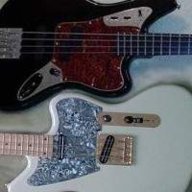
Most of us accept that tonewood is more hype than reality.
Wrong. There are differences.
Oh, if you read my original post I completely agreed there were differences. You can A/B different woods all day and pick out small differences in tone... Even in the same kind of wood. But at the end of the day, it's just going to sound like an electric bass, or guitar, or whatever it happens to be. My point in tonewoods is that the difference is so insignificant that strings, pickups, playing style each have a much more significant effect than the wood it becomes kinda silly IMO to hype the wood as the secret tone-ingredient. But I digress.
This thread is about glue. I really think those builders that choose to hype things like this are missing a vital marketing opportunity. I mean it's very simple:
First you make a point of the fantastic tonewoods you use.
Then you explain the rarely mentioned but imminent importance of quality glue joints to seamlessly transfer vibrations from one plank to another.
Finally you wax poetic about the secret family recipe of 11 rare herbs and minerals that make your glue so vastly superior to your competition.
There's tons of gullible people ready to buy into a theory like this. And let's face it. There are companies touting the tonal properties of things like power cords which are not even part of the audio circuit and people shell out big bucks for this kind of bullcrap.
I'm not saying it's right, not saying it's wrong. I'm just saying it hasn't been done yet and I wonder why.

Oh, if you read my original post I completely agreed there were differences. You can A/B different woods all day and pick out small differences in tone... Even in the same kind of wood. But at the end of the day, it's just going to sound like an electric bass, or guitar, or whatever it happens to be. My point in tonewoods is that the difference is so insignificant that strings, pickups, playing style each have a much more significant effect than the wood it becomes kinda silly IMO to hype the wood as the secret tone-ingredient. But I digress.
This thread is about glue. I really think those builders that choose to hype things like this are missing a vital marketing opportunity. I mean it's very simple:
First you make a point of the fantastic tonewoods you use.
Then you explain the rarely mentioned but imminent importance of quality glue joints to seamlessly transfer vibrations from one plank to another.
Finally you wax poetic about the secret family recipe of 11 rare herbs and minerals that make your glue so vastly superior to your competition.
There's tons of gullible people ready to buy into a theory like this. And let's face it. There are companies touting the tonal properties of things like power cords which are not even part of the audio circuit and people shell out big bucks for this kind of bullcrap.
I'm not saying it's right, not saying it's wrong. I'm just saying it hasn't been done yet and I wonder why.
Simple. Because one sells the sizzle, not the steak.
Glue and screws are not sexy. Imported (and sometimes hard to pronounce) lumber from exotic locales is sexy. Or can be made to appear so. Same thing goes for high-tech electronics. The ad copy can read, "Active three band equalization with semi-parametric mids" and sound impressive.
It is easy to make a pretty girl look sexy. It's a lot tougher to do the same thing with a sixty year old grandma. More importantly, fewer people will care.
Glue is hidden by lacquer. Who cares, as long as the slab doesn't fall apart?

Oh, if you read my original post I completely agreed there were differences. You can A/B different woods all day and pick out small differences in tone... Even in the same kind of wood.
I agree with this...(I think).
I'd say for the small amount of difference it makes (in the body of a solidbody electric bass/guitar)..you may find as much difference from 1 piece of alder to another, as you may from 1 piece of alder to ("Insert favorite tonewood").
Now..as far as the neck goes...

IME,JMO,YMMV..etc..
Oh, if you read my original post I completely agreed there were differences. You can A/B different woods all day and pick out small differences in tone... Even in the same kind of wood. But at the end of the day, it's just going to sound like an electric bass, or guitar, or whatever it happens to be. My point in tonewoods is that the difference is so insignificant that strings, pickups, playing style each have a much more significant effect than the wood it becomes kinda silly IMO to hype the wood as the secret tone-ingredient. But I digress.
This thread is about glue. I really think those builders that choose to hype things like this are missing a vital marketing opportunity. I mean it's very simple:
First you make a point of the fantastic tonewoods you use.
Then you explain the rarely mentioned but imminent importance of quality glue joints to seamlessly transfer vibrations from one plank to another.
Finally you wax poetic about the secret family recipe of 11 rare herbs and minerals that make your glue so vastly superior to your competition.
There's tons of gullible people ready to buy into a theory like this. And let's face it. There are companies touting the tonal properties of things like power cords which are not even part of the audio circuit and people shell out big bucks for this kind of bullcrap.
I'm not saying it's right, not saying it's wrong. I'm just saying it hasn't been done yet and I wonder why.
You know, I find it ironic that people like you seem to have every answer on how to, or how not to, build the perfect bass but never do so. This thread has done NOTHING to prove or disprove anything except that you feel that your opinion is right no matter what. Why don't you slap together a couple of pieces of pine with some Elmer's glue and see how it sounds and plays, oh yeah and stays in tune, and then try to make the same arguments. Me, I prefer to rely on the experience of people like Leo Fender and Rick Turner who have spent far more time studying the effects of every part of the guitar and bass than most of the rest of the world combined.
You know, I find it ironic that people like you seem to have every answer on how to, or how not to, build the perfect bass but never do so. This thread has done NOTHING to prove or disprove anything except that you feel that your opinion is right no matter what. Why don't you slap together a couple of pieces of pine with some Elmer's glue and see how it sounds and plays, oh yeah and stays in tune, and then try to make the same arguments. Me, I prefer to rely on the experience of people like Leo Fender and Rick Turner who have spent far more time studying the effects of every part of the guitar and bass than most of the rest of the world combined.
Actually, I have built a few instruments. I don't anymore, but I know my way around a tablesaw. While I'm not near as prolific a builder as the guys you mentioned I assure you that my opinions are not just random musings pulled out of a hat. This is mostly about marketing anyway.
Also, I'm not trying to prove anything with this thread.
You can find that sort of thing here:
http://www.talkbass.com/forum/f8/scrap-lumber-bass-vs-alder-bass-can-you-tell-difference-743932/
IMO, the string viberates, the pickup senses these vibrationgs and send it to your amp. No amount or type of glue will affect this.
And i hate expensive/rare woods. Yes, even if there are only 3 trees that produce this wood in the whole world, still doesnt mean it sounds good...
And i hate expensive/rare woods. Yes, even if there are only 3 trees that produce this wood in the whole world, still doesnt mean it sounds good...

I wanna bass made outta Moon-wood.
I have one. The tone is nice, but what I like about it the most is, it only weighs one-sixth the weight of my other basses.


