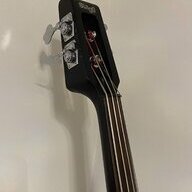
Hello, recently I completed a project for my electroacoustic class regarding the use of tone wood in for an electric bass guitar. My experiment left me with some questions, but before I begin I'm going to explain my set-up, findings, and my reasoning behind my results.
The experiment itself was quite simple. Take three common tone woods (Maple/Alder/Bass Wood), create completely identical instruments in terms of dimensions, throw some strings and a pick up on it and do a blind test. We've all herd the argument, seen the youtube videos, watched all the masters debate it but one thing always stood out to me about previous experiments: They're using two identical specification guitars but are they REALLY identical? They're using the same make/model strings and pickups but does that make them truly identical? In my electrical engineering class we learned that different ores from different parts of the earth have slightly different properties. For instance, if you go to Mouser Electronics and buy 100 1k resistors and individually test them, chances are no two resistors are going to have the same resistance value. They will vary slightly simple because they are made from the exact same ore. Do all "Pro Steel" strings of the same gauge have exactly the same magnetic properties? Do two EMGHZ pickups have exactly the same magnetic properties? Wouldn't small variations affect the electrical signal being output from the guitar? These are just some of the questions I asked myself going into the experiment. So what I ended up doing was buying one pack of strings and using one passive stock pickup with the leads connected directly to a TRS cable into an amplifier.
For the sake of having a control in the experiment I just so happen to have two identical ESP LTD F-404FM Tribal basses which were restrung with the same make/model/gauge strings and I replaced the 9v batteries with the same brand prior to the experiment. They should sound exactly the same right? They're identical in every way after all.
For the experiment all I did was install the pickup, string, and tune to A440 for each of the guitars using the exact same strings,passive pickup, TRS cable, and amplifier. For the first round of the experiment I allowed my peers to view and hear the guitars for themselves in a non-blind test scenario. To my ears, they sounded completely identical but of course my peers were skeptical and insisted that the guitars were indeed different in tonality. I then plugged in the ESP basses and while they were pretty similar most of my peers, and myself, agreed there was a difference in tonality. Which to me is pretty odd, there had to be an explanation for two completely identical guitars sounding slightly different (which was an uncontested view of the entire class.)
Round two was the blind testing. I had one student stand near me to verify that I was indeed playing each guitar and not trying to be sneaky and just pluck one over and over. The results overall were a complete failure to identify any specific tone wood and even still I was accused of not actually changing out the guitars. Even though it obviously took me a few minutes to set up each guitar for the experiment having used the same strings and pickups.
The results amazed me. I've always been a die hard believer in tone woods. Obviously for an acoustic instrument the wood DOES contribute to the timbre of the instrument but for an electrical set-up does it REALLY matter? Why are 90% of guitars manufactured with cheap woods? (This is obviously a rhetorical question) Are there some ebony guitars out there? Sure, but pretty much any instrument you buy from a major manufacturer is going to be the same types of wood that have been used since the dawn of the electric guitar.
My only logical explanation to explain my results is this: The same make/model/gauge strings are indeed not the same in terms of metallic properties and neither are two identical pickups. Look up any tone wood video on youtube. They use two identical guitars but they aren't using the same strings/pickups/cables (aside from the A/B box out) Why is that? Could this be the reason? I believe the small variations in the properties of the electrical components are to blame for the tonality of an electrical instrument. As far as I know, there aren't any woods used in electrical guitars that have magnetic properties.
Now, I could have gone about this the wrong way. Let me state for the record: I am not a luthier with decades of experience, I do not have a doctorate in electrical engineering, and I am not a geologist. All I simply did was ask questions based on what I learned in school and test those questions in a very basic way. Perhaps they did sound different, but my ears didn't perceive it and during a blind test it wasn't completely obvious to my peers either. I'm looking to the experts that are hopefully here to answer my remaining two questions. "Why did my two identical ESP guitars sound different", and "why did my tone wood guitars sound the same to the vast majority"? It's important to note that outside of the amp, they did sound different acoustically. I'm NOT contesting tone woods in an acoustical setting, only in solid body electrical instruments. I know that I'm going to get a lot of hate over this post, but I ask that if you truly have the answer don't just say "They're different, trust me I've been building guitars for 100000+ years". I want scientific reasons that are backed up by physics, testing, math, anything that can be re-created and verified by ANYONE like my experiment. Anyone can re-create it and test it for themselves. I'm not uploading any videos for that very reason, you can't trust them. I don't want to be accused of doctoring the videos or whatever else people will try to say to just try to deny my findings. This is something you have to do and hear for yourself, in person, to truly believe it.
Again, I could be completely wrong and my experiment could have just been some weird coincidence but that's why I'm here. Thank you to anyone who took the time to read this post and respond. Unlike most people, if you prove me wrong I won't be mad at all because knowing the truth is better than defending a fallacy.
EDIT: Grammatical Errors.
The experiment itself was quite simple. Take three common tone woods (Maple/Alder/Bass Wood), create completely identical instruments in terms of dimensions, throw some strings and a pick up on it and do a blind test. We've all herd the argument, seen the youtube videos, watched all the masters debate it but one thing always stood out to me about previous experiments: They're using two identical specification guitars but are they REALLY identical? They're using the same make/model strings and pickups but does that make them truly identical? In my electrical engineering class we learned that different ores from different parts of the earth have slightly different properties. For instance, if you go to Mouser Electronics and buy 100 1k resistors and individually test them, chances are no two resistors are going to have the same resistance value. They will vary slightly simple because they are made from the exact same ore. Do all "Pro Steel" strings of the same gauge have exactly the same magnetic properties? Do two EMGHZ pickups have exactly the same magnetic properties? Wouldn't small variations affect the electrical signal being output from the guitar? These are just some of the questions I asked myself going into the experiment. So what I ended up doing was buying one pack of strings and using one passive stock pickup with the leads connected directly to a TRS cable into an amplifier.
For the sake of having a control in the experiment I just so happen to have two identical ESP LTD F-404FM Tribal basses which were restrung with the same make/model/gauge strings and I replaced the 9v batteries with the same brand prior to the experiment. They should sound exactly the same right? They're identical in every way after all.
For the experiment all I did was install the pickup, string, and tune to A440 for each of the guitars using the exact same strings,passive pickup, TRS cable, and amplifier. For the first round of the experiment I allowed my peers to view and hear the guitars for themselves in a non-blind test scenario. To my ears, they sounded completely identical but of course my peers were skeptical and insisted that the guitars were indeed different in tonality. I then plugged in the ESP basses and while they were pretty similar most of my peers, and myself, agreed there was a difference in tonality. Which to me is pretty odd, there had to be an explanation for two completely identical guitars sounding slightly different (which was an uncontested view of the entire class.)
Round two was the blind testing. I had one student stand near me to verify that I was indeed playing each guitar and not trying to be sneaky and just pluck one over and over. The results overall were a complete failure to identify any specific tone wood and even still I was accused of not actually changing out the guitars. Even though it obviously took me a few minutes to set up each guitar for the experiment having used the same strings and pickups.
The results amazed me. I've always been a die hard believer in tone woods. Obviously for an acoustic instrument the wood DOES contribute to the timbre of the instrument but for an electrical set-up does it REALLY matter? Why are 90% of guitars manufactured with cheap woods? (This is obviously a rhetorical question) Are there some ebony guitars out there? Sure, but pretty much any instrument you buy from a major manufacturer is going to be the same types of wood that have been used since the dawn of the electric guitar.
My only logical explanation to explain my results is this: The same make/model/gauge strings are indeed not the same in terms of metallic properties and neither are two identical pickups. Look up any tone wood video on youtube. They use two identical guitars but they aren't using the same strings/pickups/cables (aside from the A/B box out) Why is that? Could this be the reason? I believe the small variations in the properties of the electrical components are to blame for the tonality of an electrical instrument. As far as I know, there aren't any woods used in electrical guitars that have magnetic properties.
Now, I could have gone about this the wrong way. Let me state for the record: I am not a luthier with decades of experience, I do not have a doctorate in electrical engineering, and I am not a geologist. All I simply did was ask questions based on what I learned in school and test those questions in a very basic way. Perhaps they did sound different, but my ears didn't perceive it and during a blind test it wasn't completely obvious to my peers either. I'm looking to the experts that are hopefully here to answer my remaining two questions. "Why did my two identical ESP guitars sound different", and "why did my tone wood guitars sound the same to the vast majority"? It's important to note that outside of the amp, they did sound different acoustically. I'm NOT contesting tone woods in an acoustical setting, only in solid body electrical instruments. I know that I'm going to get a lot of hate over this post, but I ask that if you truly have the answer don't just say "They're different, trust me I've been building guitars for 100000+ years". I want scientific reasons that are backed up by physics, testing, math, anything that can be re-created and verified by ANYONE like my experiment. Anyone can re-create it and test it for themselves. I'm not uploading any videos for that very reason, you can't trust them. I don't want to be accused of doctoring the videos or whatever else people will try to say to just try to deny my findings. This is something you have to do and hear for yourself, in person, to truly believe it.
Again, I could be completely wrong and my experiment could have just been some weird coincidence but that's why I'm here. Thank you to anyone who took the time to read this post and respond. Unlike most people, if you prove me wrong I won't be mad at all because knowing the truth is better than defending a fallacy.
EDIT: Grammatical Errors.









 Given how often we disagree, you might want to reassess your position.