
Enjoy the benefits of a premium membership!
Upgrade Account
-
TalkBass has been independent since 1998. Add your voice.
Create a free account to reply to discussions, view embedded media, and browse with fewer display ads.
Join free Log in
Want zero display ads or expanded classifieds tools? Compare plans.
You are using an out of date browser. It may not display this or other websites correctly.
You should upgrade or use an alternative browser.
You should upgrade or use an alternative browser.
Trivia, Sometimes Interesting
- Thread starter Vince Klortho
- Start date
More options
Who Replied?
I find it quite disturbing to find out that sandwiches are male.
yeah, that's just sort of creepy

Nearly every language assigns a gender to a word, including English. It just so happens English has a neuter gender as do German and Russian but Italian does not and neither does Spanish, Portuguese, and French. Most languages base the gender on the ending of the word while some, like English, base it on the meaning of the word.
There is another story regarding the origin of the phrase, "balls to the wall." Early aircraft's throttles had a ball on the end of them. In order to go full throttle the pilot had to push the throttle all the way forward into the wall of the instrument panel. Hence the saying, "balls to the wall" for going very fast. Obviously, the one regarding the trains is older.
Here's some more trivia regarding historical phrases that I received in an e-mail several years ago.
During WWII , U.S. airplanes were armed with belts of bullets which they would shoot during dogfights and on strafing runs. These belts were folded into the wing compartments that fed their machine guns. These belts measure 27 feet and contained hundreds of rounds of bullets. Often times, the pilots would return from their missions having expended all of their bullets on various targets. They would say, "I gave them the whole nine yards," meaning they used up all of their ammunition.
Did you know the saying "God willing and the Creek don't rise" was in reference to the Creek Indians and not a body of water? It was written by Benjamin Hawkins in the late 18th century. He was a politician and Indian diplomat. While in the south, Hawkins was requested by the President of the U.S. to return to Washington . In his response, he was said to write, "God willing and the Creek don't rise." Because he capitalized the word "Creek" it is deduced that he was referring to the Creek Indian tribe and not a body of water.
In George Washington's days, there were no cameras. One's image was either sculpted or painted. Some paintings of George Washington showed him standing behind a desk with one arm behind his back while others showed both legs and both arms. Prices charged by painters were not based on how many people were to be painted, but by how many limbs were to be painted. Arms and legs are 'limbs,' therefore painting them would cost the buyer more. Hence the expression, 'Okay, but it'll cost you an arm and a leg.' (Artists know hands and arms are more difficult to paint.)
As incredible as it sounds, men and women took baths only twice a year (May and October). Women kept their hair covered, while men shaved their heads (because of lice and bugs) and wore wigs. Wealthy men could afford good wigs made from wool. They couldn't wash the wigs, so to clean them they would carve out a loaf of bread, put the wig in the shell, and bake it for thirty minutes. The heat would make the wig big and fluffy, hence the term 'big wig. ' Today we often use the term 'here comes the Big Wig' because someone appears to be or is powerful and wealthy.
In the late 1700's, many houses consisted of a large room with only one chair. Commonly, a long wide board folded down from the wall, and was used for dining. The 'head of the household' always sat in the chair while everyone else ate sitting on the floor. Occasionally a guest, who was usually a man, would be invited to sit in this chair during a meal. To sit in the chair meant you were important and in charge. They called the one sitting in the chair the 'chair man.' Today in business, we use the expression or title 'Chairman' or 'Chairman of the Board.'
Personal hygiene left much room for improvement.. As a result, many women and men had developed acne scars by adulthood. The women would spread bee's wax over their facial skin to smooth out their complexions. When they were speaking to each other, if a woman began to stare at another woman's face she was told, 'mind your own bee's wax.' Should the woman smile, the wax would crack, hence the term 'crack a smile'. In addition, when they sat too close to the fire, the wax would melt . Therefore, the expression 'losing face.'
Ladies wore corsets, which would lace up in the front. A proper and dignified woman, as in 'straight laced' wore a tightly tied lace.
Common entertainment included playing cards. However, there was a tax levied when purchasing playing cards but only applicable to the 'Ace of Spades.' To avoid paying the tax, people would purchase 51 cards instead. Yet, since most games require 52 cards, these people were thought to be stupid or dumb because they weren't 'playing with a full deck.'
Early politicians required feedback from the public to determine what the people considered important. Since there were no telephones, TV's or radios, the politicians sent their assistants to local taverns, pubs, and bars. They were told to 'go sip some Ale and listen to people's conversations and political concerns. Many assistants were dispatched at different times. 'You go sip here' and 'You go sip there.' The two words 'go sip' were eventually combined when referring to the local opinion and, thus we have the term 'gossip.'
At local taverns, pubs, and bars, people drank from pint and quart-sized containers. A bar maid's job was to keep an eye on the customers and keep the drinks coming. She had to pay close attention and remember who was drinking in 'pints' and who was drinking in 'quarts,' hence the phrase 'minding your 'P's and Q's'.
In the heyday of sailing ships, all war ships and many freighters carried iron cannons. Those cannons fired round iron cannon balls. It was necessary to keep a good supply near the cannon. However, how to prevent them from rolling about the deck? The best storage method devised was a square-based pyramid with one ball on top, resting on four resting on nine, which rested on sixteen. Thus, a supply of 30 cannon balls could be stacked in a small area right next to the cannon. There was only one problem : how to prevent the bottom layer from sliding or rolling from under the others. The solution was a metal plate called a 'Monkey' with 16 round indentations. However, if this plate were made of iron, the iron balls would quickly rust to it. The solution to the rusting problem was to make 'Brass Monkeys.' Few landlubbers realize that brass contracts much more and much faster than iron when chilled. Consequently, when the temperature dropped too far, the brass indentations would shrink so much that the iron cannonballs would come right off the monkey. Thus, it was quite literally, 'cold enough to freeze the balls off a brass monkey.'
During WWII , U.S. airplanes were armed with belts of bullets which they would shoot during dogfights and on strafing runs. These belts were folded into the wing compartments that fed their machine guns. These belts measure 27 feet and contained hundreds of rounds of bullets. Often times, the pilots would return from their missions having expended all of their bullets on various targets. They would say, "I gave them the whole nine yards," meaning they used up all of their ammunition.
Did you know the saying "God willing and the Creek don't rise" was in reference to the Creek Indians and not a body of water? It was written by Benjamin Hawkins in the late 18th century. He was a politician and Indian diplomat. While in the south, Hawkins was requested by the President of the U.S. to return to Washington . In his response, he was said to write, "God willing and the Creek don't rise." Because he capitalized the word "Creek" it is deduced that he was referring to the Creek Indian tribe and not a body of water.
In George Washington's days, there were no cameras. One's image was either sculpted or painted. Some paintings of George Washington showed him standing behind a desk with one arm behind his back while others showed both legs and both arms. Prices charged by painters were not based on how many people were to be painted, but by how many limbs were to be painted. Arms and legs are 'limbs,' therefore painting them would cost the buyer more. Hence the expression, 'Okay, but it'll cost you an arm and a leg.' (Artists know hands and arms are more difficult to paint.)
As incredible as it sounds, men and women took baths only twice a year (May and October). Women kept their hair covered, while men shaved their heads (because of lice and bugs) and wore wigs. Wealthy men could afford good wigs made from wool. They couldn't wash the wigs, so to clean them they would carve out a loaf of bread, put the wig in the shell, and bake it for thirty minutes. The heat would make the wig big and fluffy, hence the term 'big wig. ' Today we often use the term 'here comes the Big Wig' because someone appears to be or is powerful and wealthy.
In the late 1700's, many houses consisted of a large room with only one chair. Commonly, a long wide board folded down from the wall, and was used for dining. The 'head of the household' always sat in the chair while everyone else ate sitting on the floor. Occasionally a guest, who was usually a man, would be invited to sit in this chair during a meal. To sit in the chair meant you were important and in charge. They called the one sitting in the chair the 'chair man.' Today in business, we use the expression or title 'Chairman' or 'Chairman of the Board.'
Personal hygiene left much room for improvement.. As a result, many women and men had developed acne scars by adulthood. The women would spread bee's wax over their facial skin to smooth out their complexions. When they were speaking to each other, if a woman began to stare at another woman's face she was told, 'mind your own bee's wax.' Should the woman smile, the wax would crack, hence the term 'crack a smile'. In addition, when they sat too close to the fire, the wax would melt . Therefore, the expression 'losing face.'
Ladies wore corsets, which would lace up in the front. A proper and dignified woman, as in 'straight laced' wore a tightly tied lace.
Common entertainment included playing cards. However, there was a tax levied when purchasing playing cards but only applicable to the 'Ace of Spades.' To avoid paying the tax, people would purchase 51 cards instead. Yet, since most games require 52 cards, these people were thought to be stupid or dumb because they weren't 'playing with a full deck.'
Early politicians required feedback from the public to determine what the people considered important. Since there were no telephones, TV's or radios, the politicians sent their assistants to local taverns, pubs, and bars. They were told to 'go sip some Ale and listen to people's conversations and political concerns. Many assistants were dispatched at different times. 'You go sip here' and 'You go sip there.' The two words 'go sip' were eventually combined when referring to the local opinion and, thus we have the term 'gossip.'
At local taverns, pubs, and bars, people drank from pint and quart-sized containers. A bar maid's job was to keep an eye on the customers and keep the drinks coming. She had to pay close attention and remember who was drinking in 'pints' and who was drinking in 'quarts,' hence the phrase 'minding your 'P's and Q's'.
In the heyday of sailing ships, all war ships and many freighters carried iron cannons. Those cannons fired round iron cannon balls. It was necessary to keep a good supply near the cannon. However, how to prevent them from rolling about the deck? The best storage method devised was a square-based pyramid with one ball on top, resting on four resting on nine, which rested on sixteen. Thus, a supply of 30 cannon balls could be stacked in a small area right next to the cannon. There was only one problem : how to prevent the bottom layer from sliding or rolling from under the others. The solution was a metal plate called a 'Monkey' with 16 round indentations. However, if this plate were made of iron, the iron balls would quickly rust to it. The solution to the rusting problem was to make 'Brass Monkeys.' Few landlubbers realize that brass contracts much more and much faster than iron when chilled. Consequently, when the temperature dropped too far, the brass indentations would shrink so much that the iron cannonballs would come right off the monkey. Thus, it was quite literally, 'cold enough to freeze the balls off a brass monkey.'

Two Mark 39 hydrogen bombs were accidentally dropped over Goldsboro, North Carolina on 23 January 1961. The bombs fell to earth after a B-52 bomber broke up in mid-air, and one of the devices behaved precisely as a nuclear weapon was designed to behave in warfare: its parachute opened, its trigger mechanisms engaged, and only one low-voltage switch prevented untold carnage.
Each bomb carried a payload of 4 megatons – the equivalent of 4 million tons of TNT explosive. Had the device detonated, lethal fallout could have been deposited over Washington, Baltimore, Philadelphia and as far north as New York city – putting millions of lives at risk.
Each bomb carried a payload of 4 megatons – the equivalent of 4 million tons of TNT explosive. Had the device detonated, lethal fallout could have been deposited over Washington, Baltimore, Philadelphia and as far north as New York city – putting millions of lives at risk.
Due to the shape of the North American elk's esophagus, even if it could speak, it could not pronounce the word lasagna. - c claven
In the spirit of Vince Klortho's post above:
The sculptures in this photo are Chinese foo dogs. Foo dogs are mythical creatures that inhabit the forests, but are never seen. The only trace they ever leave is piles of excrement, which are particularly vile. Legend has it that if someone ever stepped in foo dog poop, they must never wash it off, because re-exposure of the affected skin to air would cause instant death. That's where we get the expression, "If the foo sh!ts, wear it."
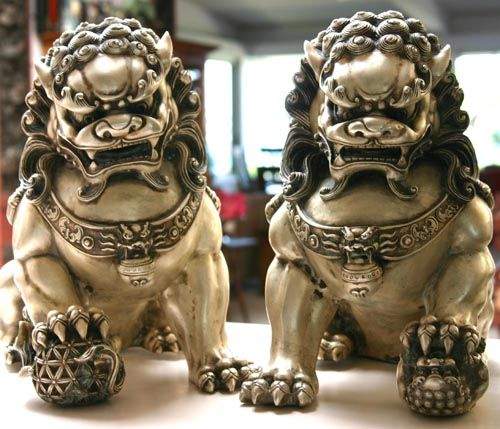
The sculptures in this photo are Chinese foo dogs. Foo dogs are mythical creatures that inhabit the forests, but are never seen. The only trace they ever leave is piles of excrement, which are particularly vile. Legend has it that if someone ever stepped in foo dog poop, they must never wash it off, because re-exposure of the affected skin to air would cause instant death. That's where we get the expression, "If the foo sh!ts, wear it."

Any month that starts on a Sunday will have a Friday the 13th in it.

If your grandparents did not have children, chances are you will not have children either.
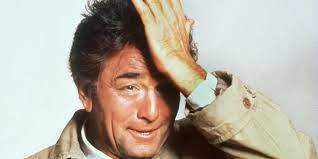
Good. I wouldn't have wanted to tell James Gandolfino he was a girl.
Hey you ain't going to believe this I really thought it was Gandolfino. Ohhhhh nooooooooooo.
slobake
resident ... something
What?It takes seven pound of force to rip off a human ear.
slobake
resident ... something
Are you sure they don't excrete TNC?In the spirit of Vince Klortho's post above:
The sculptures in this photo are Chinese foo dogs. Foo dogs are mythical creatures that inhabit the forests, but are never seen. The only trace they ever leave is piles of excrement, which are particularly vile. Legend has it that if someone ever stepped in foo dog poop, they must never wash it off, because re-exposure of the affected skin to air would cause instant death. That's where we get the expression, "If the foo sh!ts, wear it."
View attachment 734217
slobake
resident ... something

Apparently. I don't know who's gonna test it though. I'd imagine using a dead pig as a test subject could potentially demonstrate it. Any pig farmers out there willing to see how many pounds of force it'll take to rip a pig's ear off?What?

Which reminds me of the little known sole emperor of the Xin dynasty, Wang Mang who was the nephew of Grand Empress Dowager Wang Zhengjun. His only lasting legacy was the fart as a humorous device, invented by his poet and jester Hu Flung Dang
In the spirit of Vince Klortho's post above:
The sculptures in this photo are Chinese foo dogs. Foo dogs are mythical creatures that inhabit the forests, but are never seen. The only trace they ever leave is piles of excrement, which are particularly vile. Legend has it that if someone ever stepped in foo dog poop, they must never wash it off, because re-exposure of the affected skin to air would cause instant death. That's where we get the expression, "If the foo sh!ts, wear it."
View attachment 734217

Two Mark 39 hydrogen bombs were accidentally dropped over Goldsboro, North Carolina on 23 January 1961. The bombs fell to earth after a B-52 bomber broke up in mid-air, and one of the devices behaved precisely as a nuclear weapon was designed to behave in warfare: its parachute opened, its trigger mechanisms engaged, and only one low-voltage switch prevented untold carnage.
Each bomb carried a payload of 4 megatons – the equivalent of 4 million tons of TNT explosive. Had the device detonated, lethal fallout could have been deposited over Washington, Baltimore, Philadelphia and as far north as New York city – putting millions of lives at risk.
Well, yes and no. The bombs actually landed in some farmer's fields, near a little town named Eureka, about 12 miles away. Technically, the place is called Faro - good luck trying to find that, though. The B-52 was stationed at Seymour Johnson AFB, however; which is right next to Goldsboro (probably in Goldsboro, now). I was stationed there (from '78 thru '82), and one of my many, many, "additional duties" was to go out to the site every so often, where the remains of the second bomb are still buried - under many cubic yards of concrete, surrounded by a tall fence - and check to see that everything was still undisturbed. Kind of a scary thing, if you have any imagination at all; but it got me out of the shop, and away from the a**holes that made it the most unpleasant place I was ever stationed...
 Oh, and as for trivia; in Tennessee, it's illegal to get a fish drunk..
Well, yes and no. The bombs actually landed in some farmer's fields, near a little town named Eureka, about 12 miles away. Technically, the place is called Faro - good luck trying to find that, though. The B-52 was stationed at Seymour Johnson AFB, however; which is right next to Goldsboro (probably in Goldsboro, now). I was stationed there (from '78 thru '82), and one of my many, many, "additional duties" was to go out to the site every so often, where the remains of the second bomb are still buried - under many cubic yards of concrete, surrounded by a tall fence - and check to see that everything was still undisturbed. Kind of a scary thing, if you have any imagination at all; but it got me out of the shop, and away from the a**holes that made it the most unpleasant place I was ever stationed...
I read this story some years ago and thought it would be interesting to post here so I lifted the text from some website. The first hand feedback is equally interesting and appreciated.
Thank you for your service!


Well, yes and no. The bombs actually landed in some farmer's fields, near a little town named Eureka, about 12 miles away. Technically, the place is called Faro - good luck trying to find that, though. The B-52 was stationed at Seymour Johnson AFB, however; which is right next to Goldsboro (probably in Goldsboro, now). I was stationed there (from '78 thru '82), and one of my many, many, "additional duties" was to go out to the site every so often, where the remains of the second bomb are still buried - under many cubic yards of concrete, surrounded by a tall fence - and check to see that everything was still undisturbed. Kind of a scary thing, if you have any imagination at all; but it got me out of the shop, and away from the a**holes that made it the most unpleasant place I was ever stationed...
There is also a MK15 off the coast of my town: Invalid Link Removed
Latest posts
-
 Post a funnier picture than the one above - Parallel Universe Edition
- Latest: Richland123
-

-
-

-
