
If you mean that you get more power for your dollar, I would agree with that.Per $, the Sound Power for solid state is exponentially higher than that of vacuum tubes.

TalkBass has been independent since 1998. Add your voice.
Create a free account to reply to discussions, view embedded media, and browse with fewer display ads.
Join free Log in
Want zero display ads or expanded classifieds tools? Compare plans.
If you mean that you get more power for your dollar, I would agree with that.Per $, the Sound Power for solid state is exponentially higher than that of vacuum tubes.

Try turning down the Masters and cranking up the Boost control.
The boost circuit is a single FET designed to give the amp a tubey quality, but you have to hit the circuit fairly hard if you want to bring this quality out. The 800RB and 400RB had similar boost circuits.
IMHO the Volume should be called Gain. It sets the level feeding the preamp and tone network. Volume also determines how hot the signal is that hits the Boost control. The Boost control determine how much of the available signal is passed to the Boost circuit. I suggest setting the volume for a nice hot signal, but not so hot that you cause distortion in the preamp or tone network. This part of the amp does not clip gracefully IMHO, although some like it. Next set the Boost control for the desired tubey quality. As you turn up the Boost the sound will become compressed and the grindy. After you achieve the desire sound and feel, adjust the Master for how loud you want to play.
IMHO it works well, but it's sort of confusing and also a bit of an hassle.


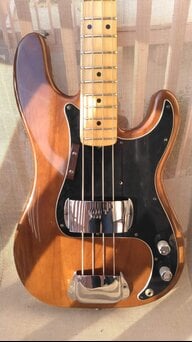
It's silly how often tube vs SS comes up on TB. I practice on SS, I do gigs and rehearse on Tube amps because that is what I prefer. It's as silly as arguing over which bass guitar is best...


Any day…and you better pack a lunch!My tube amp can beat up your ss amp. Fight me!
So I think what I'm hearing here is:
A class D amp doesn't sound like a tube amp because most people using tube amps are looking for the harmonic content or distortion that class D or solid-state in general, don't provide?
But if one plays with a clean tone or is satisfied with the harmonic content being introduced by companies like Mesa in their class D offerings or old mosfet offerings, they are fine with that?
Is that right?
View attachment 4602341
Well my current stage head is only 50 watts and not in a rack so you win (nothing). In the 90's I had roadies and a rack with 2 boogie 400+ heads in it as well as all the other goodies.
Or which accordion is best for metal.It's silly how often tube vs SS comes up on TB. I practice on SS, I do gigs and rehearse on Tube amps because that is what I prefer. It's as silly as arguing over which bass guitar is best...
Or which accordion is best for metal.
Except a good tube amp doesn't produce much distortion until it's beginning to clip. For a lot of people, it would be annoyingly too loud before you start getting into clipping territory.So I think what I'm hearing here is:
A class D amp doesn't sound like a tube amp because most people using tube amps are looking for the harmonic content or distortion that class D or solid-state in general, don't provide?
But if one plays with a clean tone or is satisfied with the harmonic content being introduced by companies like Mesa in their class D offerings or old mosfet offerings, they are fine with that?
Is that right?
View attachment 4602341
Well apparently not as some have indicated that, that is the territory that the judgment is being made about which is louder, tube vs class D or solid state. That is the realm, "I turn my tube amp way up and it still sounds good, turn up the class D and not so much!"Except a good tube amp doesn't produce much distortion until it's beginning to clip. For a lot of people, it would be annoyingly too loud before you start getting into clipping territory.
Part of the answer is going to depend on your perceptions and the type of tone you want.
Watts are watts...this is a fixed fact.
Some argue that a tube amp can be louder because it can be pushed further into distortion before it sounds awful. This depends somewhat on how the solid state amp is rated, and they are not all rated the same. A 300W solid state amp may actually be able to make more than 300W to cover transients, or it may clip harshly when the power level hits 300W.
In my experience many tube amps cannot actually play their rated power clean. They start getting more compressed as they transition over into distortion. But if you like distortion you may be able to push the amp to 450W or so. This varies by design as well. As an example, bench tests for the Orange AD200B often cite about 170W clean, and bench tests for SVTs often site about 270W clean.
Compression can be a bit confounding. Compression limits dynamic range and it is often used to make music louder (on average). This is done by reducing the dynamic range. The idea is the average SPL is increased, but the low SPL limit and high SPL limit are much closer together. Also, the peak SPL is limited. IMHO if you have solid amp with enough dynamic range to play the peaks cleanly, you may still perceive it as louder, even if the tube amp is louder on average.
I don't like playing with heavy compression, so in my experience whichever amp has the highest power rating is likely to sound loudest to me. I have tube amps rated from 12.5W to 427W. In all instances the volume goes up with their power rating. But there is also a pecking order for amps that share power ratings. For example my Hiwatt DR103 is my loudest 100W head by a fair margin. It's a great sounding amp, but IMHO it's not the best choice if you want heavy output drive. My Matamp GT120 is way better for heavy output drive, but it's not as loud. It's still one of my louder amps. My AD200B is noticeably louder than all of my 100W tube amps.
I also have solid state amps ranging in power from 260W to 2500W. The lowest powered solid state amps are my old GK RB series amps. The 2000RB is rated for 360W at 4 ohms and the 700RB is rated for 380W at 4 ohms. IMHO they seem slightly louder than my 300W tube amps and hang really well with my 400+W tube amps. Most of my larger solid state amps sound like they are still idling at low power when my 300W tube amps are hitting the wall and totally falling apart. I don't generally play at the volume my 400W tube amps are capable of, but my perception is all of my solid state amps with more than a 1000W rating are dramatically louder.
Another argument is that our ears are sensitive to distortion, and this will help make a pushed tube amp seem louder.
An additional factor to consider though. Speakers are voltage driven devices. As a tube amp is pushed into saturation the power supply voltage will generally sag under the loud. This sag reduces the peak to peak voltage swing the signal can achieve. So as the waveform begins to square off, the voltage decreases.
Despite the voltage going down, the power can still increase because the signal is staying at the peak value for a longer duration. To use a technical term, the duty cycle increases. However since speakers respond to voltage, the SPL decreases with the voltage despite to power continuing to increase. I have actually confirmed this with an experiment.
Explanation:
View attachment 4599801 The sine wave and square wave in this image have the same peak to peak voltage swing. The square wave stays at the peak value for a longer duration, so the RMS power level is higher.
When a tube amp is pushed hard into saturation, any sag in the power supply will reduce the peak to peak voltage swing. Notice the relationship of the different values in this image
View attachment 4599811
- The Peak, RMS, and Average values of the square wave are all the same.
- The Peak, RMS, and Average values of the sine wave are all different. Some valuse are higher than the square wave, and some are lower.
Note. Peak is simply 1/2 the peak to peak value.
My experience has been consistent over the many experiments I have run over the decades. A good solid state amp seems louder to me than a tube amp with a similar power rating. The first time this happened I was surprised, as I expected the tube amp to be louder.
My actual belief is this is a stupid thing to argue about. You should be able to find either a tube amp or solid state amp that is loud enough to exceed your volume needs. So go out and play a bunch of amps. Choose the one that you like best and don't worry about whether it's tube or solid state.
Button cord is much better than keys for Metal!Or which accordion is best for metal.
Chromatic or diatonic?Button cord is much better than keys for Metal!
Right, it's either loud enough or it ain't!Watss? Never heard of 'em so I have no idea.
Ok, honestly to each their own however many tube amp traditionalist will say tube watts are different than solid state watts and that in theory lower wattage tube amps can still sound way better than bigger wattage solid states. To each their own. I always same simply on the basis an amp is tube does not make it immediately superior and if an amp is solid state does not right away make it a POS.



