
This is basically why I started playing 5-string by default. Prior to that I was transposing parts, and parts of parts, to cover e.g. drop D numbers, and sometimes it even sounds different in a cool way, but sometimes ya gotta go *down* to that note, or it doesn't work, compositionally.

Enjoy the benefits of a premium membership!
Upgrade Account
-
TalkBass has been independent since 1998. Add your voice.
Create a free account to reply to discussions, view embedded media, and browse with fewer display ads.
Join free Log in
Want zero display ads or expanded classifieds tools? Compare plans.
You are using an out of date browser. It may not display this or other websites correctly.
You should upgrade or use an alternative browser.
You should upgrade or use an alternative browser.
Tuning to D or C# standard
- Thread starter Greenman72
- Start date
More options
Who Replied?For D, I might be tempted to try D standard, but I'd rather go for a fiver if it's C# / Db. I could also go both, a fiver in A standard. Tuning down to Eb might be less of a shift from standard, but a half step down really messes with my reading and where I expect the notes to be on the neck. A whole step down is surprisingly much easier to manage.
Also it's Eb, not D#.
Also it's Eb, not D#.


I tune all my basses in D standard, I don't find the strings are noticably floppier. Works well even on the short scales, but on some bridge designs you may run out of range to intonate properly.

I tried drop-tuning my NG2 with 45--105's. It was fine, no noticeable clank. But I ended up using HX Stomp Simple Pitch "drop tune" to C# standard. It works well for this application. You can set it to any interval on the fly. Some songs I transpose: put the bass back to E and play in key of C# (e.g. Children of the Grave) but for heavily open string songs, I prefer the Drop Tune block to playing a 5-string or changing to a de-tuned bass. Because (1) I failed to gained command of my 5-string lol (2) I prefer 4-string bass fingerings (3) I just refuse to change basses during a show set.
Last edited:

When I want to play in C, I just use a regular 5, and stick to the white frets.
With a 5 in standard tuning, there is no compelling reason to change tuning. A piano has a very similar low range (one step lower if you want to be picky) but I've never heard of anyone drop tuning one below standard.
With a 5 in standard tuning, there is no compelling reason to change tuning. A piano has a very similar low range (one step lower if you want to be picky) but I've never heard of anyone drop tuning one below standard.
I tune all my basses in D standard, I don't find the strings are noticably floppier. Works well even on the short scales, but on some bridge designs you may run out of range to intonate properly.
Down one whole step loses about 25% of the tension. If that works for you, great.

JeezyMcNuggles
Inactive
- Feb 23, 2018
- 14,723
- 20,970
- Disclosures
- I suck, but nobody really notices
A standard 4 string bass/6 string guitar goes to drop C without an issue. 105 - 50So....if you want to play in D# standard tuning, you can tune down your EADG bass by one half step.
If you want to play in C standard, you can tune up your BEAD (or five string) bass by one half step. .
What do you do if you want to play C#-F#- B - E? or D-G-C-F? If (for example), you wanted play a lot of A Perfect Circle, who seems to tune to C#? Would you get a special bass just for C# and D tuning? Or would you just learn how to play it on your BEAD or 5 string bass?


I went thru lots of strings (I favour flats) trying to find the tension that worked for C standard. I landed on TI Jazz Flats tuned UP.
FWIW, I find almost no strings out there tune all the way down from EADG to C, and have a tension that works well for me
FWIW, I find almost no strings out there tune all the way down from EADG to C, and have a tension that works well for me


I have a bass in D std with DDT 110s, and a guitar tuned Dstd with heavier strings
Another bass and guitar are Eb std, using DDT 105 on the bass
More are E std and used for drop D as needed
The only thing I have that can pull off Estd and Dstd successfully with the same strings is a Sire fretless
Another bass and guitar are Eb std, using DDT 105 on the bass
More are E std and used for drop D as needed
The only thing I have that can pull off Estd and Dstd successfully with the same strings is a Sire fretless

I play all my basses in D standard, even the short scales. Standard strings do fine for me in D standard, but I’ve found that I can’t really go lower than that unless I’ve got a higher gauge set. For that, I use Kalium balanced tension sets with a .114 low string, which handles drop C and C# standard pretty well.
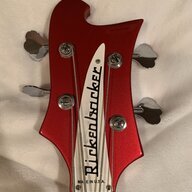
I tune all my basses in D Standard (DGCF) and it's really nice, especially having an open low G string and the two lowest notes. If I want Eb Standard or E Standard, I can put a capo over the 1st or 2nd fret. Therefore, I voted for Carrots because there's no option for tuning to D Standard.
I play medium D'Addario Nickel rounds (50-105 gauge) and light D'Addario Chromes (45-100 gauge) for this tuning. I like my strings a little looser so I can bend them and not have too much resistance. You can go up a gauge if you like more resistance. D'Addario makes heavy gauge rounds (55-110 gauge) that might be worth checking out.
As for 5 strings, I really don't need any notes lower than D1. If I were to get a 5 string, I would likely tune it D-G-C-F-A# for more economy of motion and chordal range. I also recently played a 6 string at GC and lowered its tuning to A-D-G-C-F-A#. It was a really cool bass, but I'm also one to tell you that 6 strings aren't for everyone.
Come join us at the D Standard Club if you please.
I play medium D'Addario Nickel rounds (50-105 gauge) and light D'Addario Chromes (45-100 gauge) for this tuning. I like my strings a little looser so I can bend them and not have too much resistance. You can go up a gauge if you like more resistance. D'Addario makes heavy gauge rounds (55-110 gauge) that might be worth checking out.
As for 5 strings, I really don't need any notes lower than D1. If I were to get a 5 string, I would likely tune it D-G-C-F-A# for more economy of motion and chordal range. I also recently played a 6 string at GC and lowered its tuning to A-D-G-C-F-A#. It was a really cool bass, but I'm also one to tell you that 6 strings aren't for everyone.
Come join us at the D Standard Club if you please.

I personally tune down a half step and then use the Hipshot Bass Extender for the low C#, I find no use for notes lower than that pitch.
BUT since you made it an option, definitely new bass.
BUT since you made it an option, definitely new bass.

Also it's Eb, not D#.
Only by convention. There’s no logical reason. It’s just what happens when you try to force fit a 12 tone scale into a series of 8 note keys and a 5 line staff.

Last edited:

I have 4 strings tuned to D standard (can drop C), C# standard (can drop B) and C standard can drop Bb). It’s all about the strings you use. I use a set of DR Low Riders (hex core vs round so they’re a little stiffer) for the D standard bass and they work great. I use DR DDTs .115 set for the C# standard bass and I use a light gage 5 string High Beams set for the C standard bass and tune up 1/2 step. All are 34” scale except the one I use in C standard which is 35”.
All three basses have Detuners also so I have a ton of flexibility. My band plays in all different tunings (pretty much everything from standard to drop Bb or even drop A sometimes) so having differently tuned basses and using a pitch pedal when needed helps a lot and keeps things simple so I don’t have to transcribe everything to a 5er which I used to do but didn’t like.
All three basses have Detuners also so I have a ton of flexibility. My band plays in all different tunings (pretty much everything from standard to drop Bb or even drop A sometimes) so having differently tuned basses and using a pitch pedal when needed helps a lot and keeps things simple so I don’t have to transcribe everything to a 5er which I used to do but didn’t like.

My band plays a lot of stuff in D standard and C#. I play Spector Euro 4's. At each gig I take 3 Spectors:
Bass 1 - E Standard Tuning and Drop D (Ernie Ball Orange 45-105)
Bass 2 - Eb Tuning and Drop C# (Ernie Ball Orange 45-105)
Bass 3 - D Standard Tuning (Ernie Ball Purple 55-110)
The ONLY mods I made for the D Standard tuning was to use a slightly heavier gauge set of strings. No problems with floppy strings at all.
Bass 1 - E Standard Tuning and Drop D (Ernie Ball Orange 45-105)
Bass 2 - Eb Tuning and Drop C# (Ernie Ball Orange 45-105)
Bass 3 - D Standard Tuning (Ernie Ball Purple 55-110)
The ONLY mods I made for the D Standard tuning was to use a slightly heavier gauge set of strings. No problems with floppy strings at all.

If there's a lot of quick open notes on downtuned strings, I can see the merit in the downtuning. If you dont do it often, or there aren't too many open string notes, just use a 5 and learn to play it transposed. The ability to adapt things to a 5-string like that will save you a lot of headache and unpleasant surprises in the future.
...spoken from somebody who really prefers 4-strings himself
...spoken from somebody who really prefers 4-strings himself

songwriter21
I have an obsession for wood. The musical kind.
So....if you want to play in D# standard tuning, you can tune down your EADG bass by one half step.
If you want to play in C standard, you can tune up your BEAD (or five string) bass by one half step. .
What do you do if you want to play C#-F#- B - E? or D-G-C-F? If (for example), you wanted play a lot of A Perfect Circle, who seems to tune to C#? Would you get a special bass just for C# and D tuning? Or would you just learn how to play it on your BEAD or 5 string bass?
Just use a 5-string. I covered an Alice in Chains tune that's in C#, and it's just a matter of fretting that note on the second fret of the low-B. Unless you're constantly bouncing back and forth to what would be a down/up-tuned open string, just use a 5.
https://youtu.be/1Na9xEvM4mk

For my heavy band, I have a bass tuned C# F# B E, and another tuned D G C F. Those both have heavier strings to maintain string tension.So....if you want to play in D# standard tuning, you can tune down your EADG bass by one half step.
If you want to play in C standard, you can tune up your BEAD (or five string) bass by one half step. .
What do you do if you want to play C#-F#- B - E? or D-G-C-F? If (for example), you wanted play a lot of A Perfect Circle, who seems to tune to C#? Would you get a special bass just for C# and D tuning? Or would you just learn how to play it on your BEAD or 5 string bass?


