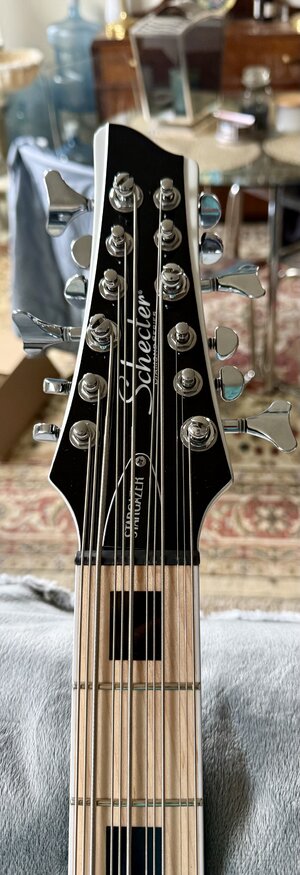
'Twas the night before Christmas, and all through the house, not a creature was stirring, except that one guy clanging away on his 12-string bass...

TalkBass has been independent since 1998. Add your voice.
Create a free account to reply to discussions, view embedded media, and browse with fewer display ads.
Join free Log in
Want zero display ads or expanded classifieds tools? Compare plans.
This is the first of a series of recordings I have planned for the 12 string

Yeah I need a lot of work yet to optimize my recording again. This is straight into the Zoom B3n and Audacity. But yeah, distortion is harsh for sure. And not sure the 3 octave thing really works well - pretty shrill...Do you record straight to the DAW? The distortion sounds pretty harsh, especially with the third octave.
If you can try any cab simulators those might help.
Yeah but tuning to chords within a course makes it a whole 'nother thing to play. Fries my poor brain.It's an interesting experiment 'though and could work for higher strings if you tuned them into chords. Add delay and volume swells and it's an ultimate ambient instrument!
Can imagine some Jon Lord triple-octave riffing through a Leslie, fat fifth chords, etc....Not nearly as well played or recorded, here's some noodling I did a while back on my BEAD 3-octave-per-course tuning:
Do you record straight to the DAW? The distortion sounds pretty harsh, especially with the third octave.
If you can try any cab simulators those might help.
Yeah, it's a bit of a pain at times and I agree that going direct or going straight into the amp hardly ever works.Perhaps a topic in itself...
I've found the 12-string bass particularly sensitive to EQ, and not an instrument that can easily reproduce the recognizable tones of 12-string players like Petersson and Pinnick by just plugging into an amp or DAW; it takes a fair amount of sculpting to get there in my experience, and I've been fighting the EQ on my modded DP-3X and VT Bass pedals trying to get a tone I really like, keeping it defined and solid in the lows, with a bit of aggressive drive that's not overly clanky, yet trying to retain a cohesive sound that blends into one rather than sounding obviously scooped and bi-amped. Clank is more than abundant with the DP-3X and taming it has taken months, and I still don't feel as if I'm quite there yet. Getting the midrange dialed-in makes a huge difference and having some sweepable parametric EQ would help immensely.
Put another way, 12-string bass is one of the more challenging instruments when it comes to tone questing. Then there's tuning and the impact of various degrees of de-tuning. Lots of variables to consider. Maybe we should all just go back to old P-Basses with lard-covered flatwounds and call it a day!
Cool... Drop-tuning... almost organ-like at the end.That said, I just recorded this short clip with the Waterstone with the equipment described above. No ideas what to play but the sound came out pretty well.
View attachment 7121141
Yes, when I used to play both of my 12-strings in a band the Waterstone was always in a drop-D.Cool... Drop-tuning... almost organ-like at the end.
Reminds me... should dig my TP-12 34" out sometime... it almost sounds an octave deeper than my Hamer B12L. Greatly prefer the Hamer neck profile, so play it almost exclusively. Would be nice to get the TP-12 tone with Hamer playability.
No... Was speaking more generally, largely in response to the odd era we seem to be caught up in, where people have been divided into opposing tribes that barely communicate or even share the same understanding of reality. Hopefully, the 12-string bass world need not be that way. I find it interesting to learn about others' experience with the instrument.I hope my barrage of postings and soundclips didn't feel I was competing with anybody. I'm usually only competing with myself in trying to find a tone and a place for this strange but in the end usually rewarding instrument. I also like that as it is such a unique and pretty seldom used instrument (for obvious reasons too) there isn't any standards how it should sound or played. In my opinion of course.
That is why I also think the three octave experiment posted earlier is indeed a very interesting option that surely can be used in some context.