• TalkBass has been independent since 1998. Add your voice.
    Create a free account to reply to discussions, view embedded media, and browse with fewer display ads.
    Join freeLog in
    Want zero display ads or expanded classifieds tools? Compare plans.

Twisted neck, composite headless

Angus

I kind of half see and half don't see your point. [ edit ] I got at least part of the concept - see later post [ / edit ]The fanned frets thing escapes me completely. Since this is a sort of a tapered helix, the outer strings end up being a smidge longer than the inner strings, first because of the taper (as on a normal neck), and again because of the twist. But since the frets lie on parallel planes perpendicular to the main neck axis, this is no issue, since (like on a standard tapered neck) the frets are still dividing the strings in logarithmic proportion.

I think of it this way: the neck is helical all the way from the nut to the bridge. This helix could be mounted with respect to the body either like Jerome Little does, with the nut "low to the body" on the treble side and the bridge "low to the body" on the bass side, and roughly the twelfth fret parallel to the body plane, or you could do it like Lace and have the bridge parallel to the body, and all the twist above that, with the nut dipping "down."

OK, maybe you were pointing out that it if the neck is to be mounted with the body-end fret parallel to the body (I can't tell from the pics), then the bridge will have to be tilted. I definitely agree with that.
 
I agree with pilotjones. I cut the whole 34" scale length. It is twisted along the whole length. It ends with the bridge being parallel with the body. The E string is flush and parallel to the body and the G string tilts down. ...so the G string is slightly longer than the E since the center/axis of rotation is around the E. Maybe I should have made the axis in the middle of the neck, but I didn't think it would make a difference. The difference in length is small.
 
OK, I see what you're saying. It could be done that way too. Compared to the way I was proposing, it's like half of (my) group of strings, from the center to one side. And the treble is a hair longer, but as long as the frets lie on a parallel set of planes, you're OK.
 
Oops, I meant I agreed with you, pilotjones. :)

As long as a fret is dividing half the length of the string, you'll get an octave down regardless of string length. So, even though the G string is a little bit longer, you have the fret dividing it in two -- just like on the E. There is a little more G string above the fret and a little more below when compared with the E. Sexy.
 
I don't know if anyone has mentioned it or not, but have you considered how difficult it is to have a twisted neck and a straight body, as had been discussed on the first page? You will effectively need to have fanned frets at that point, because the treble strings are going to travel a longer distance than the bass strings. The reason why all other twisted designs (at least that i've seen) continue the twist to the bridge is so the scale length is maintained. With this design, you're effectively stopping the twist halfway...unless you sink the bridge at the appropriate angle. Yikes.

No, the reason why all other twisted designs continue the twist to the bridge is because there's no other way. The strings must go in a straight line, so the "twist" will continue for the entire length of the string. No fanning is necessary, and in fact, fanning could be difficult, since depending on the degree of fan, and the degree of twist, you might even end up a reversed curve on some frets. (not sure if this would happen in reality, but worth calculating if you were to try)

The strings attachment to the bridge must be a continuation of what the curve would be. Assuming the neck ended at the correct ratio of the twist, it would work, there would merely be a lot of clearance at one edge compared to the other at the point where the neck attaches to the body.

-Nick
 
I think everyone is misunderstanding what I was saying, because I don't disagree with anything you guys (pilotjones and arx) said.

Of course fanned frets aren't necessary in a twisted design. The point I was trying to make was that it sounded like, from his discussion of the design, that the neck is twisted but that the twisting stops once it reaches the body, ie, he was going to try to set it up from neck joint on as you would with standard parallel frets and flatmounted bridge. It produces all sorts of problems, clearly, so I was curious why nobody questioned if that was what he was going to do. (Fanned would be necessary in that particular case because the stopped of the twist would produce different scale lengths across strings, even if only minor, that would make it intonatable/unplayable pitchwise. Of course it produces mechanical issues, too, etc, etc.)

I was not insinuating that fanned frets are necessary on all twisted designs. It just sounded like he wanted to stop the twist at the neck joint (ie, the bridge is not a continuation of the twist), which would've made this all a hopeless procedure.

We're all on the same page here.
 
Cool thread Andreas, I just read through it! You have all the cool toys. I picked up a bass in Feb of this year, played for a couple of months (used to play in my teens) and hung it up. I will take some lessons someday, hopefully soon, as I soon got frustrated with trying to teach myself.

Can't wait to see you complete this project, it's very interesting to see the crossover of our hobbies, eh?

Ed "Bad Bass" B.
 
Hey Ed! Keep with it and get some lessons (sooner rather than later). They will help a lot, plus are a good motivator. I lucked out and got a great teacher. It does take a while, so don't get discouraged. 2 months is nothing! I don't think you ever get to the point where you can't improve.

Yeah, it is cool to bring our experience with sloping into different areas. I even have a cabinet I'm building with "New Stuff"! http://www.talkbass.com/forum/showpost.php?p=6622381&postcount=494 That stuff will *never* be as good as a composite! :ninja:

Check it out!
 
I think everyone is misunderstanding what I was saying, because I don't disagree with anything you guys (pilotjones and arx) said.

Of course fanned frets aren't necessary in a twisted design. The point I was trying to make was that it sounded like, from his discussion of the design, that the neck is twisted but that the twisting stops once it reaches the body, ie, he was going to try to set it up from neck joint on as you would with standard parallel frets and flatmounted bridge. It produces all sorts of problems, clearly, so I was curious why nobody questioned if that was what he was going to do. (Fanned would be necessary in that particular case because the stopped of the twist would produce different scale lengths across strings, even if only minor, that would make it intonatable/unplayable pitchwise. Of course it produces mechanical issues, too, etc, etc.)

I was not insinuating that fanned frets are necessary on all twisted designs. It just sounded like he wanted to stop the twist at the neck joint (ie, the bridge is not a continuation of the twist), which would've made this all a hopeless procedure.

We're all on the same page here.

Yeah, well, a twisted neck with a flat bridge will not work period just because the strings wouldn't clear the board. You could have a twisted neck/flat body, with a slanted bridge, and it would work fine, you would just have huge clearance between the treble strings and body. I think you understand this already. ;)

The part about the intonation problem due to string length though, I don't know if I agree with. as long as the fret positions are proportional to the length of the string everything works fine. Of course, if there was a way to magically curve the string to follow the fretboard/body surface, you would be right, but not much point in worrying about it, since it's not going to happen.

Of course, he could have simply calculated the full twist to finish flat at the bridge, so the end of the fretboard is at 1/3ish of the twist at the end of the neck. Everything would clear just fine, and work just fine. The only that would look a little odd is that the string clearance would be very different where the body attaches to the neck. But that doesn't really matter for anything except possibly if he likes to anchor a thumb/finger on the body.

Easiest thing to do might be to ask. :)

Andreas: How's the twist planned? flat bridge, slanted bridge? What's the twist angle at the nut, and 12th fret?

-Nick
 
Ok, sounds like we are all on the same page. I think I mentioned elsewhere that the nut is twisted 25 degrees. The bridge is flat because it feels good to me to have the bridge in the typical position for my right hand.

I drilled the LED holes and wired one of the LEDs.

I put all of my pics online here:[Invalid or Expired Link Removed]

Mind you I haven't sanded this at all after coming off the machine. Don't worry, it will look just fine....

Take a look at this one in particular: [Invalid or Expired Link Removed]

I have room for up to the 24th fret on the lower horn, but the upper horn gets in the way of LED markers past the 17th fret. I can't put in LEDs on the fretboard because there really isn't enough clearance. Any suggestions? Should I just leave it and maybe paint or add fretboard markers later if I really need them? I don't usually play there anyway. ;)
 
Ok, sounds like we are all on the same page. I think I mentioned elsewhere that the nut is twisted 25 degrees. The bridge is flat because it feels good to me to have the bridge in the typical position for my right hand.
So, as long as the twist is 12.5 degrees at the 12th fret, it should be good.
And, by extension, 6.25 degrees at the 24th fret, over the body.

I think this is the one thing I and perhaps Angus were seeing a problem with: if you've got the strings flat to the body at the joint area, you can't have it flat at the bridge also. However, looking back at one of your CAD pics, it looks like you've got it right.
 
Hey Andreas, just looked through your pics album again, got me thinking that you could put together a kick a__ DIY dust collection system. ;) I'm no neatnick by any means but that amount of wood in the air would drive me nuts!

Oh, back OT, I jammed for about 5 minutes in my neighbor's basement the other night, felt good and I might be re-motivated.

Lovin the twisted progress, any pics of your body design yet?
 
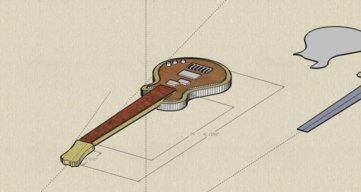
The twist is linear. You can do this easily in a CAD program by making profiles/cross sections of the neck for both ends. Twist one or both of the ends (in the same axis perpendicular to the cross section), and then loft the two together. It is really easy to do, but of course that is just the beginning of the project. ;)

Ed, I have a whole room air filter and an Airshield (face mask/shield). I think even with a dust collection system I would still have some sawdust getting into the air and on everything, although not as much all around the machine. I'd still have to clean it out of the bags and often! I'd have at least a bag every day. I'd still have to take a shop vac to the top of the machine between pieces. It's not a bad idea at all. Actually, I'd rather encapsulate the whole machine in a plastic curtain. If you are ever in the Albany area I'll show you the shop. Glad I inspired you to jam for a little bit. If you get a drum machine (recommended) you can even jam by yourself. I have a Zoom B2.1u that has one and I really like it.

I don't have pics of the body because I'm going to glue blanks on for the body and then route out pockets for the bridge/tuners/pickups. I can clamp it to the machine easier that way. Then I'll cut out the shape either by hand or the machine, and then hand sand it. I'm thinking I'll get a better shape doing it by hand as designing free form 3d shapes in CAD is rather cumbersome.
 
FWIW, Chris Squire (the Ric Master himself) plays octaves and chords using his thumb to fret the E string. This keeps your wrist in a more comfortable position. It takes a bit to get used to, but seems to work well (unless you have really small hands).
 
I hear ya Ed. I'll try to put in a couple of hours this weekend. I need to replace one of the LED sockets since I was a bit too liberal with the CA glue. I hope I can just punch it out. I think next time I might skip the LEDs because they take a bit of time....and they are kinda cool, but kinda cheesy. If you know what I mean? :hmm:

I've heard of people using their thumb on the E. I'll experiment a little. I haven't had much pain lately even though I've been practicing more. I think my wrist is getting used to it...or maybe I'm using a little less pressure fretting.
 
I've been learning guitar for the last 9 months and now am getting back into bass. I decided I need to get something built quickly so I don't get overwhelmed by details. I'll still be doing a twisted neck, but without the carbon fiber, trussrod or LEDs. This will make the project much, much easier. I'll learn some things on the way and then the next one can be improved and more complicated.

So this morning I started: I cut out the neck, routed out a pocket for the MM PU, glued some unshaped body wings on, routed out the bridge, mounted the PU and bridge, mounted the headstock mounts, drilled out holes for the tuner and stopped there because I had to get some lunch!

I made one mistake that I'm not going to admit to right now, but at least it is going fairly quickly! :hyper:

Link Removed
 
II'll still be doing a twisted neck, but without the carbon fiber, trussrod or LEDs.

Good to see you're still at it, and good call on the simplification. I wouldn't leave out the trussrod though. It's one simple slot, and without it, you're likely to end up with an unplayable BSO.

The LEDs and CF you're better off without.

If you want to try again later, maybe just route in some channels for some plastic fibre optics on the back of the fretboard. Same effect, but without the cheesyness.

Not to highjack the thread, but any advice on the CNC machine? I'm actually building one myself right now. I've already got the design figured out, and have started assembling the frame, but if there's any gotchas you ran into, especially with motors/drives I've be glad to hear them, before I make the same mistakes.

-Nick