• TalkBass has been independent since 1998. Add your voice.
    Create a free account to reply to discussions, view embedded media, and browse with fewer display ads.
    Join freeLog in
    Want zero display ads or expanded classifieds tools? Compare plans.

Twisted neck, composite headless

Yes, I think I'm crazy too. ;) Thanks for the encouragement!

I really like the look of LEDs, and they are really simple to do as long as you have a way to get the power to them....it just makes the project more complicated, which is not really what I want to do at this point.

Looks like the Torzal has the trussrod right in the middle: [This invalid link has been removed]

I know what you are saying about which plane it should lie in. Maybe the trussrod is twisted too? Nah, that would require a 5 axis cnc to cut the slot. I would lean toward slanting it halfway between the angles of the neck.

...or I could go without a trussrod. The carbon fiber over the wood is most likely stiffer than even using two carbon rods. The CF is located on the outside which is the most advantageous structurally.

Isn't the relief very small? I just read it is around .02". If you have a very stiff neck, you likely will have between 0 and .05" relief, which is not much off. Relief is a compromise anyway, right? I really would like to avoid a trussrod on my first build....you know, it being a twisted neck and all! I can calculate bending moments to make sure it will be stiff enough.

I do take rests when my muscles hurt. I can feel the fatigue. The wrist pain is only when I am playing octaves for the most part. It feels like tendonitis. You make good points. I have not been playing my bass as much recently as I was a few months ago....partly due to the pain, and partly because of being busy with other interests.

I did write my first song snippet a couple of days ago -- that was fun. :D
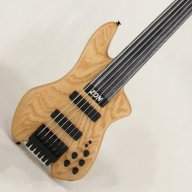
 
I agree on the wrist thing.. Take it very easy for a while, and hopefully they'll stop bothering you, and you can _slowly_ ramp it back up. Going at it too heavy will mess you up. I had a problem with my right hand index finger's knuckle, and I'm fairly certain it was just from overuse. I had a couple days in a row where I played for many hours (much more than I'm used to) and I ended up with a really sore knuckle that persisted for over a month even though I stopped using it as much as possible. I switched to playing with middle/ring finger, or using a pick (which I was never into before).

It seems completely back to normal now, but I'm sure if I had just ignored it and kept going, there would have been some lasting effects.

I think you're right about routing the slot in the back of the neck.

I'd skip the leds though. as cool as they are, without a removable fretboard it will be near impossible to get them in place, and fibre optics don't like sharp corners.

Get the important stuff out of the way on the first build. Once you've got it down, add the extras.

uprightben: The problem with making it non-adjustable is that his fretboard isn't going to be wood, but carbon fibre/fibreglass weave.
Any built in relief he carves into the board will need to be done before testing under tension, and might be tough to predict.
The tall frets filed for relief would work, but would be tricky to get right. Probably the extra effort required would exceed the effort required to make it adjustable.
The twist shouldn't be much of an issue really. I would just align my trussrod with the centre of the board. Adjusting the trussrod will move the strings horizontally with respect to the fretboard, but that's not much of an issue with standard (non fanned) frets. Any error should be negligible I think.
 
Even full carbon fiber necks will benefit from some adjustability.

What i would do - build the neck on your cnc, route out the truss rod, install it, sheathe in carbon fiber, epoxy, then glue on a fretboard. This reduces the problem of having to fret carbon fiber, yet maintains most of the strength you've been setting out to have.
 
Thanks for the comments and suggestions everyone!

I'm a big believer in rest after an injury. I don't like to "work through" tendon pain. I don't mind playing with a little muscle pain though.

I'm finally decided on using a trussrod....I figure since it is only for such a small movement, even if it is in a slightly wrong orientation, it won't make that much of a difference. At worst, I figure it will just sit in the neck not doing anything. At least I'll have the option of using it.

I don't think I want to have a fretboard on top of the carbon fiber at this point. The carbon will only be ~.01" thick so I'll basically be mounting the frets in the wood underneath. I have a .02" router bit that I will be using on the CNC to cut the fret channels. I certainly could add a fretboard afterwards if I run into problems.

For the LEDs, I was thinking that I could use magnet wire (very thin insulated wire <.01"). I could route the truss rod slightly over size, and drill some holes from the side for the side LEDs (I don't think I "need" fretboard LEDs). I could then run the wiring down the side of the trussrod channel and into the holes. I can glue a small, thin shim (.02" thick) to cover the wire. I wouldn't use fiber optics, but LEDs in each position. If I can find a suitable LED socket, I could swap them out to different colors if I wanted. It seems rather straightforward.
 
I'm finally decided on using a trussrod....I figure since it is only for such a small movement, even if it is in a slightly wrong orientation, it won't make that much of a difference. At worst, I figure it will just sit in the neck not doing anything. At least I'll have the option of using it.
Good! You'll probably be glad you did later. I'd suggest getting a dual action one which will flex either way, since your neck may actually be too stiff to have the relief which is normally provided by string tension.

I don't think I want to have a fretboard on top of the carbon fiber at this point. The carbon will only be ~.01" thick so I'll basically be mounting the frets in the wood underneath. I have a .02" router bit that I will be using on the CNC to cut the fret channels. I certainly could add a fretboard afterwards if I run into problems.
Plus, I think that coloured fibreglass/CF weave will look really cool. ;)
For the LEDs, I was thinking that I could use magnet wire (very thin insulated wire <.01"). I could route the truss rod slightly over size, and drill some holes from the side for the side LEDs (I don't think I "need" fretboard LEDs). I could then run the wiring down the side of the trussrod channel and into the holes. I can glue a small, thin shim (.02" thick) to cover the wire. I wouldn't use fiber optics, but LEDs in each position. If I can find a suitable LED socket, I could swap them out to different colors if I wanted. It seems rather straightforward.
I'd suggest going with wire-wrap wire instead of the magnet wire, but either will work. The wire wrap wire is just nicer to strip. A lot of people just heat magnet wire until the enamel burns off, but it's not a good idea since it tends to overheat your components.

I still think I'd skip it on my first go, but if you really do go with the leds, I'd route a separate channel. with the twist in your neck, the trussrod will probably creep over at one end.

On my next bass I'm going to route a channel right near the edge of the board, just big enough to get an led pushed through from the inside. wire it up, then fill the channel with good quality epoxy. I think that'll be good solid, and reliable. Then I'll sand the domes off of the leds so they're flush with the surface.

Get LEDs which are much brighter than you want, then underdrive them to the brightness you want. It'll cost a tiny bit more that way, but you won't have problems with them overheating and fading over time.

Also, I'd suggest a current limiting resistor per diode (probably using resistor packs), and then run it off of the appropriate number of AA batteries. The AAs will last much longer than a 9v, and you can put it in a much less lossy voltage range (assuming you don't want to go crazy with a switching regulator or something)

The common method of just putting however many diodes in series to get you to the right voltage and then using a single current limiting resistor will work, but if you are running the diodes anywhere near their limits you can get problems with current hogging, which causes uneven brightness which gets progressively worse.

Diodes have a negative temperature coefficient, so if they overheat they actually start drawing more current, which causes more heat, etc. Eventually they'll cook. Depending on the diode and the way it's used, it can be pretty fast, or can just slowly get worse over time.

My point is, be really conservative in how you use the leds, and they'll last forever, which is a good thing if you're gluing them in. ;)

Also, don't use blue. Blue leds are passe. Also, they screw up your night vision and make you see little spots in the dark (where you'll generally be using the leds). Blue light also focuses at a slightly different depth in your eyes, which can be really annoying in low light.

Red is best for not screwing up your eyes. Green, yellow, and amber are all just fine if you don't run them ridiculously bright.

-Nick
 
Nick, I planned on getting a dual action trussrod. I think you mentioned it previously.

I'm not sure if I'm going to get the bicolored weave or just the straight carbon. Black goes with everything, don't you know? :D

I was planning on using sockets for the LEDs so I could swap them out if they go bad or if I want to change colors. They would not be sanded flat like yours. I don't think they would look bad. Opinions?

I could make 11 pairs/sets of the magnet wire attached to the sockets and then run them through the channel. I'd be able to solder them no problem outside the bass. I could then add the resistor(s) in the body and use a couple of AAs to power it. It depends on the specs of the LEDs, of course. I'm pretty comfortable with electronics. I've designed some circuits for different projects.

I have a shopping list from Stew Mac:

1819 Flush-mount Output Jack $6.90
0158-LB Wide Fretwire - Wide/Pyramid, 44 ft (1 lb) $31.93 0286 String-thru Top Ferrules - Chrome $2.79
0988 1/8" Allen Nut Hot Rod - 24" length $18.98
1403 GHS Bass Boomers - 4-string medium $23.73
3770 Fret Rocker $22.20
4138 Blend Pots - 500K-ohm Yes $5.34
4595 Bass String Ferrules - Chrome, $5.89

I figured this jack would work best. The ferrules will be used at the neck to anchor the strings. I'm assuming I need them on both the front and back. The strings seemed like a decent deal and I figure the fret rocker would be a good idea.

Shopping list from GFS:

Guitar Preamp- Gain/Bass/Mid/Treble- Our Best Unit! $57.95
Low Impedance 50K Audio Pot, Full SIzed Alpha Brand $5.95
REDESIGNED Chrome Strap Locks Pair- Straplok style HEAVY

I'm planning to use a blend between the two pickups, and then a boost/cut high/med/low preamp from GFS. It says it will do a low impendence circuit -- I'm not sure if that is what is called "active" or not. I thought active PUs have a battery connection so let me know what is what!

I already have the two PUs, the bridge, and the tuners. I think I'll have everything I need, but feel free to let me know if I forgot anything....

Speaking of that, I will be getting some weird knobs from Mcmaster. I think I might be going for a future/industrial look. :ninja:

Item 7354K11 from Mcmaster.com maybe?
 
I'm not sure if I'm going to get the bicolored weave or just the straight carbon. Black goes with everything, don't you know? :D
Yeah, either way would look good.

I was planning on using sockets for the LEDs so I could swap them out if they go bad or if I want to change colors. They would not be sanded flat like yours. I don't think they would look bad. Opinions?
They'd probably look okay, though I'd be worried about corrosion/getting loose and falling out over time. They shouldn't ever require changing assuming you don't do anything silly and burn them out, though the option to change colours is a bonus. Perhaps RGB leds would work if you want to spend that kind of dough. They're usually a few bucks each though.
I could make 11 pairs/sets of the magnet wire attached to the sockets and then run them through the channel. I'd be able to solder them no problem outside the bass. I could then add the resistor(s) in the body and use a couple of AAs to power it. It depends on the specs of the LEDs, of course. I'm pretty comfortable with electronics. I've designed some circuits for different projects.
Yep, that'll work. 2 AA should do it with most colours. Some blue or white ones would need a 3rd AA. Assuming you're doing them without switching regulation, the closer your battery voltage is to the led voltage, the more efficient it'll be. In theory, your regulation wouldn't be as good if your leds are really inconsistent, but in practice the error is pretty much swamped anyways.

I have a shopping list from Stew Mac:

0158-LB Wide Fretwire - Wide/Pyramid, 44 ft (1 lb) $31.93
Your list looks reasonable, but I hope you're planning on building a LOT of basses. I think a 4 string probably takes about 4 feet of fretwire. It's good to have lots of extra in case you screw up, but you can buy smaller pieces if you're not planning on building a whole bunch.

I figured this jack would work best. The ferrules will be used at the neck to anchor the strings. I'm assuming I need them on both the front and back. The strings seemed like a decent deal and I figure the fret rocker would be a good idea.
Whatever jack fits your design is fine. I prefer the neutrik locking ones, but they're a bit of a pain in the ass to install (need a 15/16 or metric drill bit), and they're a bit more $

Shopping list from GFS:

Guitar Preamp- Gain/Bass/Mid/Treble- Our Best Unit! $57.95
Low Impedance 50K Audio Pot, Full SIzed Alpha Brand $5.95
REDESIGNED Chrome Strap Locks Pair- Straplok style HEAVY

I'm planning to use a blend between the two pickups, and then a boost/cut high/med/low preamp from GFS. It says it will do a low impendence circuit -- I'm not sure if that is what is called "active" or not. I thought active PUs have a battery connection so let me know what is what!
It depends on terminology. An active pickup like an EMG is pretty much a pickup with a buffer built in. They can get away with a low impedance coil, which gives a flatter response. But it can be confusing, because a lot of "active" setups are actually just standard high Z pickups, with a preamp after them. Assuming the preamp doesn't require a low impedance source, it should be okay with either. (Though I'm not familiar with that specific one, so you best double check)
 
I would not route my LED wires through the truss rod slot. Remember that the truss rod is a moving part, under a lot of force. If it crushes or cuts your very thin wires while you're adjusting the relief, you're screwed.

Also, due to the twist, if the trussrod slot doesn't fit tight, it may try to creep over to the diagonal where it's slightly easier to flex. A second slot is definitely the way to go. I'd fill it with epoxy too, just to keep things nice and solid.

-Nick
 
It depends on terminology. An active pickup like an EMG is pretty much a pickup with a buffer built in. They can get away with a low impedance coil, which gives a flatter response. But it can be confusing, because a lot of "active" setups are actually just standard high Z pickups, with a preamp after them. Assuming the preamp doesn't require a low impedance source, it should be okay with either. (Though I'm not familiar with that specific one, so you best double check)

The preamp can do either supposedly...

I really don't think there will be a problem with the wiring in the trussrod channel with a thin wood separator. The wood should compact before the copper if there really is some tremendous force being applied. I'm not going to worry about it.

I figured with a couple of basses I would pay for all those frets. :)
 
The preamp can do either supposedly...

I really don't think there will be a problem with the wiring in the trussrod channel with a thin wood separator. The wood should compact before the copper if there really is some tremendous force being applied. I'm not going to worry about it.

I figured with a couple of basses I would pay for all those frets. :)

I'm not sure I follow.. Are you talking about putting another channel beside the trussrod channel, with a thin wood seperation in between? If so, it should work alright. The horizontal forces from the trussrod aren't very strong, so it'll take very little to keep it where it belongs.

-Nick
 
Nick,

That is exactly what I'm proposing. Just enough so it is not metal on metal contact to give it some cushion.

I did some CAD work.... I changed the thickness of the neck so I could fit the trussrod and I changed the neck taper so it matched the strings and not the bridge (duh).

Here are a couple of pics of a mockup -- one with the tuners placed poorly (I need to fiddle with them) and another without. I'm including the tuners so you can see the size and general position. I'm not married to the design, but I'm looking for something different! Suggestions and comments are welcome...especially how to make the tuners look decent, fit well, and be functional.
 

Attachments

  • bass 1.jpg
    bass 1.jpg
    10.5 KB · Views: 76
  • bass 1 with tuners.jpg
    bass 1 with tuners.jpg
    11.4 KB · Views: 94
Ok, so at least I'm not crazy (in that respect). I'll have to fiddle with placement a bit more to see if I can come up with something better.

I'm assuming regular guitar tuners are too weak...? I compared string tensions, and depending on string gauge bass tensions are 2-3 times that of a guitar. Has anyone used guitar tuners on a bass? They would be smaller and fit much better for this application. Maybe their pegs are too small in addition as the strings wouldn't like to bend around the smaller diameter?

Up at the "headstock", I was thinking of mounting the strings using a machine bolt through the ball end. Are the holes through the balls pretty standard? I was planning on doing a through the neck kind of mounting, but that would require the strings to bend 90 degrees in a small radius where they are thickest and double wrapped.


As far as the body shape, I was trying to make it small/light while keeping it from looking like a stick. (It should balance well because of the headless design.) I like funk, so I wanted to make it "funky". I'm not sure if I met my goal or not. Any ideas welcome!
 
I'm assuming regular guitar tuners are too weak...? I compared string tensions, and depending on string gauge bass tensions are 2-3 times that of a guitar.
Has anyone used guitar tuners on a bass? They would be smaller and fit much better for this application. Maybe their pegs are too small in addition as the strings wouldn't like to bend around the smaller diameter?
Strength would probably be a bit of a problem depending on the tuners, but I think the bigger issue sill be the tightness of the bend. There's no way you're going to get an E string around those tiny pegs. You would probably have to drill it out bigger to start with, and would only have room for 1 wrap. Coupled with the fact that you're going to have to turn the knob a lot further to get the same amount of movement, it's probably a deal breaker.

I think I may have read something about a guy swapping the handles off of a guitar tuner onto a bass tuner, but I'm sure he had to look around a lot to find one that's compatible. At some point you're going to be better off just springing for a purpose built headless tuner set.
Up at the "headstock", I was thinking of mounting the strings using a machine bolt through the ball end. Are the holes through the balls pretty standard? I was planning on doing a through the neck kind of mounting, but that would require the strings to bend 90 degrees in a small radius where they are thickest and double wrapped.

I think it should be okay. I'm planning on using a bolt through the hole to hold my strings to the straight pull tuners I'm building. I'm just going to use a set-screw at the headstock end.

You're not just talking about screwing them down flat though, are you? I think I'd want the screw supported both above and below the ball. Like mill a slot in a chunk of aluminum which the heads slide into, and then drill and tap through from the top. don't drill the top with too much clearance though, since it's going to be bearing load. either drill it with very tight clearance so you can just barely slide the screw in, or just tap it at the same time as you do the bottom hole(probably the better way to go)

As far as standardization of size, I don't know if there is any kind of official standard, but I checked a half dozen sets I have kicking around, and an M3 machine screw fit quite nicely on all of them, so even if they're not 100% standardized, I can say that there's a lot of common brand strings that will fit.

-Nick
 
I think I may have read something about a guy swapping the handles off of a guitar tuner onto a bass tuner, but I'm sure he had to look around a lot to find one that's compatible. At some point you're going to be better off just springing for a purpose built headless tuner set.

Are you going to make a headless tuner that you can tune without the use of tools? I'm assuming that's the norm, but I've seen a few designs that require an allen wrench. I might try and put a new handle on the tuners, or even grind down the originals. It would be easy to grind them down, but I doubt I could polish them up to look as good as they do now. I can see now that there is a way to position the tuners so they will look good, but I'll have to see if they fit in with the design.

You're not just talking about screwing them down flat though, are you? I think I'd want the screw supported both above and below the ball. Like mill a slot in a chunk of aluminum which the heads slide into, and then drill and tap through from the top. don't drill the top with too much clearance though, since it's going to be bearing load. either drill it with very tight clearance so you can just barely slide the screw in, or just tap it at the same time as you do the bottom hole(probably the better way to go)

I was planning on screwing them down flat. :smug: I'd use something like 95631A050 (these are great) from mcmaster.com in the wood of the neck and then bolt all the way down on the ball with the M3 bolt. I think if you minimize the height of it all, you wont need to secure the top also. There should be minimal flexing of the bolt since the lever arm is so small (half the width of the ball). Mind you, I haven't tried it.....

:D
 
Are you going to make a headless tuner that you can tune without the use of tools? I'm assuming that's the norm, but I've seen a few designs that require an allen wrench.
no, they'll be tensioned with a knurled nut, much like on a steinberger, etc. I wouldn't want to require tools for tuning. Sort of a pain when you need to tweak it between songs and gotta dig a wrench out of your bag.
I might try and put a new handle on the tuners, or even grind down the originals. It would be easy to grind them down, but I doubt I could polish them up to look as good as they do now. I can see now that there is a way to position the tuners so they will look good, but I'll have to see if they fit in with the design.
Yeah, if you grind them, they're not likely to look good afterwards, and worse, the edges of the chrome can sometimes be sharp.

I have seen some setups with conventional tuners that look decent, but it does definitely cause some design constraints. I gave up on the idea because I'm trying to make a nice short, ultra-portable bass. Be careful about extending the body to make room for tuners, because it moves the balance point so the neck is further away. Not a really big deal if you've got long arms, but some people don't like it that way.


I was planning on screwing them down flat. :smug: I'd use something like 95631A050 (these are great) from mcmaster.com in the wood of the neck and then bolt all the way down on the ball with the M3 bolt. I think if you minimize the height of it all, you wont need to secure the top also. There should be minimal flexing of the bolt since the lever arm is so small (half the width of the ball). Mind you, I haven't tried it.....
:D

Yeah, I thought about screwing them down that way. I was thinking of just screwing them down to a bar, but those inserts look pretty cool. Be sure you get extras, so that if the threads get screwed up you can replace them (they're 10 packs, so you should be good). Make sure you use good quality bolts too. You don't want them bending or breaking under the string tension. It shouldn't be an issue as long as you always keep it nice and tight.

Personally I think I'd still go with the slotted aluminum holder. If you have access to a milling machine, it would be a very simple piece to make. OTOH, your way would give it a nice clean look.

Either way, I can't wait to see it.

BTW, If it all works out, there might be a good market for those necks, since most of us don't have CNC rigs. I've been wanting one for a while. I'll likely just twist and laminate a stack of thin sheets, but if I could get a reasonably priced neck just milled out of a single piece, it would save me the experimentation, and might be hard to resist. ;)

-Nick
 
If I remember correctly, the Kramer Duke Bass I had many moons ago had pretty small "guitar size" tuners on it. Take a look on this page about halfway down, a little hard to see...

http://www.vintagekramer.com/alum.htm

Another option would be to turn the strings around like a Steinberger, with the ball end at the first fret end. The one thing I liked about the Steinberger way, was it used a zero fret, which made it easy to change string gauges when I wanted to experiment a little.
 
That Kramer Duke does look like it has small tuners on it. Thanks! I do think that the pegs need to be some minimal diameter for the bigger bass strings, so I don't know if they just used regular guitar tuners or bass tuners with smaller knobs.

I'm going to see if I can rearrange the tuners I have and change the body shape accordingly.

I am wondering about where exactly the balance point will be. I could estimate it, but I think I would get in the too-much-analysis state of mind. With the headless design and a smaller than average body, I think I should get close....especially if I'm lucky!

Those brass threaded inserts work well. If the threading gets messed up, you are doing something wrong! It could always be retapped if you are desperate. I'll see if I can get a knurled bolt for the balls so I don't need a tool to change strings. Mcmaster has a bunch, but I didn't see a lot for M3s. I could also try a standard sized bolt.

I'm not even considering selling necks at this point. If I think of it as a business at this point it will drive me crazy. I'm just trying to make a bass that will be different than everyone else's and hopefully be one that I'll like to play. If it turns out great, then I'll go from there. (Thanks for the confidence though! :) )