You post makes no sense. Comments about one particular cab (that I do have experience with) are not 'generalizations'

Making global statements based on the diameter of a driver.... well

Who's doing that?
My point is that the situation will vary GREATLY depending on the voicing, tuning and performance of each cab. One 15/210 stack might work wonderfully, and another might sound unbalanced.
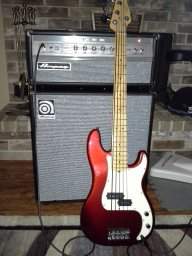
And that is completely unpredictable due to phase relationships, and the only way to tell if it'll work is to try it. And every time I have tried it, it has sucked in some way for me. Sometimes a lot of suckage, sometimes just a little, but it has never once worked as well for me as matching cabs and stacking them vertically. So I don't even take the chance. I want to be able to set my gear up and forget it exists so I can concentrate on my playing, except of course when I look at my beautiful Ampegs and see how pretty they are

The point is that the experiences posted by the OP were a bit of a mismatch with his title of 'vertical stacking' (i.e., greatly low end, etc.
The low end boost comes from using two cabs instead of one, just to clarify. Vertical stacking doesn't really affect that...it just affects dispersion and your ability to hear yourself.
If one is talking about an Eden 210XLT x 2 stack sounding better than an Eden 210XLT/115XLT, that is, of course, valid. Generalizing that to all 210/115 stacks, and ESPECIALLY seemingly indicating that difference in low end response is due to 'vertically stacking' seemed to warrant a comment.
Well the science behind vertical stacking is valid and proven, though I'll admit that increase in low end is not due to stacking but adding drivers. Of course, when we play bass, we are creating a sound, and if you like the sound you're creating by not doing things by the book, it's all good. For example, when I plug into my SVT 810 or my Portaflex rigs, dispersion issues go completely out the window for me. I'm not a huge treble fan to begin with, and I've yet to be disappointed in my tone in the house on those rare times I've used those rigs without PA.
But learning is never a bad thing, and I am MUCH happier knowing the what fers and the how's comes of audio than I was before. Before I learned them, I was helpless to fix issues with room vs. tone I might have been having. Nowadays, I can fix pretty much any issue I'm having. Arguing against learning proven audio science is just dopey on so many levels. I always hear people say, "If it sounds good, it IS good," as a way to dismiss learning this stuff. Well what if it doesn't sound good? What do you do then?



 )
)

 .
. 
 Oh my schweaty balls.