• TalkBass has been independent since 1998. Add your voice.
    Create a free account to reply to discussions, view embedded media, and browse with fewer display ads.
    Join freeLog in
    Want zero display ads or expanded classifieds tools? Compare plans.

Two "P" pickups???

A Split P as a neck pickup works fine. Two Split P pickups used simultaneously is OK, though not great. A Split P bridge pickup soloed… whatever side is closest to the bridge (usually the g/d side) will be horribly thin sounding. Leland Sklar’s dual P bass has the pickups in “reversed” configuration, and both the bridge and neck pickups are further from the bridge than normal. Where you put the pickups matters - don’t put the neck pickup in the usual place, and try to squeeze in a bridge pickup.
 
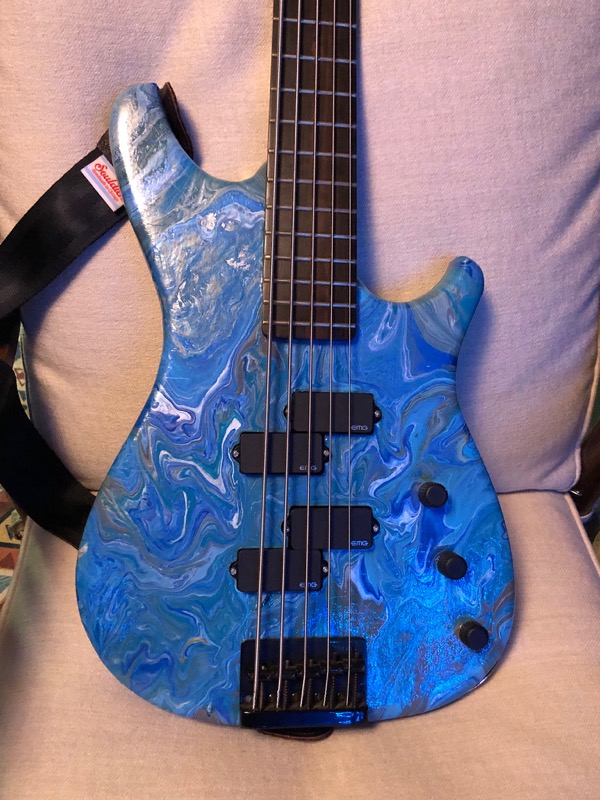
Two P pickups together is a great sound, like an angry Jazz with plenty of muscle to throw around. I prefer them in the reverse orientation, with the E/A side closer to the bridge than the D/G side, but that really only matters close to the bridge. And yeah, as @micguy said, don’t mount the bridge pickup too close to the bridge; I like to have at least 4cm between the E string saddle and the centerline of the E/A half of the pickup.

RDP_0399.JPG
 
A Split P as a neck pickup works fine. Two Split P pickups used simultaneously is OK, though not great. A Split P bridge pickup soloed… whatever side is closest to the bridge (usually the g/d side) will be horribly thin sounding. Leland Sklar’s dual P bass has the pickups in “reversed” configuration, and both the bridge and neck pickups are further from the bridge than normal. Where you put the pickups matters - don’t put the neck pickup in the usual place, and try to squeeze in a bridge pickup.
This is accurate from my experience. Bridge pickup solo'd didn't sound good on the DG strings, but everything else sounded great. With both pickups on you got the scoopy nature of a jazz bass, but fuller and meaner sounding. My dual-P is gone now, but I really liked it at the time.
 
A Split P as a neck pickup works fine. Two Split P pickups used simultaneously is OK, though not great. A Split P bridge pickup soloed… whatever side is closest to the bridge (usually the g/d side) will be horribly thin sounding. Leland Sklar’s dual P bass has the pickups in “reversed” configuration, and both the bridge and neck pickups are further from the bridge than normal. Where you put the pickups matters - don’t put the neck pickup in the usual place, and try to squeeze in a bridge pickup.
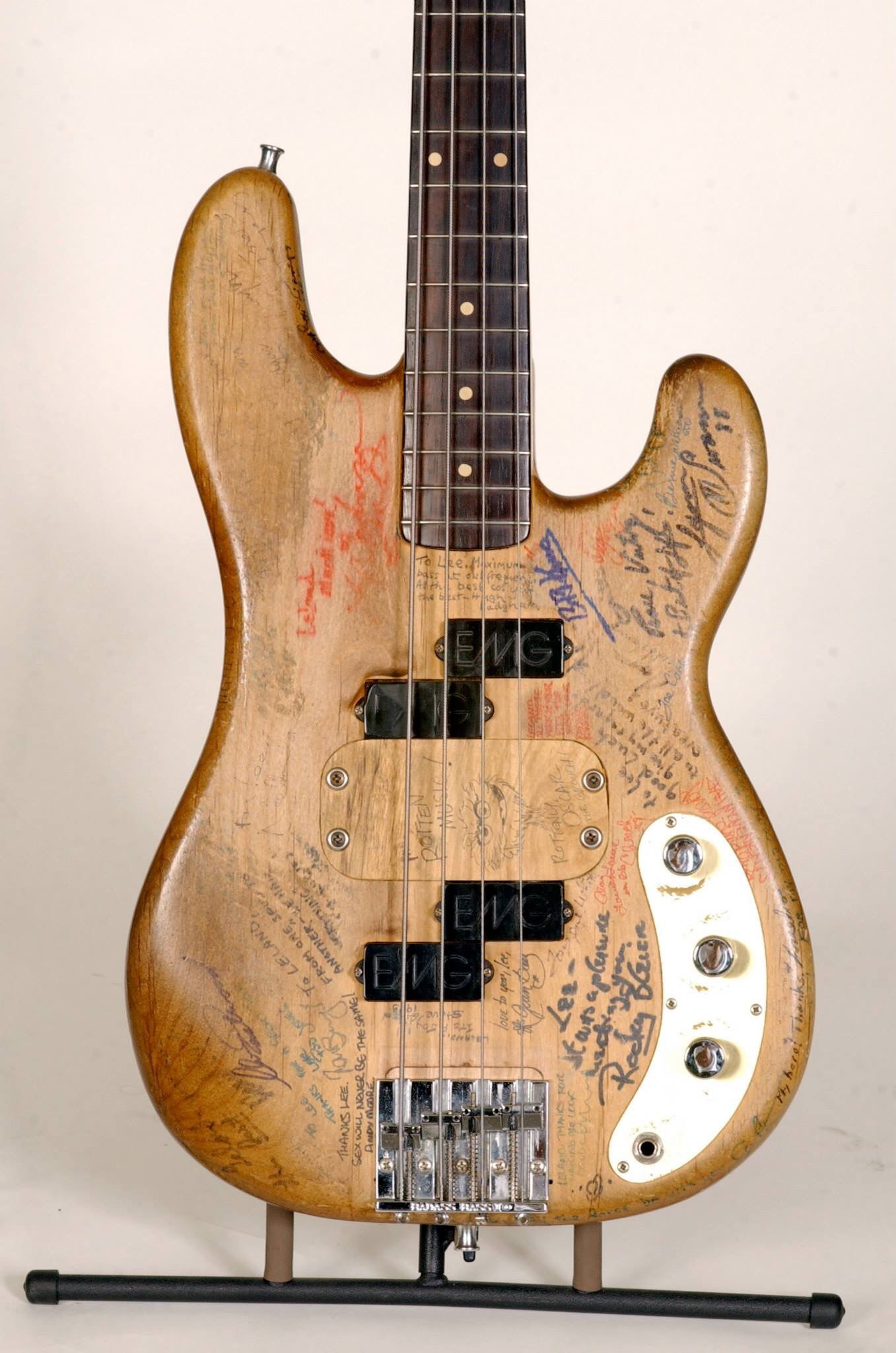
Here's Leland's P bass with two EMG split coil pickups. It sounds great, and you've probably heard it since it's been played on hundreds of songs.
d02d924b369883a5a15bb3ab68d961d4.jpg
 
Here's Leland's P bass with two EMG split coil pickups. It sounds great, and you've probably heard it since it's been played on hundreds of songs.
d02d924b369883a5a15bb3ab68d961d4.jpg

That picture shows where he put the pickups, and also where the stock position was. Note the neck pickup E/A half is actually closer to the neck than where Leo put it - despite being “reversed”, it actually has more low end on the lower strings, not less as it would be with most reversed P’s.
 
So a mean as hell J bass tone. That sounds awesome - something I would totally be into. Unfortunately, I've never used a router in my life. My thought was to see what Warmoth's custom body builder would come up with...other thought would be learning/practicing pickup routing.

Y'all have given me a lot to think about. Thanks much for all of your responses.
 
So according to this article (Leland Sklar: Relative Pitch), Mr Sklar's 2 p pickup bass has the pickup routes at "J bass positions" -

The Frankenstein bass, built by John Carruthers in 1973, consists of a P-Bass neck reshaped to J-Bass dimensions, a Charvel P-Bass body with two first-generation EMG P-Bass pickups routed into J-Bass positions, and mandolin fret wire.

So, in theory, I could modify a J bass and get similar results? Warmoth gives you the option of a split coil route in the neck position, but not the bridge. Maybe I could buy a J body from them, the route the bridge pickup to be a split coil?
 
They’re not really in the exact J bass positions. Just very approximately so.

And Warmoth’s “neck” P route is 1) in the standard P bass spot, not in the Sklar spot, and 2) not reversed.
 
  • Like
Reactions: definenredefine
They’re not really in the exact J bass positions. Just very approximately so.

And Warmoth’s “neck” P route is 1) in the standard P bass spot, not in the Sklar spot, and 2) not reversed.

Oh. Boo.

Okay, well what if I started with a J bass body, then rerouted the cavities for split coils myself? Reverse the orientation of the bridge pickup so the E/A side is closer to the bridge. And route the neck pickup so the E/A side is towards the neck, with the whole route centered approximately around the middle of the J pickup route.

Would that work?
 
Oh. Boo.

Okay, well what if I started with a J bass body, then rerouted the cavities for split coils myself? Reverse the orientation of the bridge pickup so the E/A side is closer to the bridge. And route the neck pickup so the E/A side is towards the neck, with the whole route centered approximately around the middle of the J pickup route.

Would that work?

On second thought, probably wouldn't want to reverse the bridge pickup...durp.
 
On second thought, probably wouldn't want to reverse the bridge pickup...durp.

Well, that’s one of the polarizing aspects of this discussion. Some people, myself included, feel that reversing is more beneficial at the bridge than at the neck. I’ve done it both ways, and the standard orientation makes the thin strings too twangy. Other people disagree….

 
Well, that’s one of the polarizing aspects of this discussion. Some people, myself included, feel that reversing is more beneficial at the bridge than at the neck. I’ve done it both ways, and the standard orientation makes the thin strings too twangy. Other people disagree….

I could see that. I guess my initial thought against reversing the bridge pickup would be making the low strings sound too thin, but I guess that wouldn't be as much of a factor.
 
FWIW, or possibly as a "problematic" pickup placement example: That's my old Wotan Shark bass, a quite rare German brand that had its instruments built in Japan in the 70/80. It's probably designed after some early BC Rich models. You will notice that the neck PU is placed nearer to the neck as on a P bass, and the bridge PU is really near to the bridge.... As a result, I rarely use the neck solo'ed because it is really fat (at least in serial mode, you can switch both Split-PUs between serial/parallel), and the bridge has rather weak output on the D/G strings. But both pickups combined provide a full sound, and less scooped than a J.
I'd suspect it might improve with a reversed bridge Split-PU...
IMG_20220613_082948255~2.jpg
 
Last edited: