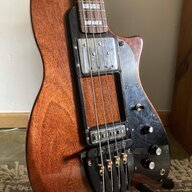
Chiming late but yes maple and poplar were both used and I don't have enough info to say when one was used over another. I believe poplar was the preferred wood and I would think that from the late 80's on all were poplar.
This is how I think it worked out, too. I only have factory (opaque) painted basses, so this is my take...
My main squeeze black 84 Foundation is def a maple body, as looking at the distinctive wood grain in the neck pocket, the hardness of the wood (fingernail can't dent it) and heavy weight is conclusively maple. My early 90s era basses are/were most likely poplar, as they had that signature wood grain, I could dent the wood with my fingernail, and they were very light. There
is a chance that they might be alder or basswood. Basswood was a very popular choice with imported instruments at the time, and it seems those 90s era bodies with the slimmer dimensions were made in Korea. My 93 Foundation was crazy light (8 pounds), but the body wood was pretty soft. I'm positive it was a Korean body.
The basses from the late 80s seem to be poplar here, maple there, maybe some alder..?
Doesn't really matter, though. They all sound and perform great. None of the hardware is popping out of stripped screw holes, so the body woods are sufficiently solid.
It's funny, 'tone woods' are not as important (IMHO) as they are purported to be. I come across this a lot with drums, which is my other nerd-level 10 instrument. Drummers argue over the minutia of shells made of maple vs birch vs poplar vs basswood vs mahogany (plus combos of those woods), let alone how many plies they use in relation to the thickness of the shells. Yes, all things being equal with shell design, certain woods can impart a signature tonality, but how the edges are cut, the heads used, and how those heads are tuned make a
bigger difference in the final tonality than the wood. Drums are an acoustic instrument, so they are heard more like an acoustic guitar, or similar to when you play your unplugged solid body bass. However, once strings, pickups and an amp come into play with that solid body instrument (just like when the drums get mic'ed up and processed with compression, EQ and reverb), the subtle to not-so-subtle differences in the woods fade away to the processing.
Do my German 9 ply/9mm (.35") poplar Sonor shells with a sharp 45 degree bearing edge sound like my US made 8 ply/.25" (6.35mm) Rogers shells made of old growth eastern hard maple and cut with a
really sharp 45 degree edge? Not so much acoustically, though both kits have the
same heads and tunings. The Sonors sound more 'old school/vintage' with less sustain like 60s era Ludwigs and Slingerlands vs the Rogers sounding more 'modern' with way more sustain and attack. This is funny, considering that the Sonors are from '92 and the Rogers from '83. However, once mic'ed up, they sound nearly the same, so much so I have to note which kit I used for the recording or I will get them confused.









 Walnut sounds like a great idea....without the maple top.