• TalkBass has been independent since 1998. Add your voice.
    Create a free account to reply to discussions, view embedded media, and browse with fewer display ads.
    Join freeLog in
    Want zero display ads or expanded classifieds tools? Compare plans.

U.S. Peavey Club

Can't say I see the resemblance David, well apart from short horns.


There was 10 main factories in the 70's. Most started out in the 50's but Terada go back to 1912. Peavey were definitely aware of them, you can see the origin of the harpoon peghead on Kawai/Teisco guitars from the 60's.


I'll agree on proprietary parts but don't see the unique features, not on the late 70's T-series.

The phase switch was nothing new. Dan Armstrong put a Spin-a-Split tone knob in his London guitars/basses back in 1971/72. Even the 'Bi-laminate' neck was old hat. Reverse grain for strength is not only an ancient woodworking technique it wasn't a Peavey first, my old Wilson Sapphire from 68 has a bi-laminate neck.


For me it's the simplicity of that single Super Ferrite 👍
Features were unique compared to USA basses not that they were first...I did wood working in school... Peavey was way apart from Fender and Gibson feature wise and appearance....the pickups sound and look different....luckily I have an ash maple neck 1st gen Fury which in in my not so humble opinion is the perfect classic SF Peavey bass...big neck, light weight natural slightly contoured ash body, black pickguard and lettering, knobs and bridge classic Peavey and the grail slant Super Ferrite 👌....it's perfect.
 
  • Like
Reactions: kodiakblair
Can't say I see the resemblance David, well apart from short horns.


There was 10 main factories in the 70's. Most started out in the 50's but Terada go back to 1912. Peavey were definitely aware of them, you can see the origin of the harpoon peghead on Kawai/Teisco guitars from the 60's.


I'll agree on proprietary parts but don't see the unique features, not on the late 70's T-series.

The phase switch was nothing new. Dan Armstrong put a Spin-a-Split tone knob in his London guitars/basses back in 1971/72. Even the 'Bi-laminate' neck was old hat. Reverse grain for strength is not only an ancient woodworking technique it wasn't a Peavey first, my old Wilson Sapphire from 68 has a bi-laminate neck.


For me it's the simplicity of that single Super Ferrite 👍
Features were unique compared to USA basses not that they were first...I did wood working in school... Peavey was way apart from Fender and Gibson feature wise and appearance....the pickups sound and look different....luckily I have an ash maple neck 1st gen Fury which in in my not so humble opinion is the perfect classic SF Peavey bass...big neck, light weight natural slightly contoured ash body, black pickguard and lettering, knobs and bridge classic Peavey and the grail slant Super Ferrite 👌....it's perfect
Now I got you, I'm a bit slow on the uptake this weekend 👍
Ha that's usually me.
 
  • Like
Reactions: kodiakblair
My 1st generation Fury neck to me is fine...long skinny fingers...I'm thinking about new rw strings eventually because what is there now is a bit floppy but tone is great, not sure what the strings are.

Thinking GHS Pressure Wounds maybe...I do like present rw strings w tone rolled all the way down but I don't want any more tension...I have an 89 Fury with Fender 9050 flats and I cannot deal with the tension.
I have GHS Pressure Wounds on my Patriot and very satisfied with them. I dislike Fender flats with the tension also, they were on my Patriot when I bought it and the bass had sat in storage for a lot of years under tension so the neck was almost pooched. Once I got the truss rod freed up and a lower tension string on, I was able to make some adjustments over a period of time and get the neck pretty much perfect. Very slight twist still but the ski jump is gone. Fortunately this bass had the baseball bat neck profile which I think saved it in the end.

On my Gen1 Fury I have Chromes. I gig with it regularly. I think either Chromes or Pressure wounds are good choices for super ferrites especially if you want to tame them a little.
 
I have GHS Pressure Wounds on my Patriot and very satisfied with them. I dislike Fender flats with the tension also, they were on my Patriot when I bought it and the bass had sat in storage for a lot of years under tension so the neck was almost pooched. Once I got the truss rod freed up and a lower tension string on, I was able to make some adjustments over a period of time and get the neck pretty much perfect. Very slight twist still but the ski jump is gone. Fortunately this bass had the baseball bat neck profile which I think saved it in the end.

On my Gen1 Fury I have Chromes. I gig with it regularly. I think either Chromes or Pressure wounds are good choices for super ferrites especially if you want to tame them a little.
Ah I have Fender flats on the 89 Fury it came that way ...sounds great but a slight twist and ski jump but very playable and I can play it on a good day lol

I am guessing Chromes would be good on my 1st gen Fury and yes I may go Pressure Wounds next but I'm liking the existing rounds because of lighter tension and tone up or all the way down is good ....but rough feel and finger noise is a bit annoying ...I sure like the big neck and lightweight, balance is great...never tried chromes.
 
Ah I have Fender flats on the 89 Fury it came that way ...sounds great but a slight twist and ski jump but very playable and I can play it on a good day lol

I am guessing Chromes would be good on my 1st gen Fury and yes I may go Pressure Wounds next but I'm liking the existing rounds because of lighter tension and tone up or all the way down is good ....but rough feel and finger noise is a bit annoying ...I sure like the big neck and lightweight, balance is great...never tried chromes.
If you like the roundwound sound then Pressure Wounds are a great choice and string noise almost eliminated.
 
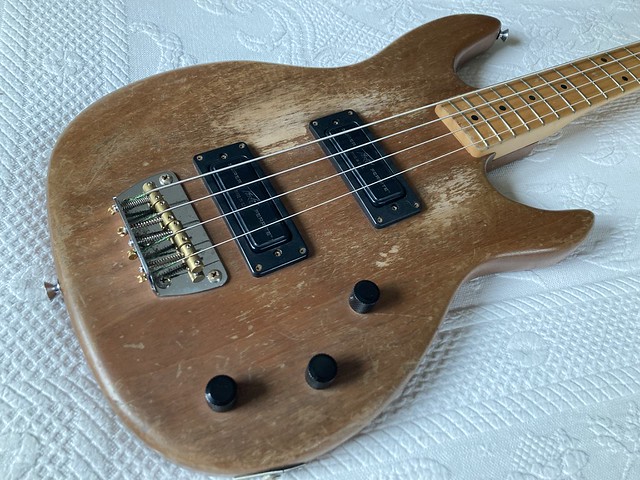
Hi everyone! I’ve been away for a while…question for the experts. I have a bead on a local Patriot body but it is a (bad) respray job and I can’t really see the pocket well to see what wood it may be (I want maple, as most of you probably know). The seller says it weighs 5lbs 9oz. Here are the pictures:

Thoughts? Thanks!
 

Attachments

  • IMG_3234.jpeg
    IMG_3234.jpeg
    771.4 KB · Views: 12
  • IMG_3233.jpeg
    IMG_3233.jpeg
    570.9 KB · Views: 12
  • IMG_3232.jpeg
    IMG_3232.jpeg
    988.6 KB · Views: 11
What's the story with this fancy backplate? It's on a Precision copy for sale (so I guess a Peavey Fury). The neck is an unlabelled fretless.

But all the MIA Furies I see have a very boring, plain backplate.

This is the only hint that it's only a Peavey (since the original neck is gone).

Any knowledge about these?
Are the pickups on Fury's close to a P-bass?

000000121722093-05-2000x2000-cropped.jpg
000000121722093-00-2000x2000.jpg
 
Last edited:
Any knowledge about these?
Are the pickups on Fury's close to a P-bass?
It's a T-series neck plate so from a T-40/45, I don't recall those plates on the T-20.

Furys are basically P-basses, apart from the slant ferrite single coil. Fury necks differ from Fender/Squier etc in being a narrower jazz style, they're also slightly narrower at the pocket. Split coil pickup has ceramic mag not Alnico5 slugs, ceramic gives a bit brighter tone which appears louder to the human ear.

If the neck is blank, does it have the harpoon peghead ? That will tell you if it's a stripped Peavey or a bitsa that just happens to have a Peavey neck plate.
 
  • Like
Reactions: robert_stuart
They’ll be cheap junk. lol
That depends entirely on Peavey.

If they want their name on a quality product, they'll set a proper budget.

If they don't give a monkey's and just want maximum profit, they'll set the budget at peanuts.


Products originating from certain countries get a bad rep yet that rep is the result of a corporate decision 🙄

In the past corporate Peavey were pretty good, nobody grouches about their Sarzo Cirrus coming out of China or Indonesia 👍