
• TalkBass has been independent since 1998. Add your voice.
    Create a free account to reply to discussions, view embedded media, and browse with fewer display ads.
    Join freeLog in
    Want zero display ads or expanded classifieds tools? Compare plans.

Ultimate No-load Ungrounded Blend Pot (Pics!)

oops!

yeah, two different things. the tonestyler is a bank of 6 different tone caps, the turnstyle is a whole crazy new switching scheme.

the website (which is thoroughly confusing, it shows pictures of guitars instead of pictures of what they actually sell) makes all kinds of claims for the turnstyle switching your strat to sound like a PAF or like a P-90 or whatever, claims i don't believe for a second from a passive system. still, a bunch of new tonal variations is always fun.
I assure you that my bass is 100% passive, but it has five different voices (tone presets), all due to that Turnstyle switch. The switch by itself is nothing more than a six position rotary switch, but what makes it special is the custom circuitry in each position. It's best to think of each position as a blank canvas on which you can put anything you want, and then it's their job to make it happen. Regarding the website, the pictures on the Pro Shop page are the guitars they have worked on. The Turnstyle is a six position rotary switch with circuitry. There's really not much to look at. I'll show you the guts of my bass if you think it will help you discern anything.

By the way, I get nothing for endorsing Turnstyle except discounts on projects. I just really believe in it, enough to have them do additional projects. There are two more in the works as we speak.
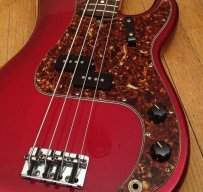
BrozTone_zps5a35d94c.jpg
 
rainbow strings!

totally OT, but a guitar-playing friend recounted how he tried a set and they totally messed him up visually; at the gig, different colored stage lights would make different strings on his guitar randomly appear and disappear :nailbiting:
 
  • Like
Reactions: MattZilla
rainbow strings!

totally OT, but a guitar-playing friend recounted how he tried a set and they totally messed him up visually; at the gig, different colored stage lights would make different strings on his guitar randomly appear and disappear :nailbiting:
Hahahaha! DR makes a rainbow string package, but that set on mine is a special edition red-white-&-blue set. I've been using DR Neons for a long time -- I use fishing lure stickers as fret markers, otherwise I wouldn't be able to see them. One time I mixed green and blue strings, and for whatever reason, I often couldn't see the blue strings at all. And same with people in the audience -- I had some people wondering how I could play what I played on only two strings.

Yeah, we're pretty far afield of ungrounded no-load blend pots. I'll shut up now.
 
Keep in mind that with three pickups, you have a lot more possible combinations. That "turnstyle" switching system does not really make sense for standard basses with only two (single-coil) pickups. The only switching that can be done with two single-coils is parallel/series and in/out of phase.

In my opinion, all these varitone/stellartone/tonestyler contraptions are just poor, passive approximations of a parametric EQ that would be far better handled by your preamp/amp or the mixer.
I would only put such a thing in my bass if I had a hole to fill in my control plate...
 
Last edited:
You know you can't get 100k blend pots easily but you can get 25k blend pots meant to be used with some active pickups.
i'd already tried one of those with high hopes, but i found that it mostly sounded like "both pickups on" until it hit one end of the travel, where it abruptly switched to one pickup when it hit the cut trace.
So I'm still confused about what value pot to use with active pickups. I ordered a 25k blend pot, and I certainly hope it performs better than Walter's did. It should provide much more blending action since it'll be receiving a low impedance signal, right?
 
Keep in mind that with three pickups, you have a lot more possible combinations. That "turnstyle" switching system does not really make sense for standard basses with only two (single-coil) pickups. The only switching that can be done with two single-coils is parallel/series and in/out of phase.

In my opinion, all these varitone/stellartone/tonestyler contraptions are just poor, passive approximations of a parametric EQ that would be far better handled by your preamp/amp or the mixer.
I would only put such a thing in my bass if I had a hole to fill in my control plate...
You're thinking of the Turnstyle as nothing more than a conventional pickup selector switch. It can be that, but it's capable of a lot more. Starting with two good pickups, it can become a voice selector switch, which is how I use it.

And Elias actually does have a hole to fill, which is why I brought it up in the first place. ;)

Still not an ungrounded no-load pot, so I'll shut up again.
 
I definitely appreciate the Turnstyle recommendation, and any other recommendations for that matter. I bought this bass--a used Brice V2 fretless 5-string--in part to have something to experiment with. I knew the electronics would likely need work. That said, for now I want to stick with something cheap and diy-able. I feel like I've already learned a lot about bass electronics just doing the research for this bass, and I think I'll learn even more by doing the work myself. So I'm gonna stick with the Tonestyler/"Varitone" idea for now. (I'm using the quotation marks because the thread I linked to earlier isn't a Gibson/Epiphone style Varitone in that it doesn't use an inductor. It just uses different caps, just like the Tonestyler.) I may try the Turnstyle or even an active preamp in the Brice (or other basses) down the road.
 
So I'm still confused about what value pot to use with active pickups. I ordered a 25k blend pot, and I certainly hope it performs better than Walter's did. It should provide much more blending action since it'll be receiving a low impedance signal, right?
I looked at my EMG blend pot and it is indeed a dual ganged 25K.
Something else to consider with tone caps... Due to the low impedance nature of EMGs, they use totally different values of caps for similar characteristics of higher impedance circuits. Seems most EMGs have a .1uF cap for starters, and you stack them to get deeper characteristics. Where a .1uF cap in a passive bass is super deep and old school, in a EMG setup, it's much like a .022uF or .033uF equivalent. Stacking a .1uF with another (or just installing a .2uF cap) in a low impedance set yields a result much like a .047uF to .068uF equivalent in a passive bass.
Check and see what your current bass is loaded with and temper your experiment accordingly. It will all depend on the needs of the circuit. Outside of EMG with low value pots and larger cap values, I have some active systems that still use higher value tone pots and smaller caps (the same as high impedance/passive values), and others that use 25K-50K pots and standard high impedance cap values.
 
  • Like
Reactions: DavesnothereCA
So I'm still confused about what value pot to use with active pickups. I ordered a 25k blend pot, and I certainly hope it performs better than Walter's did. It should provide much more blending action since it'll be receiving a low impedance signal, right?
i should think so yeah (it's been so long since i tried any of this on actual active pickups), but it might not work ungrounded at all; 25k series resistance might not even get noticed by the active pickups, you may have to keep the blend grounded to get any results. there again, the pickups being active should also not get any real tonal loss from the grounding either.

EMG sells an actual active blend pot, 9V powered with two buffered ins and a mixed output like from a mixing board; that might be the best bet.
 
after talking about the "ungrounded blend" thing for a while now, i finally got around to snapping some pics of one while i was installing it!

this is a 250k M/N pot that i've also modded to be "no-load" by cutting traces, so that at each extreme the "off" pickup is entirely disconnected. (i figured out that even with no parallel ground load path, at the ends of the travel each pickup was still being loaded by the other pickup's path to ground, so the 250kΩ of the pot plus the 8kΩ or whatever of the "off" pickup.)

instead, with the traces cut this pot really is just like a 3-way switch in the middle and at each end of its travel, no signal loss at all.

the sweep is smoother than a typical 500k grounded blend, too; i'd love to try this with say, a 100k M/N for even smoother shading between pickups, but i don't know if that's really a thing.

start with a little x-acto saw like this to cut the trace on the one side:
View attachment 2311328

View attachment 2311329

flip the pot over and do the same thing:
View attachment 2311330

you know you've got it when you can turn it all the way up or down and the resistance from the center to the output side goes from short to almost 250k to "open" on the wafer of the pickup you want "off".

here's the jumper across the output lugs of the two wafers:
View attachment 2311331

(i ran it around the back to get it out of the way.)

and finally, here are the outside connections, two pickups in, one output wire, and done!
View attachment 2311332
WalterW--finally got the pots, but I'm reading around 100 ohms on the opposite posts from the ones you have illustrated.
 
WalterW--finally got the pots, but I'm reading around 100 ohms on the opposite posts from the ones you have illustrated.
100Ω or 100kΩ?

the first just means a little residual resistance, shouldn't be a big deal; the second means those pots are "backwards", meaning you'll need to mirror-image the layout to make it work.