
Enjoy the benefits of a premium membership!
Upgrade Account
-
TalkBass has been independent since 1998. Add your voice.
Create a free account to reply to discussions, view embedded media, and browse with fewer display ads.
Join free Log in
Want zero display ads or expanded classifieds tools? Compare plans.
You are using an out of date browser. It may not display this or other websites correctly.
You should upgrade or use an alternative browser.
You should upgrade or use an alternative browser.
More options
Who Replied?

You can cut pretty close to the end of the carbon strip but the cut has to go all the way. As the wafer is in the picture, there is still a connection.
Shining a light through the wafer from the back will make it easy to see when you have properly cut it all the way.
Remember to blow away all the dirt and put some contact cleaner/protector on the wafer after you are done.
Shining a light through the wafer from the back will make it easy to see when you have properly cut it all the way.
Remember to blow away all the dirt and put some contact cleaner/protector on the wafer after you are done.
OK, after some prompting i finally made a diagram of the whole thing, done in my apparently now traditional goofy MS paint style
View attachment 2779754
it also works just fine without cutting the traces, you still get the smooth blending between pickups and you still avoid extra loading loss from the blend pot; the only drawback is that when you're cranked over to one pickup you still get a slight bit of the other, "off" pickup in the mix. (you don't really hear it though)
if you're a player who mostly shades between the two pickups rather than running either one solo, then this will work nicely without cutting the traces on the blend pot.

Thanks for this.
I've just rewired my fretless jazz and it worked properly straight away. The tone pot seems to add around 70% of tone from off to 3 and then very little for the next 7/10ths of the sweep. I might try a log taper instead of the current audio taper. What's the consensus on how this might work?

"log" is "audio" taper, and is what you want for the tone pot.The tone pot seems to add around 70% of tone from off to 3 and then very little for the next 7/10ths of the sweep. I might try a log taper instead of the current audio taper. What's the consensus on how this might work?
are you sure you don't have a linear tone pot? that's what linear tones do, nothing happens from "10" down to like "2" then all the tone changes like throwing a switch.
"log" is "audio" taper, and is what you want for the tone pot.
are you sure you don't have a linear tone pot? that's what linear tones do, nothing happens from "10" down to like "2" then all the tone changes like throwing a switch.
I just realised when i was typing on another thread that I'd gotten that wrong. It is definitely an audio taper (Invalid Link Removed so I'll try a linear taper pot and see if it helps.
I should state that i didn't do the trace cutting on the blend pot. My electronics knowledge is basically non-existant and I didn't want to screw it up. If anyone cuts a few of these I'd be more than happy to pay for one.
Don’t bother, trust me.It is definitely an audio taper (Invalid Link Removed so I'll try a linear taper pot and see if it helps.
a linear tone will be way worse, not better.


I think you have two options: (1) switch to aThanks Walter. That'll save me time and money.
Edit: NVM about option (1), I had my thinking backwards. Since the cap goes between the hot and ground, increasing the pot value won't help. I think I just confused myself. Decrease the pot value? Sorry, I'm a little tired.
Last edited:
hmm, yeah. lowering pot value will even up the effect across its range, at the price of a darker maximum sound at the top.I think I just confused myself. Decrease the pot value? Sorry, I'm a little tired.
i suspect what @BAG is hearing is normal though. starting at the top, a normal audio tone pot does nothing but slowly remove treble until you get down to like "4", then the cap's "character" starts to kick in below that where you hear the sound start to sort of "shift". when you hit "0" this resonant low-mid peak kicks in, making "0" in some ways louder than "2".
Thanks for the info guys.
I probably wouldn't notice it at all except that (by memory) it had a more progressive sweep before I did the rewiring. It's hard to say definitively as I replaced all of what I believe were the original VM Squier V/V/T pots (small cheap looking items), the cap and the jack to the V/B/T, oil cap and jack.
It could also be just my (bad) memory but it feels like there was more of a tonal difference between "all neck pickup" versus "all bridge pickup" with the VVT setup than now with the VBT. I thought that maybe, as mentioned at the start of this thread, that there was still some of the bridge coming through when the blend pot was all the way to the neck and vice-versa. I have no way of measuring this but using the "tap the poles with a metal object" test shows that there isn't any audible bridge pickup coming through at the neck setting (and vice-versa). I used to favour the neck pickup by itself but now find i'm liking the centre setting.
One thing that had me concerned about doing this was that this was the quietest bass (or guitar) I own despite it being the only twin single-coil bass and being the only bass I haven't copper shielded and was concerned that i'd finish the work and suddenly find it's buzzing like a bee. As it turned out it is still eerily quiet.
I did find that there are ground wires screwed into each pickup cavity going to the main control cavity and was wondering if this is standard for the Squier VM '77 Jazz Bass. It's possible that it is an aftermarket shielding job but if not then the factory job was superb.
There's a good chance i'll eventually bite the bullet and buy some Bill Lawrence J45's for this. If i'm still not satisfied with the sound after that I'll finally conclude that I just do not like Jazz pickups.
I probably wouldn't notice it at all except that (by memory) it had a more progressive sweep before I did the rewiring. It's hard to say definitively as I replaced all of what I believe were the original VM Squier V/V/T pots (small cheap looking items), the cap and the jack to the V/B/T, oil cap and jack.
It could also be just my (bad) memory but it feels like there was more of a tonal difference between "all neck pickup" versus "all bridge pickup" with the VVT setup than now with the VBT. I thought that maybe, as mentioned at the start of this thread, that there was still some of the bridge coming through when the blend pot was all the way to the neck and vice-versa. I have no way of measuring this but using the "tap the poles with a metal object" test shows that there isn't any audible bridge pickup coming through at the neck setting (and vice-versa). I used to favour the neck pickup by itself but now find i'm liking the centre setting.
One thing that had me concerned about doing this was that this was the quietest bass (or guitar) I own despite it being the only twin single-coil bass and being the only bass I haven't copper shielded and was concerned that i'd finish the work and suddenly find it's buzzing like a bee. As it turned out it is still eerily quiet.
I did find that there are ground wires screwed into each pickup cavity going to the main control cavity and was wondering if this is standard for the Squier VM '77 Jazz Bass. It's possible that it is an aftermarket shielding job but if not then the factory job was superb.
There's a good chance i'll eventually bite the bullet and buy some Bill Lawrence J45's for this. If i'm still not satisfied with the sound after that I'll finally conclude that I just do not like Jazz pickups.
that's likely because you were just hearing the effects of typical V/V/T wiring, which puts the tone pot necessarily "after" the volume pots. you get a bigger dropoff change at the top of each control, especially if the others are down a little. the tone affects the sweep of the volumes and vice versa.I probably wouldn't notice it at all except that (by memory) it had a more progressive sweep before I did the rewiring.
this wiring is more "normal", with the tone "before" the volume; a more even sweep of both controls and they don't change each other's behavior. that's how P basses are wired.
One could cut the trace at the top...?lowering pot value will even up the effect across its range, at the price of a darker maximum sound at the top.

yep!One could cut the trace at the top...?
with a tone pot you can make it more "audio" by choosing a lower value and then cutting it for no-load. you'll hear a transition between "10" and "9.5" but that's not a big deal.
you could then set the max value by putting a resistor across the outer lugs, like a 500k resistor on a 250k cut for no-load. that should make it a 500k tone that drops a little faster from "10".

I did find that there are ground wires screwed into each pickup cavity going to the main control cavity and was wondering if this is standard for the Squier VM '77 Jazz Bass. It's possible that it is an aftermarket shielding job but if not then the factory job was superb.
There's a good chance i'll eventually bite the bullet and buy some Bill Lawrence J45's for this. If i'm still not satisfied with the sound after that I'll finally conclude that I just do not like Jazz pickups.
I have a Squier VM Bass VI and it had those same cavity ground wires, screwed into the PU cavities and going to the main ground buss in the control cavity. I put two layers of shielding paint in all the cavities and used those ground wires for the PU combs when I did the series/parallel mod to the wiring. It was rather handy those wires were in there! I didn't notice any more or less grounding noise after my changes.
The Wilde J45s are killer!
Finally measured my 100k m/n pot values for each sweep.
From neck side I'm reading 1.3 at full lock. Moves at 0.1 increments until center indent at 4.1. After that it sweeps at 1-2 to a max of 82 before 0.L M ohms.
Bridge side is 1.4 full lock, sweeping 0.1 to center at 4.5. Past that it's 1-2 maxing at 104 before open.
So I seem to have cut the traces on the bridge pup side better than the neck although I don't think those values are going to affect the sound that much.
Hope this makes sense and helps!
From neck side I'm reading 1.3 at full lock. Moves at 0.1 increments until center indent at 4.1. After that it sweeps at 1-2 to a max of 82 before 0.L M ohms.
Bridge side is 1.4 full lock, sweeping 0.1 to center at 4.5. Past that it's 1-2 maxing at 104 before open.
So I seem to have cut the traces on the bridge pup side better than the neck although I don't think those values are going to affect the sound that much.
Hope this makes sense and helps!
I’m thinking about doing this for my active Fretless Jazz.
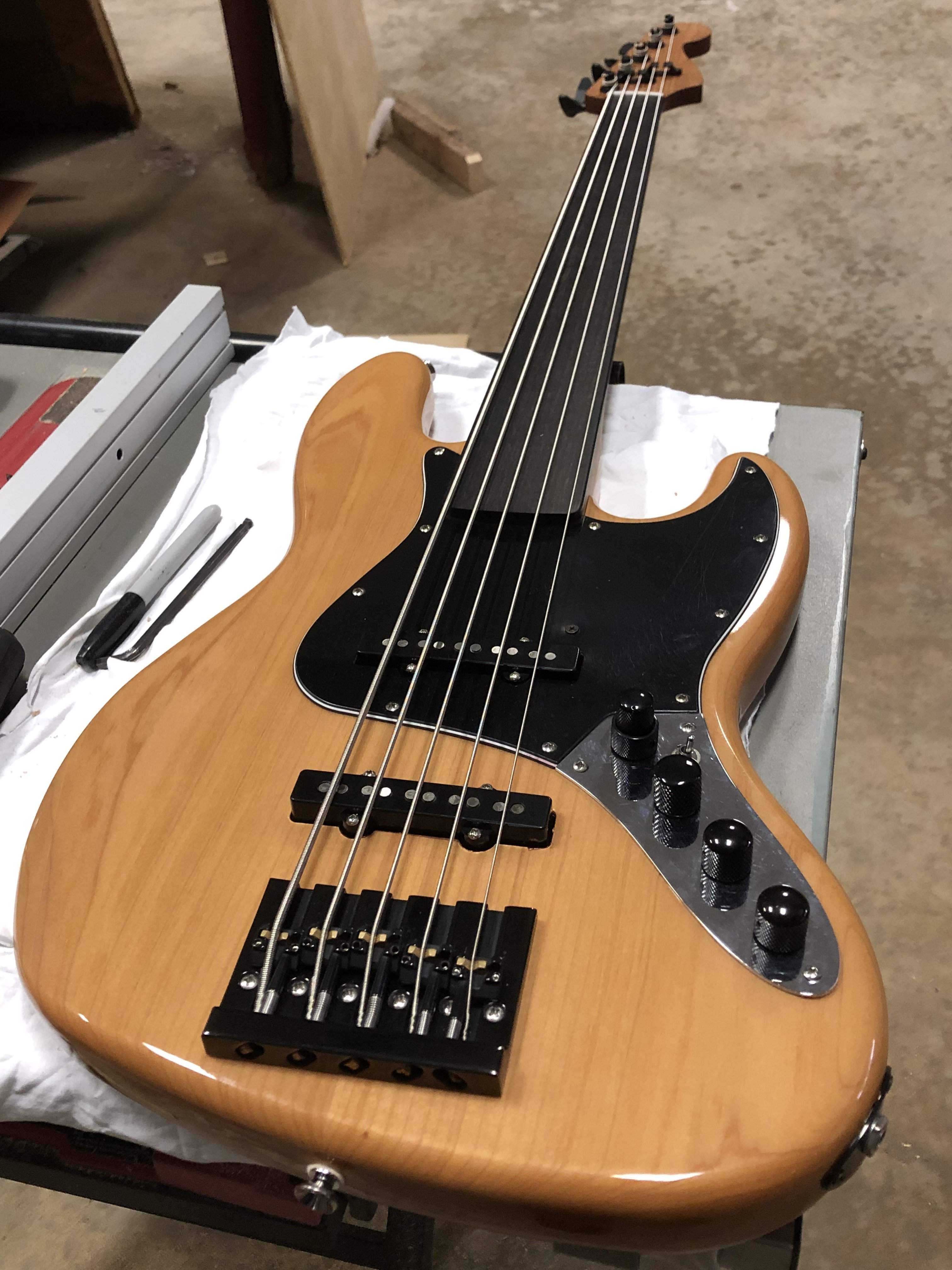
It currently has:
Pot 1- stacked neck vol/passive tone
Active/passive switch
Pot 2- bridge vol
Pot 3- active treble
Pot 4- active bass
Both volumes are Log taper, especially since I have the stacked vol/tone, it would be unfeasible to find a Linear top/log bottom in a stacked pot.
I may or may not cut the traces, I have to see if I have something small enough to get into the M/N pot I have...maybe a small dental pick thingy...
It currently has:
Pot 1- stacked neck vol/passive tone
Active/passive switch
Pot 2- bridge vol
Pot 3- active treble
Pot 4- active bass
Both volumes are Log taper, especially since I have the stacked vol/tone, it would be unfeasible to find a Linear top/log bottom in a stacked pot.
I may or may not cut the traces, I have to see if I have something small enough to get into the M/N pot I have...maybe a small dental pick thingy...

i could see it!It currently has:
Pot 1- stacked neck vol/passive tone
Active/passive switch
Pot 2- bridge vol
Pot 3- active treble
Pot 4- active bass
if the neck volume taper is acceptable, just make it the master volume and replace the bridge volume with the blend pot


