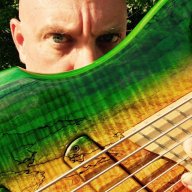
I am pretty sure you can play any style of music on the fanned-fret basses. From the physics standpoint it must really make sense to have longer low strings.
Playability is an issue, which strongly depends on two factors:
The length of the longest string compared to the shortest string and the way the frets are "fanned". For the second factor the builder can decide where to position the "regular" (right-angled) fret. I would prefer those basses, where the "regular" fret is in 8th or 9th place. This makes the distance for the higher strings in the low registers even bigger, which can be problematic for players with smaller hands. But it also makes the distance for the higher strings in the high registers comparably longer, which would be nicer for my hands.
The Ibanez has its "regular" fret at the 6th or 7th position (not so good for me). At the Dingwall it looks like the right-angled fret is in the 7th or 8th position, whereas we also have Maruszczyk where it's the 5th or 6th (even worse for me).
Btw: I like the look / shape of the Ding and the Kiesel better ...
Playability is an issue, which strongly depends on two factors:
The length of the longest string compared to the shortest string and the way the frets are "fanned". For the second factor the builder can decide where to position the "regular" (right-angled) fret. I would prefer those basses, where the "regular" fret is in 8th or 9th place. This makes the distance for the higher strings in the low registers even bigger, which can be problematic for players with smaller hands. But it also makes the distance for the higher strings in the high registers comparably longer, which would be nicer for my hands.
The Ibanez has its "regular" fret at the 6th or 7th position (not so good for me). At the Dingwall it looks like the right-angled fret is in the 7th or 8th position, whereas we also have Maruszczyk where it's the 5th or 6th (even worse for me).
Btw: I like the look / shape of the Ding and the Kiesel better ...

 but I'll go with it. I like the idea of fanned frets, there's perfectly good logic behind them, but I can't play one to save my life.