• TalkBass has been independent since 1998. Add your voice.
    Create a free account to reply to discussions, view embedded media, and browse with fewer display ads.
    Join freeLog in
    Want zero display ads or expanded classifieds tools? Compare plans.

Uncontrollable feedback on stage with a "drum alcove"

bdplaid

Supporting Member
Aug 31, 2007
9,451
18,584
florida
We play a room with a stage that has a recess in it for the drums. The drummer uses a monitor in the recess. It seems we can't get 5K feedback under control when the drummer is in that alcove using a monitor. Monitors on the front of the stage seems fine. The feedback is coming between the main vocal mic and the drum monitor.

The whole setup is something of a worst case scenario though: mixed monitors, mixed mics, no 31 band eq. Still, that's what's there, and I'm trying to make the best of it.

My thoughts are that the whole alcove becomes something of a speaker, because the sound from a monitor inside it is bouncing around.

Thoughts?
 
  • Like
Reactions: rodl2005
Ditch the monitors and make the drummer use IEM. Feedback problem solved. It is fairly common for a drummer to use wired IEM, even if the rest of the band is still using wedges. Putting a drummer in a square box with 8+ mics and loud wedges is going to be a feedback nightmare.
 
  • Like
Reactions: five7
We play a room with a stage that has a recess in it for the drums. The drummer uses a monitor in the recess. It seems we can't get 5K feedback under control when the drummer is in that alcove using a monitor. Monitors on the front of the stage seems fine. The feedback is coming between the main vocal mic and the drum monitor.

The whole setup is something of a worst case scenario though: mixed monitors, mixed mics, no 31 band eq. Still, that's what's there, and I'm trying to make the best of it.

My thoughts are that the whole alcove becomes something of a speaker, because the sound from a monitor inside it is bouncing around.

Thoughts?

What kind of monitor is it? I have a pair of Mackie SRM550s and the only level control on the speaker is actually input gain. With those, the overall level from the speaker doesn't matter, if the input gain is too high, it will feedback. People who use that as a volume knob and crank it will get uncontrollable feedback. Had a guy run us with our PA one time, he wasn't familiar with the speakers and apparently his normal routine was to crank all of the mains and subs (at the time 4 SRM550 and HD1501 that had the same controls) and then control. He couldn't get anything out of the PA without the whole thing feeding back wildly. Fortunately, I knew about the control being input gain but it took a while to find out that's what he had done. You might check how the level is being established and if it's a powered speaker with input gain, try backing that off and get the level from going higher from the board and/or the master on the monitor if it's that kind of control setup.
 
  • Like
Reactions: bdplaid
Are you sure it's the vocal mic causing the feedback? If so turn that down in the drum monitor mix, reposition the monitor and or the vocal mic.

Pick up a good used EQ for the monitor mixes.
A hardwired IEM is not that all that expensive to set up.
Behringer P2 (or equivalent), XLR cable and KZ buds… < $100.
 
To get back to the original question though, which is more theoretical than practical, is it possible that the alcove itself can act as a radiator that will pick up and generate feedback?
Yes - no....but it could be controlled. I could see it projecting the drums acoustic sound out of the alcove / box in a not so great way and bleeding into the lead vocal mic.

I'm picturing an 8 x 8 recessed box.
 
  • Like
Reactions: s0c9 and bdplaid
To get back to the original question though, which is more theoretical than practical, is it possible that the alcove itself can act as a radiator that will pick up and generate feedback?
Absolutely! Those alcoves are always an issue, usually near impossible for the poor drummer, even worse if they require a monitor for their vocals. IEM’s would help in all respects. That’s what our poor drummer who hated the alcove finally did, and was at last able to hear something besides his drums. Best thing (not always possible of course) is to fill the alcove with instrument cases, etc and put the drummer out on stage, particularly if they sing. As for feedback control, that’s a lengthy and site-specific topic. In an alcove is asking for it. Overuse of compression in an attempt to level peaks is also asking for it. Best of luck with your next band!
 
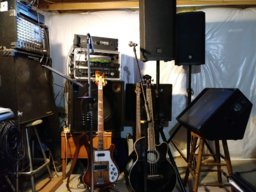
Here's a look at the offending stage.

473898899_122215091876073805_4268916888224114294_n.jpg
 
  • Like
Reactions: rodl2005
I haven’t read all the posts in this thread so I’m sorry if this is redundant. Here are some things to check/consider.

1.) Yes, the alcove can create feed back due to noise bouncing around to unwanted places. You can combat this with good speaker angle, mic placement, and gain structure.

2.) A Note of Gain Structure- I don’t know how much sound experience you have. So please don’t take offense. But, I find when I’m in a less than ideal location that keeping it simple helps best. Try turning all of your speakers all the way down then set all the master/bus/sacs to zero. Next, set gain for your mics based on the displays on your board. This forces you to get the gain right. Next pull up the volume in your speakers (you’ll be shocked how low you actually need to turn them up). From here you can do your EQ. Mic feedback should be less of a problem, and your EQ cuts and boosts will be more efficient.
 
2.) A Note of Gain Structure- I don’t know how much sound experience you have. So please don’t take offense. But, I find when I’m in a less than ideal location that keeping it simple helps best. Try turning all of your speakers all the way down then set all the master/bus/sacs to zero. Next, set gain for your mics based on the displays on your board. This forces you to get the gain right. Next pull up the volume in your speakers (you’ll be shocked how low you actually need to turn them up). From here you can do your EQ. Mic feedback should be less of a problem, and your EQ cuts and boosts will be more efficient.
I was at my rock band rehearsal last night.. they are trying to go all-IEM for the first time.. except for one guitar player who left his at home.. SMH!
Simple wired setup with P2's. I left my wireless rig at home, brought my P2.
So.. the click track - coming off an iPad - wasn't that loud and plugged into the AUX-IN on the digital mixer (TM16) which has NO GAIN setting. iPAd volume was max'd. The vocals were also low in the mix, so I bumped up the input gains to appropriate levels, which (in turn) jacked up the level in the wedge they had set up for the guitar player.
BL wanted to turn down the mic gain. I said no, there won't be enough head room if you reduce the gain, I'll just turn down the level in the wedge.
If that channel is now too loud in your IEM mix then I will turn down that down in your mix too.
Basically we ended up cutting each channel in each mix so the click could be heard, having gain-staged each input properly.

It's beginner stuff, but the point is, IEM's (and wedges) need all channels going to the board to be properly gain-staged., not adjusted based on how much of a specific channel you hear in your mix. It's a much too common issue~!
 
Last edited:
To get back to the original question though, which is more theoretical than practical, is it possible that the alcove itself can act as a radiator that will pick up and generate feedback?


The alcove doesn't generate anything. But sound bounces around. So you may have multiple paths the sound travels from the speaker, to the alcove surfaces, to the mic. Since the length of each path is different, the various sound fronts arrive at the mic at different phase angles. However if you have a couple of prominent paths that arrive in phase, they sum and the tendency for feedback increases.

Wavelength is indirectly proportional to frequency. The wavelength for 5K is only 2.7". Sometimes moving a mic or speaker a small amount can be all that it takes.

Lets say one path arrives first. If another path is 5.4" longer, the sound arrives at a 720 degree phase angle. In other words the from the second path arrives two cycles behind, but perfectly in phase.

Keep in mind the sound from the alcove is probably reflected into the front of the mic...which is the sensitive side. The front vocal monitors should placed in the null(s) where the mic has the best rejection. This allows the front monitors to have way more gain before feedback.