I have found little difference. You can get used to both. But unlined looks cooler.

Enjoy the benefits of a premium membership!
Upgrade Account
-
TalkBass has been independent since 1998. Add your voice.
Create a free account to reply to discussions, view embedded media, and browse with fewer display ads.
Join free Log in
Want zero display ads or expanded classifieds tools? Compare plans.
You are using an out of date browser. It may not display this or other websites correctly.
You should upgrade or use an alternative browser.
You should upgrade or use an alternative browser.
Unlined or Lined: Irrelevant?
- Thread starter Dr. Cheese
- Start date
More options
Who Replied?
Do what works for you.
FWIW, though, my own experience, has me shifting from lined to unlined.
Both my fretless basses are lined, and my first EUB had fingerboard dots corresponding to the frets, and I found that really convenient, especially in the early days. But the more I play my unlined EUB and learn to intonate properly by ear, the more the lines bother me.
One reason is that they're never exactly where the correct intonation is, so they're really only useful as ranging marks - and the 3-5-7-9-12 dots are sufficient for that. So now I find them distracting and misleading, because if I'm looking down for any reason, they grab my attention and I instinctively play by eye instead of by ear - it throws off my intonation, and it's slowing me down in properly learning by feel.
Thus, my other reason for coming to dislike them is that they're now getting in the way of my progress, so now I have to put extra work into learning to ignore them.
FWIW, though, my own experience, has me shifting from lined to unlined.
Both my fretless basses are lined, and my first EUB had fingerboard dots corresponding to the frets, and I found that really convenient, especially in the early days. But the more I play my unlined EUB and learn to intonate properly by ear, the more the lines bother me.
One reason is that they're never exactly where the correct intonation is, so they're really only useful as ranging marks - and the 3-5-7-9-12 dots are sufficient for that. So now I find them distracting and misleading, because if I'm looking down for any reason, they grab my attention and I instinctively play by eye instead of by ear - it throws off my intonation, and it's slowing me down in properly learning by feel.
Thus, my other reason for coming to dislike them is that they're now getting in the way of my progress, so now I have to put extra work into learning to ignore them.
It's true 100% of the time. The pics you posted were not of any double/upright/standup bass.True 98% if the time
No lines. Never. You got the side dots anyways, innit?
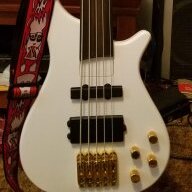
I prefer the aesthetics of an unlined fingerboard on a fretless.
My first and only fretless is unlined, and I don't think that hindered me in any way. I think the biggest hurdle for most people in switching to a fretless is all in their head, and the lines or lack thereof really is not a big factor. At least not as big as people think.
To each their own though.
And as a side note, I really want one of those Tony Franklin LPB basses. They're gorgeous.
My first and only fretless is unlined, and I don't think that hindered me in any way. I think the biggest hurdle for most people in switching to a fretless is all in their head, and the lines or lack thereof really is not a big factor. At least not as big as people think.
To each their own though.
And as a side note, I really want one of those Tony Franklin LPB basses. They're gorgeous.

I prefer the aesthetics of an unlined fingerboard on a fretless.
My first and only fretless is unlined, and I don't think that hindered me in any way. I think the biggest hurdle for most people in switching to a fretless is all in their head, and the lines or lack thereof really is not a big factor. At least not as big as people think.
To each their own though.
And as a side note, I really want one of those Tony Franklin LPB basses. They're gorgeous.
I agree with pretty much everything you're saying. I have 4 fretlesses and 2 have lines and 2 do not. They both look cool, so I'm good either way, but there is that extra visual oomph, with the unlined.
Also. The Tony Franklin fender fretless is my #1 ax. It plays beautifully, and is good value for the money. One day, I'd like to get a 5-string custom fretless F bass. They put dots on the side facing you, and they also put dots on the actual fretboard on the high side (about the 12th fret), which makes it much easier to intonate a solo up there.

Try spending some time above the 12th Cheese. You'll find out.

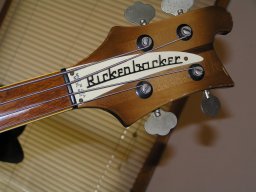
Back in the late '70's I bought a plain maple Mighty Mite fretless neck. No lines, dots, fret markers or anything. I wanted to be able to train my ears and fingers to work together and have flawless intonation. Any sort of guide would be cheating. The idea was that in the event of a poorly lit stage where you couldn't see the neck anyway (much less the position markers), the show must go on and the audience doesn't deserve any excuses as to why you stunk. I achieved enough of that goal to be able to play relatively in tune most of the time, especially in the lower register where the ratio of spot on and Mulligan is at its most forgiving. Teachers that wish to destroy a student's ambition to excel aren't really teachers, but are a hinderance.
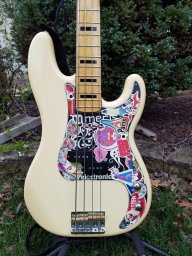
I do find it easier to play chords high on the neck on a lined fingerboard, and I do prefer the aesthetics of an unlined board, but otherwise I just don't care.
I agree with this whole heartedly. Playing unlined is fine and dandy, but playing up the neck and playing chords are much easier IMO with lines. As someone who doesnt play fretless exclusively, I'll take whatever makes playing easier, and thus more enjoyable, every day.
This certainly would have not sounded the same without lines. Even Willis would admit that. Unlined basses are alright, as long as you stay below the 12th fret... The human ear is not very efficient at all at lower frequencies, you can get away with ropey intonation down low, but not at the upper scale of the board. It will all become apparent.
Oh, you'd better believe I ordered my new bass with Luminlay side-dots. They might "only" be ranging marks, but I ain't that kind of wizard.The idea was that in the event of a poorly lit stage where you couldn't see the neck anyway (much less the position markers)

I think you made the right decision Cheese, you already have a killer fretless.
Thanks.
It's true 100% of the time. The pics you posted were not of any double/upright/standup bass.
No lines. Never. You got the side dots anyways, innit?
I will have to search harder, but I have seen lined uprights. I have seen uprights with dots. I have even seen one with frets.They are not common, but they exist.
My fretless is converted from fretted, and the slots are filled with epoxy and wood from sanding the fingerboard, so they match the wood about as much as it's possible to. Lines are still visible when you're up close in a reasonably-lit space.For fretless conversions (removing frets from fretted basses), is it possible to go unlined by covering up the old lines?
This is fine with me since the front and side dots are offset for a fretted bass anyway.
Recently I've been practicing while reading stuff on the computer (like talkbass) to distract my eyes from the fingerboard. My intonation isn't getting better but I guess what's significant is that it isn't getting worse either.
Oh geez, here we go again. If you want to play in tune right away, get a lined, if “more or less in tune” is good enough, get an unlined. It’s no more or less a “crutch” than position markers of any kind. Eventually you may not need to look at the board, but a lot of monster fretless players (Mark Egan and that Jaco guy, to name two) play(ed) lined fretless, and demonstrably looked at the board while playing, using the lines as “targets” for big position jumps and double stops. Most classical instruments are unlined because the players can’t look at the neck while reading sheet music. Most electric players are not sight reading sheet music during performance, so are free to look at whatever helps them play better. If any of the unlined snobs would care to demonstrate how they can play this guy under the table, please post video of you playing
Quiz: where are Jaco’s eyes looking for most of this video?
Quiz: where are Jaco’s eyes looking for most of this video?
Try spending some time above the 12th Cheese. You'll find out.
I do play above the 12 fret, but not so much in videos.
If you want to play in tune right away, get a lined, if “more or less in tune” is good enough, get an unlined.
Good luck with that. Lined or not, you'll probably not be in tune without allot of practice.
Just because Jaco (Gary Willis, etc. on and on) had lines on his fretless doesn't mean that everyone needs them, anymore than having lines on a fretless means that a person will be able to play as well as Jaco because they have them. It's a stupid argument. There are plenty of very talented fretless players who don't have lined boards.
That isn’t my experience at all, particularly, as others have said, in the upper registers. My fretless is intonated such that having my finger just behind the lines gets me as close to dead on intonation as I’m capable of. There is a reason most upright players always sound just slightly out of tune, all the time: Because they are. which is why Leo Fender invented the “Precision” bass. It’s an aesthetic choice with consequences for playing in tune. With a lot of practice, you eventually don’t need to look at the board, at which point the absence or presence of lines is irrelevant, but it’s ridiculous to argue that lines aren’t a HUGE leg up to accurate intonation when learning to play a fretless, or, as is true for many fretless players, it’s not your primary instrument.
I do play above the 12 fret, but not so much in videos.
You know why that is Cheese. It's the scary end of a fretless. I'm waiting for someone to come up with a reason why it would be an advantage to play an unlined fretless. What possible benefit would removing a visual aid to intonation provide?


