• TalkBass has been independent since 1998. Add your voice.
    Create a free account to reply to discussions, view embedded media, and browse with fewer display ads.
    Join freeLog in
    Want zero display ads or expanded classifieds tools? Compare plans.

Upgrading Markbass Rig

If you're already using a 4 ohm cab then going to a 410 at 4 ohms is only moving more air. Going to a 410 at 8 ohms is losing a bunch of power.

The answer is to upgrade your head. I run an Ashdown ABM 500 rated at 575 watts into an 8 ohm 210 and it absolutely crushed while having a TON of headroom.

That's the whole idea. To make sound you have to move air.

Moving up to a 4 ohm 4X10 achieves the same thing as doubling your wattage.

An 8 ohm 4X10 will be still be louder then the 4 ohm 2X10 - even with the decrease in power.
 
For me, the best 212 cab is made by TecAmp. Most places that I've played are smaller rooms and when I used anything bigger than my TecAmp 212, I would have to deal with boominess. The TecAmp cab produces no boominess in rooms and they sound great, and a fat bottom. There rated at 600 watts at 4 ohms or 8 ohms. The Markbass 212's are similar: rear ported, but slightly smaller. For me, the TecAmp is slightly larger which gives it an advantage. Not too small, and not too big. BTW, it weighs about 5 lbs more than the Markbass 212 since they started using ceramic speakers. I don't like to deal with more than one cab because I feel if you stack a cab on top of another, the top one is just not going to operate as good as the bottom cab. Believe it or not people, a cab sounds better on the floor and any cab that's off the floor does not have the natural baffle reflection, and has to work harder. One cab with 2 speakers seems to not have that problem. Obviously you can have 2 cabs on the floor but I never have enough room on the stage for that. The TecAmp cabs are usually bought direct from them so they're a little less money than the Markbass. Would like to try the Markbass but I'm pretty happy with my TecAmp S 212.
 
I feel if you stack a cab on top of another, the top one is just not going to operate as good as the bottom cab. Believe it or not people, a cab sounds better on the floor and any cab that's off the floor does not have the natural baffle reflection, and has to work harder. One cab with 2 speakers seems to not have that problem. Obviously you can have 2 cabs on the floor but I never have enough room on the stage for that.

False

You WANT a vertical stack, NOT side by side.
 
That would work... but it's a complete rethink of the OP's rig... and money as you say.

Meanwhile, back in the real world ;)

There are entry level gear and working musician's gear. And no insult intended towards the op, but he has entry level gear and didn't know enough technical information to be able to make good decisions when assembling his rig. So he came to tb to learn that information so he can make better decisions going forward! Good for him. Meanwhile back in the real world, the gear he has is no longer going to get the job he needs it to done. He has to rethink and redo his entire rig, and imho, there is no better place than scouring his local used sites and reporting back to see if he has found something that will work in the world of cabs and in the tb classifieds to find a good deal on a head that is going to searve him well for many years to come. Cheers.
 
I see a lot of posts here about air movement and wattage with impedance; but not much on flavor. The size of the driver has more to do with the speed and character of the tone than volume.

The first step is deciding if you like the tone of the 10s. 12s have more low end projection, 15s even more so. The downside to that is there is less articulation on the wavelengths. Not good or bad, just different.

Then see about how much air needs to be moved. 300w to 410s should be enough in 90% of any venue.

Adding a cab to your rig fixes the resistance issue, but opens the potential for phasing.

Because you have a mark bass head, why not bring it in a shop and see that flavor does it for you, then see what a 4 ohm version will set you back.
 
There are entry level gear and working musician's gear. And no insult intended towards the op, but he has entry level gear and didn't know enough technical information to be able to make good decisions when assembling his rig. So he came to tb to learn that information so he can make better decisions going forward! Good for him. Meanwhile back in the real world, the gear he has is no longer going to get the job he needs it to done. He has to rethink and redo his entire rig, and imho, there is no better place than scouring his local used sites and reporting back to see if he has found something that will work in the world of cabs and in the tb classifieds to find a good deal on a head that is going to searve him well for many years to come. Cheers.

No offense taken but this rig is not my first. I bought a 4 ohm 210 initially to use with my SVT-CL at rehearsal because it was easier to haul up and down stairs than my 410hlf. I liked the sound of the cab so much that I figured I would try one of their heads as well. I didn't want to spend a lot on a brand I was unfamiliar with so I bought their cheapest. Entry level be damned, it's a great sounding little amplifier. And, like I said, it gets the job done in the small bars I play and is a hell of a lot easier to haul than any other rig I've had. So now my goal is to take the sound I got and take it up a notch, volume-wise.
 
  • Like
Reactions: mcnach
There are entry level gear and working musician's gear. And no insult intended towards the op, but he has entry level gear and didn't know enough technical information to be able to make good decisions when assembling his rig. So he came to tb to learn that information so he can make better decisions going forward! Good for him. Meanwhile back in the real world, the gear he has is no longer going to get the job he needs it to done. He has to rethink and redo his entire rig, and imho, there is no better place than scouring his local used sites and reporting back to see if he has found something that will work in the world of cabs and in the tb classifieds to find a good deal on a head that is going to searve him well for many years to come. Cheers.


He also was reluctant to spend too much money, so suggesting a whole new rig seems a bit OTT.
As for entry level gear... well, it's perfectly adequate for the job just not loud enough, which an additional speaker can take care of.
I regularly see people being advised that their bass or amp is just not good enough and they need to invest $$$, and I think that is a very wrong attitude. Talkbass, and other forums, focus a hell of a lot on gear, which can be fun... but we often try to solve problems by throwing money at them rather than by educating.
If the OP came here saying he doesn't like his amp's tone or whatever, that's one thing, but he's just mentioning it cannot get enough volume. In my opinion, it is far better to discuss what contributes to volume and what doesn't quite so much. I only say this because I wish I had known these things when I was starting out to buy amps and cabs trying to find what worked for me. I would have not wasted quite so much money as I have. ;)
You are right in that it's probably preferable to have a different rig... but not because it's 'entry level'. Entry level these days is amazing compared to what was available 15-20 years ago, and perfectly gig-ready. The reason I'd personally prefer another rig is because I personally prefer a bit bigger, that's all, to cover all bases. I have more powerful amps and more numerous and capable speakers. But guess what? I could play most gigs I do with the OP's amp and a couple of 210s and I bet I'd be really happy with the result, because it's rare that I need to go 'big'. So, to suggest that the OP needs an entire new rig seems to me, quite frankly, OTT, without knowing the gigs he plays. If hes been managing with a single 210 and the MB250 but finds it's not quite enough... chances are he doesn't need 10 times the volume. That's all.

I would hate to discourage people making them think they cannot get a suitable rig without investing a lot of $$$. A lot of the time, spending more can be fun, but not *necessary* strictly.

And I'll stop now :D In writing my reply sounds a lot more serious than intended ;) I mean, I am serious, but I am not 'speaking' in a serious tone, just disagreeing firmly but friendly with you, that's all :)
 
For years I very much enjoy my Markbass LMIII and Markbass 104 HF. Great, full, loud and powerful sound.
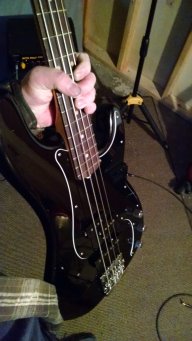
IMG_20160126_133856991.jpg
 
I see a lot of posts here about air movement and wattage with impedance; but not much on flavor. The size of the driver has more to do with the speed and character of the tone than volume.

The first step is deciding if you like the tone of the 10s. 12s have more low end projection, 15s even more so. The downside to that is there is less articulation on the wavelengths. Not good or bad, just different.

Then see about how much air needs to be moved. 300w to 410s should be enough in 90% of any venue.

Adding a cab to your rig fixes the resistance issue, but opens the potential for phasing.

Because you have a mark bass head, why not bring it in a shop and see that flavor does it for you, then see what a 4 ohm version will set you back.

Erm... not really.
The size of the cone has little to do with tone or anything. For any given size of speaker you have a variety of driver designs, and some offer a faster response, some move more air...
I think traditionally the speakers were much more limited and we've ended up associating certain sound with a pair of 15" and another with a 4x10" etc... but cone size is just one of many parameters and not even a highly decisive one. Have a look at Alex Claber's docs on the Barefaced website, pretty interesting.

Adding another identical cab, with the dimensions and positions we're talking (one cab right on top of the other etc) is not going to add any weird phasing issues.
 
He also was reluctant to spend too much money, so suggesting a whole new rig seems a bit OTT.
As for entry level gear... well, it's perfectly adequate for the job just not loud enough, which an additional speaker can take care of.
I regularly see people being advised that their bass or amp is just not good enough and they need to invest $$$, and I think that is a very wrong attitude. Talkbass, and other forums, focus a hell of a lot on gear, which can be fun... but we often try to solve problems by throwing money at them rather than by educating.
If the OP came here saying he doesn't like his amp's tone or whatever, that's one thing, but he's just mentioning it cannot get enough volume. In my opinion, it is far better to discuss what contributes to volume and what doesn't quite so much. I only say this because I wish I had known these things when I was starting out to buy amps and cabs trying to find what worked for me. I would have not wasted quite so much money as I have. ;)
You are right in that it's probably preferable to have a different rig... but not because it's 'entry level'. Entry level these days is amazing compared to what was available 15-20 years ago, and perfectly gig-ready. The reason I'd personally prefer another rig is because I personally prefer a bit bigger, that's all, to cover all bases. I have more powerful amps and more numerous and capable speakers. But guess what? I could play most gigs I do with the OP's amp and a couple of 210s and I bet I'd be really happy with the result, because it's rare that I need to go 'big'. So, to suggest that the OP needs an entire new rig seems to me, quite frankly, OTT, without knowing the gigs he plays. If hes been managing with a single 210 and the MB250 but finds it's not quite enough... chances are he doesn't need 10 times the volume. That's all.

I would hate to discourage people making them think they cannot get a suitable rig without investing a lot of $$$. A lot of the time, spending more can be fun, but not *necessary* strictly.

And I'll stop now :D In writing my reply sounds a lot more serious than intended ;) I mean, I am serious, but I am not 'speaking' in a serious tone, just disagreeing firmly but friendly with you, that's all :)


Had I not just ordered yet another bass I'd be a little less reluctant to spend more. I've been playing for over 20 years and truth be told I love "entry level" gear. I just sold a $2200 bass because I prefer my $300 bass. I think price has little to do with anything (within reason) and people that insist they must play expensive equipment are simply justifying their purchases. I've had cheap basses and amps that rocked and expensive stuff that made me yawn, and vice versa.
 
Had I not just ordered yet another bass I'd be a little less reluctant to spend more. I've been playing for over 20 years and truth be told I love "entry level" gear. I just sold a $2200 bass because I prefer my $300 bass. I think price has little to do with anything (within reason) and people that insist they must play expensive equipment are simply justifying their purchases. I've had cheap basses and amps that rocked and expensive stuff that made me yawn, and vice versa.

Amen brother!
 
Had I not just ordered yet another bass I'd be a little less reluctant to spend more. I've been playing for over 20 years and truth be told I love "entry level" gear. I just sold a $2200 bass because I prefer my $300 bass. I think price has little to do with anything (within reason) and people that insist they must play expensive equipment are simply justifying their purchases. I've had cheap basses and amps that rocked and expensive stuff that made me yawn, and vice versa.

Ain't that the truth?!

I don't mind spending money when I like something, but I don't look at the price tag to decide if something is good enough or not... as a result I have owned Fender, Warwick, MusicMan, Lakland... but my current fretless is an under $100 Precision copy that I customised. When it came to let one of the two fretless Precisions go, the 70s re-issue got the boot :D
That's a bit extreme, as generally the more expensive instruments are nicer... but even the cheaper ones are fine. I'm pretty sure a lot of great music was made in the 60s-70s with instruments and amps we'd now laugh at. These are good times for music equipment!
 
You will lose some power... but the small amount you lose has a small effect compared to what you gain by doubling the speakers, so in practice you still sound a lot louder, even at 8 ohm. It'll sound a *bit* louder at 4ohm but that would require getting two new speakers... and for a small gain, not worth it as I found the hard way over the years.

Remember when people used to gig with 100-200W bass amps? They could do it because they had lots of speakers too.

More speakers trump amplification power every time.

I'd argue that point....somewhat. I play a 575 watt head through a 210 4 ohm cab and it completely destroys my buddies 300 watt head going through an 8 ohm 410.
 
Sound is measured in dB.
To get to dB:
dBm = 10 * (log ( P))

dB = log (P1/P2)

where P = Power (in W for example)

Also note that dB is purely a ratio, and dBm (read mili decibel) has a unit value.

Now. If we have a 100W amp, and a 10W amp, we'll get values of {10[log(100W)]=20, and 10[log(10W)]=10, and 10[log(50W)] = 16.9897}.
this is why a 100W amp is NOT twice as loud as a 50W amp, but IS twice as loud as a 10W head.

Now, why is a tube amp louder than a solid state? Well it's not.
BUT
Where the difference lies is in the harmonics.
Solid state amps are near enough mathimatical perfection. they drive that signal, and they drive it well. But tube amps are not so perfect, and as such they deliver more harmonics with the final signal.
Now these are likely 3rd, 5th, 7th harmonics at low levels (low dB as compared to original signal) and probably some of the even harmonics as well...
Whilst this doesn't audibly change the volume, it DOES create more sound waves, that reach your ear. More sound waves, is more pressure, is more relative dB pressure as compared to that single wave driven by those transistors.

When it comes to speakers....there are a few things to consider the first primarily being speaker efficiency. greater speaker efficiency can equate to loudness. Simply adding more speakers will move more air (which is technically not correct it is really increasing air pressure) and will create a fuller sound that may be perceived as loudness however that is rarely the case.
 
Not true.

an 8 ohm speaker will draw 1/2 the power from an amp as a 4 ohm speaker. This does NOT result in half as loud, it results in a 3db drop in volume. This is why a bass amp rated at 500 watts at 4 ohms will put out about 350 watts at 8 Ohms

You are wrong.............

Doubling your speaker area nets a +3db

Same exact thing as doubling your wattage output. Only difference is, when doubling your output, very seldom can your existing speakers handle that increase in power without going into power compression.

In the quest to get louder, increasing your speaker area trumps increasing your power every time.
 
  • Like
Reactions: mcnach
You are wrong.............

Doubling your speaker area nets a +3db

Same exact thing as doubling your wattage output. Only difference is, when doubling your output, very seldom can your existing speakers handle that increase in power without going into power compression.

In the quest to get louder, increasing your speaker area trumps increasing your power every time.

So ohms law is wrong?
 
Thanks for the responses everyone! I am really liking the 212 idea and eventually upgrading to the Lm3 as well. Doing things incrementally helps make spending money on toys easier. I also like the idea of running two Traveler 210's but at $600 a pop this would be the most expensive option.
$350 Avatars are a little heavily built but you can get them under $400 with Faital neo. If you are handy you could diy.
 

Latest posts