• TalkBass has been independent since 1998. Add your voice.
    Create a free account to reply to discussions, view embedded media, and browse with fewer display ads.
    Join freeLog in
    Want zero display ads or expanded classifieds tools? Compare plans.

Double Bass Use of tablets at jams

Speaking of watching everyone in the jam...

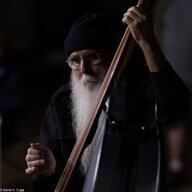
At a jam yesterday the bassist stepped away thinking his bass was safely standing in a corner. I was sitting next to the bass, playing banjo...

1773709891405.jpeg

I never saw what hit me, the scroll and I had a slight disagreement.

Fortunately, the bass hit something soft and suffered no damage. :D

It's a lesson all of us double bass players can benefit from, gravity always wins.
 
Played with the tablet jam again yesterday. Really nice group of folk, and gives me a great opportunity to work on clawhammer. But again, some of the tablet use impressed me as curious.

Like I said, really good group of folk, and my impression is that nearly all of them have some ability. Wasn't looking, but didn't readily spot a single beginner. But nearly all of them wanted to pull up chords for even the simplest, most well-known 1/4/5 song. I mean, they have played "Will the Circle be Unbroken" in G every week I've been there. It surprises me that someone with decent skills, familiarity with the song, and a lengthy history in a casual group would not at least attempt to play the chord changes by ear. Everyone's experience is different, but I wonder that someone could play in such a group for any length of time and not develop at least SOME feeling for chord changes.

Speaking that afternoon with my classical ensemble, the other 3 all thought it entirely normal, saying they found attempting playing by ear was "humiliating." Different folk are free to perceive things differently. But I see a bit of a difference between a fiddle trying to play by ear in a style to which they are unaccustomed, and one of a gaggle of guitars just hammering out cowboy chords. Just seems like such a zero-risk opportunity to try to explore a different aspect of one's playing.

I find myself going THE OTHER way. Played piano as a kid, but on bass, have always played by ear. Now I'm working on my music reading ability in ensemble/community orch.
 
  • Like
Reactions: Don Hergert
... attempting playing by ear was "humiliating." ...
That was the impression I got from my brother (a concert violinist) when he and I tried to play together... And in his case the term "humiliating" would really mean embarrassed that he couldn't improvise, in the same way that I was embarrassed that I couldn't sight read -- we were both embarrassed that we couldn't make music together. But we had both spent most of our adult lives playing the way we had learned to play, one with written music and one by ear, so the difference and difficulty was only natural.

I'm always very impressed with people who both sight read and improvise!

I hope I mentioned it before, but I can certainly get why people might use lyric sheets for occasional reference.

My big concern though, is everyone having full attention on the whole jam or band, not being totally focused on a tab or a music book or sheet. Or worse yet, having a music stand or tab holder in front of them that not only blocks the player's view outward, but also prevents other players from seeing that player. Band or jam, body language is so important.
 
That was the impression I got from my brother (a concert violinist) when he and I tried to play together...
I think fiddle is a tad different from bass, guitar, mando, banjo... Especially if the fiddler is not confident with chopping, or even simply playing long notes. (Curiously enough, this "tablet jam" does not have a single fiddle...)

But for any other "chorded" instrument, it strikes me a curious that a picker would not at least try to develop this ability. They are clearly able to follow songs with multiple minor and 7th chords, often changing rapidly. No criticism of them, but just strikes me as curious that they wouldn't simply say, "I've got this!" for some simpler songs.
 
  • Like
Reactions: Don Hergert
I’m friends with wind player (flute, clarinet , sax) who is a teacher at London Royal College of Music. It’s the sort of thing where he has a few students per year (like 2 or 3).
He is a monster jazz player as well as doing all the classical work.

He says that every single year he has students that cry when they come to him because he asks them to play a simple improvised melody over some simple music/chord changes. Some of them are professional musicians, adults, but they just don’t know what they’re supposed to do or how to hear music without it being written down for them. It’s fascinating.
 
I saw a survey of music students asking what they wished they had learned but hadn't. Two of the main ones were sight reading and playing by ear. Obviously the teachers were not covering every skill, depending on their own knowledge. I try to expose my students to as many aspects of bass playing as I can so that they can minimize those feelings of inadequacy. I don't want anyone coming back and saying, "Why didn't you teach me that?".
 
  • Like
Reactions: Don Hergert
I don't play in an orchestra, but I'd guess that classical musicians are quite capable of reading their sheet music at the same time as looking at the conductor and listening to what's happening around them...

As for jazz jams, I'd rather play from memory if I can, but tunes are bound to be called which I don't know at all or which I've heard but don't know the changes. If I glance at iReal Pro then I can get a head start on following those changes whilst still paying attention to the rest of the band, improvising etc. to an acceptable standard for the context. The rhythm section not knowing a piece is not usually considered grounds for skipping it and we'll move on to another call only if the horn player(s) don't know the head, so I will have to play tunes I don't know. Being able to quickly transpose for a singer is invaluable (but see below).

The OP mentioned "Before each song, there is a clustef__ of people asking to be sent the chords," which is a fair point, I think. In my experience the delays and faff seem to be caused mainly by the following:

1. Difficulty operating the tablets, e.g. "what's 'AirDrop'? Do you mean 'AirPlay'? How should I turn that on?", problems connecting to the network, or emailing charts around, or someone using an Android device when others have iPads (a problem Google has been working on).
2. Singers not knowing what key they prefer to sing in, resulting in much fiddling with transposition to see which key might suit.
3. An obscure call which is not in iReal Pro or whatever real/fake book is present, resulting in hunting for charts on the internet or trying to get the caller to explain.

All three could be ameliorated by preparation before attending the jam.

Delay (3), in my experience, tends to be people attending a jazz jam whose interest is more blues, soul, pop &c. and whose call is not a jazz standard. Unfortunately, they often seem not to know what the form is and struggle to explain it - I have on occasion asked if the blues we're about to play is 8, 12 or 16 bars, for example, and they can't tell me. "You'll work it out, just look at my left hand" is all very well, but it takes a while and meanwhile things won't be sounding great.
 
  • Like
Reactions: AGCurry
The OP mentioned "Before each song, there is a clustef__ of people asking to be sent the chords," which is a fair point, I think. In my experience the delays and faff seem to be caused mainly by the following:
A good part of my sensitivity reflects my personal preference that (most) jams focus on making music. If I just wanna chat with people, I won't have to haul a piece of furniture around with me! ;)

Yeah, inherent in open jams, herding cats and all. But my personal jam preference - which I've encountered mostly at music camps, is for people to:

-be aware that calling songs goes around in a circle;
-pay attention to who the next person in the circle is, and listen for when that person names the tune/key;
-be ready to either call out a tune/key or pass when it is your turn;
-sing and play audibly when you are leading a tune.

Not saying it has to rocket around with zero dead air. But just pay some attention, folks.

Like I said, one reason I enjoy attending a couple of music camps each year is because the generally high caliber of pickers who attend know how to keep a high level jam moving. Even the slow jams at these camps with relative beginners move along, as part of the camps' purpose is teaching folk HOW to jam. Not just what to play, but how to act. If people want to hang out or mess around, they find it no great burden to simply step out of the circle.
 

Latest posts