• TalkBass has been independent since 1998. Add your voice.
    Create a free account to reply to discussions, view embedded media, and browse with fewer display ads.
    Join freeLog in
    Want zero display ads or expanded classifieds tools? Compare plans.

Double Bass Use of tablets at jams

I've hosted an open mic & jam session for the past 15+ years (open format). I've seen big 3-ring binders, single sheet hand-outs, tablets, phones, verbal communication and a lot of reading the back of a guitarist's hand. It really comes down to communication. The latest trend is a keyboard player and a guitarist using Ultimate Guitar Pro to access charts on the fly. They didn't know each other until they met at my event. I see the inherent value in being able to instantly call up a chart to "get on the same page," but I'm old school- and then again whatever it takes to get the job done... with heart or otherwise.
 
My wife and I try to gently influence people to watch, listen and learn songs from what the other people in the jam are doing -- especially including body language -- as this is the essence of a good jam in bluegrass. Bluegrass jams are immersive. People who are staring at either paper music or tablets cannot experience that, and they also cannot learn improvisation.
I would say this is true for almost any type of jam, not just bluegrass.
 
  • Like
Reactions: Don Hergert
Just around the time Covid retired me from gigging on bass I had started working on a book (I'm a history prof) that involved the history of Irish immigration to the US, and Irish folk music, which I'd never especially liked, but I thought I'd need to understand if I was going to write the book. So I started playing conical bore, baroque era wooden flute and going to Irish music sessions. It's a lot easier than lugging a bass and amp up a flight of stairs

Even though it's folk music, the learning curve is the same as for jazz. There's an idiom and a style of playing, and there's a potentially huge and intimidating repertoire, and at first learning the tunes is hard, partly because there are so many variations: which one do you learn? The more you do it the easier it gets, because you build a vocabulary of moves and phrases and because the similarities between tunes that once seemed really different start to show up.

Learning from charts is great and if it gets more people playing that's all good, but if people never let go of reading from charts I feel like they miss the real experience of the music. Even in classical music, where reading in real time is such a central part of the genre, a good soloist is letting go of the score
 
  • Like
Reactions: Miles_ONeal
Your comments are interesting. I had thought of writing here to say that I use a tablet and don't see a problem with it. I certainly prefer to know what the chords are, and since my memory sucks, I feel more at ease when I can refer to a tablet (which I consider a step up from paper, but essentially the same result). However, you point out that lots of people could be using them and not focusing on what's going on around them. This is worth thinking about and also avoiding. So I don't have a solution other than to be the only one using a tablet and just playing with people who know what they're doing! :) Otherwise, it'd be like sitting in a room of people on the cell phones kind of ignoring each other.
 
  • Like
Reactions: Miles_ONeal
I am relatively new to the BG world, and have brought both books and tablets to jams in the past as I was getting familiar with the material.

I spent time with books when I was starting out but since I was rooming with a banjo player at the time most of my learning was oral or by ear. I never used any kind of cheat sheets in sessions or gigs.

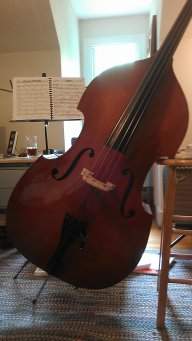
bass.jpeg


fake.jpeg
 
  • Like
Reactions: newfuture
I certainly prefer to know what the chords are, and since my memory sucks, I feel more at ease when I can refer to a tablet (which I consider a step up from paper, but essentially the same result).
Not attacking you, just asking a question - do you use the tablet for the ENTIRETY of EVERY song? Even on a really straight-ahead song with few chords which you've heard several times?

Because that is what I see many people doing. I called Columbus Stockade Blues in C (because the 3d verse is so seasonal right now!), and folk (not all) were scrambling to find it on their tablets.

For some people, I think it turns into a crutch, which they COULD discard or lessen their reliance on, but they are either afraid to or just got a habit ingrained. If you are so uncomfortable that you feel you NEED the tablet on simple songs, you might want to consider if weaning off of it - at least on some songs - would help your development in other areas.

With or without your charts, do you have a sense for where the song is moving? You don't have to play every beat the first time through. Just hitting the 1 on the 1 beat every time it gets to the root chord is fine. Just keep in time playing the 1 beats and listen for when it goes to the 4 and to the 5, and whether there are any "weird" chords in there. Second time thru, play 1-5 when on the root chord, and just try to hit the 4 and 5 chords at the right time. And make a guess at the weird chord. 3d time thru, your rocking and rolling!

(I remember talking to pros about jamming on unfamiliar songs, and they said (paraphrase), "The 1 for the song's chord nearly always works. If you only hit the 1st beat, people will think you are intentionally adding tension, when in fact you are just trying to figure it out!" :D

Pro tip - you'll know you finally got the weird chord and all the changes correct because that's when the leader raises his foot! :D

And are you incapable of leading the simplest song without charts? The first song I ever learned to lead in a jam was Roll In My Sweet Baby's Arms. Not exactly rocket science to master the words and chords of that toughie! If you are staring at your chords, I wager you'll find it challenging to call out breaks, or receive any other feedback from your fellow pickers.

If you are not familiar enough with the standards to "hear/sense" where they are going when, I recommend listening to more music. Get a Flatt and Scruggs collection or any number of other CDs (or however you listen to music) and put it on heavy repeat at home and in your car. It will get to the point where someone calls a song you've never heard before - and definitely never played, but when it starts, you can just sense where it is going. That feeling is SO MUCH COOLER than reading a chart.

All of this is intended as encouragement, not criticism.
 
I've recently encountered this at 2 BG jams, but I'm starting the thread here, as I suspect it may apply to different genres.

I've played at BG/oldtime jams pretty frequently for several years. The standard practice was to pick up the chords by reading a guitatist's hand shapes. Hopefully the leader would say something like, "It is in A - basic 1/4/5, but it hangs on the A and the odd chord is a B minor." At times, someone would bring pages with the words and chords and pass them around.

I recently joined 2 new jams at which the standard is for pickers to use tablets. I had previously encountered tablets maily in classical music settings, as an alternative to wrangling sheet music. I readily acknowledge the benefits tablets can bring, but my impression (after only a few sessions with these groups) is that people tend to be overly focussed on their tablets. Before each song, there is a clustef__ of people asking to be sent the chords. The leaders often do not think to call out the key for those not using chords. Then, as the song progresses, iMO too many people remain focussing on their tablets - instead of looking around at their fellow pickers.

I guess I'm thinking that their is no problem with tablet USE, but my initial impression is that tablet use seems to necessarily result in OVERUSE/ABUSE. And I thought there was some benefit to be derived from "figuring out" the songs organically, rather than simply reading the chords/tab.

Anyone else have experiences/thoughts about the use of tablets in jams?
“Figuring out” a song is analogous to transcription (minus the writing of course). Yes there are significant benefits to that.

But reading? It’s a superior skill. If you can read the music, you can quickly see what’s happening and play it. Figuring out a song becomes more about arrangement than about what chord is what.

I do transcription on my own time. In ensemble settings I expect at least rudimentary reading skill.
 
Not attacking you, just asking a question - do you use the tablet for the ENTIRETY of EVERY song? Even on a really straight-ahead song with few chords which you've heard several times?
...

I agree with everything you said. In jam situations, I usually just play with a more or less vague idea of what's going on without even thinking about using sheets or a tablet. Those are fun jams for me, not always for respecting a song's integrity. Generally, someone announces the key (but not always) and things go from there. In my band, I use a tablet as a crutch and I'm not ashamed to admit it: the responsibility for playing correctly is too great, and other band members often refer to me for chords. But then when I know a song, I don't need to look at the tablet too much once I remember what's going on. Just the fact that it is there is very reassuring.
 
I play with a jazz combo that plays a lot of songs from the Real Book. Do I have a lot of the standards memorized? Yes. Can I use my ears in case I get lost? Often yes. But I don't see the harm in having it out to make sure I don't get lost.

I see a lot of top jazz musicians at a club near me. Some bring sheet music or tablets when they perform. I never see any lack of spontaneity or ability to improvise/solo.
 
  • Like
Reactions: knirirr
In my band, I use a tablet as a crutch and I'm not ashamed to admit it: the responsibility for playing correctly is too great, and other band members often refer to me for chords
Hmm, sort of off topic, but in my bluegrass band, everyone realizes we never play exactly the same way more than once, and we all rely on each other to decide on the details of their own arrangements on the fly. If there's a question about chords we work it out in practice. If we make a mistake on stage we innovate around it so it's not too obvious. There is no exact arrangement detail set in stone, and no one tells anyone else how to do their parts, be it harmony backup or melody breaks. We're constantly watching each other for body language hints and we work pretty efficiently that way...

The only paperwork we have on stage is the set list, usually at our feet, which may have a few very brief lyric hints for the vocalists.

Where this is more on topic is that bluegrass jams are school for people who want to be in a band. So all those band skills mentioned above are at least partially derived from participating in jams.
 
  • Like
Reactions: Miles_ONeal
I was at a BG show locally and knew some of the players. They all just play; no tablets, etc…Afterwards, in the back room they started a jam and asked me to join on a bass that was sitting there. I didn’t know any of the tunes but was familiar enough and enjoy the genre that it came pretty fast and was a lot of fun. In jazz, one the groups I’m in, frequently just start jamming as a warm up to the show. Low key, the piano first, then I just find the key and listen for the form and changes. The drummer as he sets up joins us and the horns will tune off the piece. These are way more fun than our setlist that we play from lead sheets (mine on a tablet). The free jams allow me to explore and really listen to the tune the piano player picks to play. Using the tablet unfortunately makes me dependent on the lead sheets. To be fair, the band leader wants it a certain way and the lead sheets are helpful, but I really like breaking away and letting go during a jam.
 
  • Like
Reactions: Don Hergert
I called Columbus Stockade Blues in C (because the 3d verse is so seasonal right now!),
Little disappointed no one has picked up on this:

Thought I had your love forever
Now I find twas only lent.


I crack myself up!

Saw Showman and Coole the other day (in a 60 seat venue). They didn't even have a setlist. Just looked at each other and one would say, "Let's play..." And then they'd tear it up! What a show!

Several iterations ago our band had a frontman who was tied to his tablet. I always thought it looked so unprofessional for him to have his tablet on a stand right in front. (Hell, if we PLAY poorly, the least we can do is try to LOOK professional!) ;)

The only reasons I bring paper to jams is if it is a jam I've been to several times and have played over and over the 30 or so songs I can sing and play at the same time. Having the words on paper allows me to lead another 30 or so songs.

In case it isn't clear, I have nothing against someone bringing paper or a tablet to a jam. I DO think, however, that too many people grow to rely on it as a crutch. And for those people, it can actually dufus their growth WRT playing in a group.
 
Honestly, I’ve sat in on some bluegrass pub jams that could have benefited from a couple people looking a charts 😆 I’ve also played some klezmer sessions where everyone had the arrangements pulled up on ForScore and were improvising beautifully. Tablet is pretty unobtrusive compared to a music stand and you can turn the pages with a lil foot switch when needed.
For bluegrass specifically, no charts is definitely the norm but I care more about the musicianship than the tools tbh.

Easy to enough to have a room full of players with charts who are listening to each other and improvising beautifully. Also very easy to show up to an open jam with any number of guitar players hammering away at cowboy chords, arriving at the changes a beat late because they are watching somebody else’s left hand, and waiting for their turn to do play a break that doesn’t have much to do with the melody or give anyone a clue about the changes.

Everyone is responsible for keeping time, playing the form, listening well and being sensitive to dynamics. If you can do most of those things most of the time, I’d love to jam with you. Being able to sort it out by ear is definitely preferable but I guess I care more about how it sounds than how we get there.

There is someone near me that started a Jazz Without Charts jam and is developing a pretty great community of folks working together to reach that next level. Maybe there are some BG folks around you that want to level up and are hungry for a jam to help them get there
 
  • Like
Reactions: AGCurry
I play with a jazz combo that plays a lot of songs from the Real Book. Do I have a lot of the standards memorized? Yes. Can I use my ears in case I get lost? Often yes. But I don't see the harm in having it out to make sure I don't get lost.

I see a lot of top jazz musicians at a club near me. Some bring sheet music or tablets when they perform. I never see any lack of spontaneity or ability to improvise/solo.

I think the O.P. is applying this specifically to bluegrass jams.
 
Played in a new jam last night in a violin store after hours. What a hoot! BG and fiddle tunes. Invitation only. Probably maxed out at 12 pickers. More mandos than anything else, never more than 2 guitars at any one time. EVERYONE could play; and I mean RELLY play. Most could play 2 or more instruments. At one point someone counted and around 8 out of 10 pickers were playing instruments they had made - which I thought pretty cool.

I've been jamming BG for some 12 years, and had never heard of at least 50% of the songs. But I had no problem picking up any of the songs except for 2 - 1 was crooked as all heck - took me 2 times through to figure it out. Another was in A, but moved pretty quickly and had a Bm and F#m in places I didn't quite get. One picker passed me his phone which had the chords f- rom Strum Machine I believe. Allowed me to contribute to that song instead of detract.

In case I haven't been clear, I have no objection to an experienced jammer using tablet/paper to remember words or tricky chords. Generally such pickers only need to glance at the source periodically. And I have no objection to a newbie using aids if that is what it takes; but I would urge such newbies to try to get away from their aids - at least on the simplest, most familiar tunes. What shocked me at this one jam was seeing essentially everyone pretty much staring at their phones the entire jam.

And, yeah, I described BG jams. But I'm fine with anyone posting here about tablets in any situation.

Meanwhile, I know where I'll be the 2d Tues of every month! :D
 
I'm OK with reading, but the experience is usually better when people just know the tunes being called. And that means sometimes you will call a tune that someone won't know and need to skip it and try another. So essentially, you should really try to know some tunes before heading to a jam, but reading a chart in a pinch is totally fine just maybe not ideal.