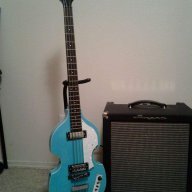
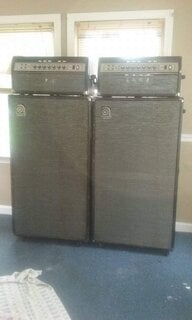
OK, so it's almost sunrise and I am so jazzed about my new rig that I can't calm down! And as a new convert to vertical stacking, I'm going to run off at the keyboard a little. I now believe that just as PA systems have converted to vertical cab stacking, all instrumental amplification systems should convert to vertical stacking as well.
It only makes sense. In the 70's, PA systems were spread out horizontally. The idea was to have a cab pointed at approx. every person in the audience so they could hear equally. It worked, sort of, except for those down in front where there were no speakers. That was one problem. The other problem is that it required giant bass bins with equally giant mid cabs and these gigundus horn tweeters. And of course, the amps to power them. Back then, to fill a 1000 seat club, there would be at least two giant 18" folded horn subwoofers (we called them "sugar scoops"), two big mid cabs with like 4-12"s in each, and two big horns on each side. Not only was it massive, but the people in front of the stage still couldn't hear well, and worst of all, it blocked any side viewing of the band.
Then in the 80's, PA designers got the bright idea to fly the PA over the stage. The cabs were still massive, but at least the subs were on the floor and the mids and tweeters were out of the way. And the audience in front of the stage no longer got shortchanged. Full range speakers also became the rage in clubs. Buy two full range speakers a little bigger than Marshall cabs per side, stack them, and everyone heard much better with less speakerage and amperage. And you could even aim the bottom speakers toward the dance floor and aim the top speakers at the rest of the crowd, and everyone was happy.
Which leads us to today, where in arenas, sub cabs way smaller and more efficient than previous designs line the floor, and a series of small cabs are arranged in "line arrays" at strategic points above the stage. These line arrays are stacked vertically and cover way more people all over the arena, and sound much better than anything previous. The club version is two modern sub cabs on either side of the stage, and two small full-range cabinets on poles or hung from the ceiling. If the club is large, they'll scatter some smaller full-range cabs here and there for better coverage.
And now that I've set up a very small bass rig based on the efficiency of vertical stacking that takes my head off even at low volumes, I don't know why everyone doesn't do it. Once I retired the old SVT and 8-10" 10 years ago (vertical stacking at its finest, BTW), I got a 4-10" cab. The audience heard a great sound from it if I used it without a PA. But unless I stood 15 feet away from it, it blew right past me and never gave me a representation of what the audience was hearing. And as we all know, a lot of times the bassist is stuck in the back of the stage 2 feet away from the amp. Now how are you going to hear what your 4-10" sounds like when you're standing two feet in front of it with your back turned? Sure, put another 4-10" or 2-10" on top of it, but then you're back to SVT-land. Or you can elevate and lose all your lows.
But just like a PA, if you take a nice small sub that's built to sound good stacked vertically as opposed to horizontally, stack your rack or head on top of it, then put a smaller full-range cab like a single 12" or 10" with a tweeter on top of everything, it acts very much like a flown PA and puts your lows on the floor to do their thing while the full-range cab hits you in the head and gives you a much truer representation of the sound your audience hears. Plus your bandmates will hear it as well as that 4-10" they wish you'd turn down (even though you can't hear it, they can because they're farther away than you), and you can control the volume for them much better while still getting your own rocks off.
Even though I know this is old hat to some of you, it's a brand new concept to me, and I could kick myself for not doing it sooner. My new stage rig as of last night is a vintage B-15N speaker, a 4 space rack with a dbx compressor and wirelesses on top of it, and a Markbass 12" combo on top. I had it loud enough to where I thought everyone would complain, but everyone in the band loved it and said how they liked that they could hear it plainly but it didn't overwhelm them like the 4-10". And when I got offstage to yuk it up with the audience, my onstage sound was identical to the PA. It was the absolute best sound I ever had, and I didn't once miss that great feeling of a big 8-10" behind me because I had it once again.
So now I'm going to make it my mission to spread the word to bass cab manufacturers to make cabs designed to be stacked vertically. It could be done with any configuration of speakers you like. Make rectangular 15" cabs with the port designed to stack vertically instead of horizontally. Elevate the top 10" or 12" cab to where it's ear level (for God's sake, don't use a milk crate---be a pro and buy an amp stand if you don't have a rack). Like your 2-10" cab? I'll bet you'll like it more if you stack it vertically. Want a 4-10" cab that does the work of an 8-10" cab and sounds better than a square 4-10"? Build a cabinet with 4-10"s stacked vertically and stick the tweeter on top. Waitasec, that won't fit in a car. OK, so take two 2-10"s and stack them vertically. You'd need some sort of bracing system so they don't topple over accidentally, but I guarantee they'll sound better than any 4-10" square cab. You just have to port them the right way. Or maybe not. People have been stacking cabs the wrong way for their ports for decades.
After going vertical, I can't ever see going back to horizontal, and I can't think of one good reason not to do it. Maybe some of you can, but it would have to be pretty compelling for me to ever switch back. I guarantee you that it's going to be the next big thing in cabinet design, and once it catches on, nobody will be using anything but vertical stacks for all instruments.