

Enjoy the benefits of a premium membership!
Upgrade Account
-
TalkBass has been independent since 1998. Add your voice.
Create a free account to reply to discussions, view embedded media, and browse with fewer display ads.
Join free Log in
Want zero display ads or expanded classifieds tools? Compare plans.
You are using an out of date browser. It may not display this or other websites correctly.
You should upgrade or use an alternative browser.
You should upgrade or use an alternative browser.
Vintage Craftsman Drill Press - Repairable?
- Thread starter Gilmourisgod
- Start date
More options
Who Replied?


Candy apple red with pinstripes! Glitterburst! Glowy Dots! (Yeah, I know, all the restorers try to get them back to boring old factory color paint. Yawn. There must be a place where it needs some abalone shell...)I may eventually do a full restoration.
Practically speaking, it's missing the gooseneck lamp 90% of shop drillpresses had in well-equipped school and college shops, which is a dang useful feature.

Glad you got it (mostly) working. Looking forward to the final result. I do like the candy apple red with racing stripes idea. 
Someone in the OWWM group on Facebook painted the housing of their Craftsman table saw from about this same era in red. It ended up reminding me of an old drug store soda fountain. It was neat.

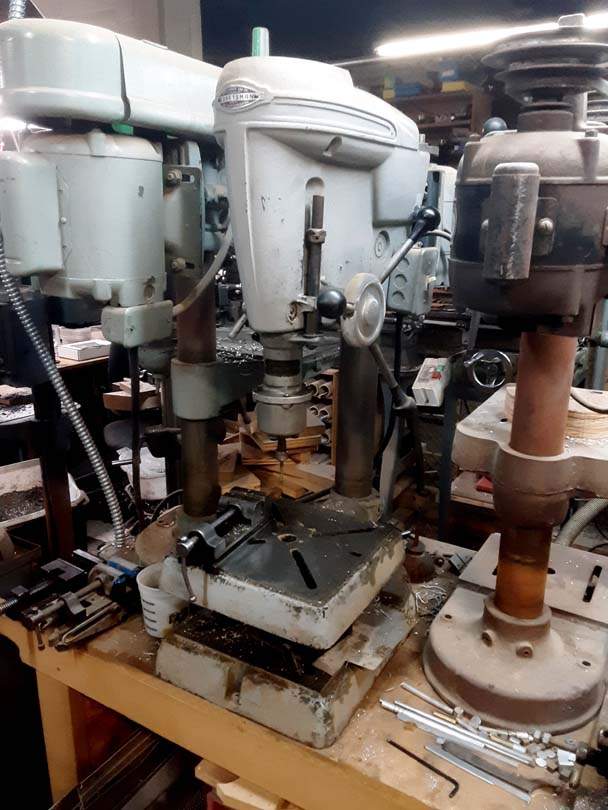
For reference, here's mine. It's the 15" benchtop model like yours, but I think it might be newer? Notice how it has the triple quill handles and the Craftsman name badge is smaller. It's been painted a light pale grey, but it was originally the dark charcoal grey. It's fitted with a Procurnier #1A Tapping Head. I use it for tapping 10-32 holes in many instrument parts. I bought it around 2007 for $110 from Reliable Tools via ebay, just like it is with the tapping head. No time to take it down and restore it. It's a working machine that I use frequently.
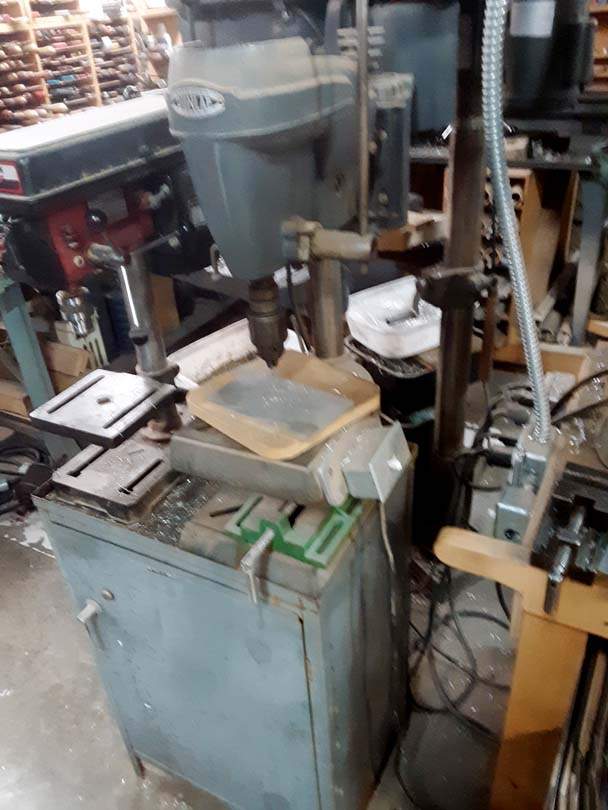
I also have one of the small 7" bench top models, with the Dunlap badge. I also got this one from Reliable Tools via ebay about 15 years ago, for about $50. It has a chunk broken off the side of its table, so I mounted an aluminum plate with the switch there. I keep it set up with a 1/8" spotting drill, just for spotting holes about to be drilled. I use it just about every day. It's in my row of working drill presses.
I also have one of the small 7" bench top models, with the Dunlap badge. I also got this one from Reliable Tools via ebay about 15 years ago, for about $50. It has a chunk broken off the side of its table, so I mounted an aluminum plate with the switch there. I keep it set up with a 1/8" spotting drill, just for spotting holes about to be drilled. I use it just about every day. It's in my row of working drill presses.

"My row of working drillpresses". Life is good.
"My row of working drillpresses". Life is good.
That was almost exactly my thought! I guess that’s one more reason why I hope to someday grow up and be Bruce!


Candy apple red with pinstripes! Glitterburst! Glowy Dots! (Yeah, I know, all the restorers try to get them back to boring old factory color paint. Yawn. There must be a place where it needs some abalone shell...)
Practically speaking, it's missing the gooseneck lamp 90% of shop drillpresses had in well-equipped school and college shops, which is a dang useful feature.
I purchased one of those short goose neck lights with the large plastic spring clamp for my band saw. I removed the plastic spring clip, drilled a hole in the upper housing where the light would be best utilized, and permanently mounted the goose neck through the drilled hole. I liked it so much that I added a second one to the back side of the upper housing to illuminate the other side of the blade. I keep the small "60 watt equivalent" screw in LED bulbs in them. They plug in a small power strip that supplies the power to the band saw, large table router, and smaller trim router in the same table as the big router.
The older I get the more I appreciate good lighting.
I bought a PC router based on reputation alone, and im kind of disappointed it doesnt include a built in led light, like most modern routers. I just assumed it had one. Ive been trying to figure out some kind of simple jury rig, like maybe a small stick-on led "puck". I havent seen the need on the drillpress so far, it has an 8' double tube fluorescent right above it, but i finally fixed the bandsaw light by the simple expedient of removing the years of sawdust packed into the bulb socket. I think it was the original 70's era bulb! So true about lighting in general, the older I get, the more light i need to see detail.
On a weird personal note, we just had an earth tremor, the first I've ever felt on Cape Cod, a minor episode compared to what Californians are used to, but dang, that was weird! Like most people, at first i thought the boiler was exploding.
On a weird personal note, we just had an earth tremor, the first I've ever felt on Cape Cod, a minor episode compared to what Californians are used to, but dang, that was weird! Like most people, at first i thought the boiler was exploding.
One more clueless question on this drill press: the belt has always been set on the lowest two pulleys, though of course the belt has been replaced a few times over the years. Its enough of a PITA to move it that ive never bothered. We use this as a general purpose tool, wood, metal, whatever. Is there an "optimum" speed for general use? Some of the higher end versions of this drill had a cool quick adjust widget to vary speed, but this one requires some tinkering to change.

Good progress on the repair. Most fun I’ve had on TB in awhile!One more clueless question on this drill press: the belt has always been set on the lowest two pulleys, though of course the belt has been replaced a few times over the years. Its enough of a PITA to move it that ive never bothered. We use this as a general purpose tool, wood, metal, whatever. Is there an "optimum" speed for general use? Some of the higher end versions of this drill had a cool quick adjust widget to vary speed, but this one requires some tinkering to change.
I have one of those well loved antiques also. Mine has been on the slowest speed for years. I’ve found very rare need to speed it up. In such instances I use the hand drill
I inherited this from a dear family friends grandfather. It’s built 4 offroad vehicles and 4 racecars. Probably needs some TLC
There is not supposed to be a single universal speed. The correct drill press speed is determined by the material being drilled, the diameter of hole, and the type of bit. Here is a typical chart:One more clueless question on this drill press: the belt has always been set on the lowest two pulleys, though of course the belt has been replaced a few times over the years. Its enough of a PITA to move it that ive never bothered. We use this as a general purpose tool, wood, metal, whatever. Is there an "optimum" speed for general use? Some of the higher end versions of this drill had a cool quick adjust widget to vary speed, but this one requires some tinkering to change.
http://images.meredith.com/wood/images/pdf/speedchart.pdf
"My row of working drillpresses". Life is good.
I have approximately 22 drill presses currently. I count 12 that are fully functional and in regular use. 3 in the woodworking area of the shop and 9 for metalworking. All different sizes and purposes, from little tabletop machines to 1200 lb monsters. Many of them are set up and dedicated to particular operations. The 10 non-functional ones are antiques (1900-1940) that I plan to eventually fully restore.
I believe it would like a new belt.Probably needs some TLC
Drilling speeds:
There are plenty of charts and tables of Recommended Drilling Speeds. Those are really optimal speeds for maximum production rate. I drill at about 1/4 of those speeds, both wood or metal. From many years of drilling holes, I like slow speeds better. I find it easier to control and fewer problems with chips jamming. Most of my drill presses are set at their lowest speeds, and I rarely change them.
There are plenty of charts and tables of Recommended Drilling Speeds. Those are really optimal speeds for maximum production rate. I drill at about 1/4 of those speeds, both wood or metal. From many years of drilling holes, I like slow speeds better. I find it easier to control and fewer problems with chips jamming. Most of my drill presses are set at their lowest speeds, and I rarely change them.
It told me that years ago. I’m a bad ownerI believe it would like a new belt.

As do I. Works well once you have a good feel and watch what you do. Thanks for all your input in this thread, lots of great detailDrilling speeds:
There are plenty of charts and tables of Recommended Drilling Speeds. Those are really optimal speeds for maximum production rate. I drill at about 1/4 of those speeds, both wood or metal. From many years of drilling holes, I like slow speeds better. I find it easier to control and fewer problems with chips jamming. Most of my drill presses are set at their lowest speeds, and I rarely change them.
I bought a PC router based on reputation alone, and im kind of disappointed it doesnt include a built in led light, like most modern routers. I just assumed it had one. Ive been trying to figure out some kind of simple jury rig, like maybe a small stick-on led "puck". I havent seen the need on the drillpress so far, it has an 8' double tube fluorescent right above it, but i finally fixed the bandsaw light by the simple expedient of removing the years of sawdust packed into the bulb socket. I think it was the original 70's era bulb! So true about lighting in general, the older I get, the more light i need to see detail.
I can’t remember if I told this story here, but my mid- to late-60s floor model Craftsman drill press originally belonged to a neighbor down the street when I was a kid. When he was moving my dad bought it from him. Over the years we often had an issue with positioning light where we could see what we were doing. Five years ago, Dad passed, and eventually the drill press made its way to my basement. I downloaded the manual from online, and found a reference to a built-in light. Huh? I ran downstairs, craned my neck around and looked up into the housing, and sure enough, there was a light socket there. Empty. I put a bulb in it, and what do you know, there was light shining on the work area. Dad never knew it was there, and I’m sure the neighbor didn’t, either. After fifty years, I was the first to install a bulb. Dad would have been amused.
On a weird personal note, we just had an earth tremor, the first I've ever felt on Cape Cod, a minor episode compared to what Californians are used to, but dang, that was weird! Like most people, at first i thought the boiler was exploding.
We felt it here on the Connecticut shore. First I wondered if it was a train, but usually the heavy freights go through late at night. Then I wondered if a truck driver ignored the clearance sign again and slammed into the rail overpass. And then, yes, I truly worried my boiler had blown. Had a plumber tell me it desperately needs to be replaced. Now I can’t get him to return phone calls.
Seismic activity takes some getting used to, I guess. Its pretty active here on the Pacific rim, but I've never really been cool with it.

fwiw, most of those "speeds & feeds" charts bolted onto machines or found in books are either totally whack or are very conservative and do not take into consideration of how the work piece is fixtured in terms of rigidity and holding power -because they can't. If you delve into machining and specifically HEM further, even the majority of cutting tool manufacturers recommendations are starting points with few manufacturers really dialing it down to a range of a few hundred rpm and sfpm. The orthogonal model of chip production is pretty mature though and drives chip load per tooth fairly accurately.
For wood work i like to be at the point where i'm cutting fibers cleanly but not burning, and not so slow that i'm pushing fibers and tearing rather than cutting -if that makes sense.
For wood work i like to be at the point where i'm cutting fibers cleanly but not burning, and not so slow that i'm pushing fibers and tearing rather than cutting -if that makes sense.
Most of my drill presses are set up to run in the 400-700 rpm range. That's the speed I like for most holes from 0 to 1/2", and Forstner bits up to 1 1/2". My big Royersford 21 is normally set at 170 rpm. I use it for twist drills from 1/2" up to 1 1/2", and big Forstner bits up to 4".
In my milling machines, I've experimented with running drill bits at the high speeds that they show in the charts. Metal parts tightly clamped. I haven't seen the advantage to it. It's not a whole lot faster. It doesn't seem to be smoother or more accurate. And you have to be much more careful not to get the chips jammed up or overheat the work.
In my milling machines, I've experimented with running drill bits at the high speeds that they show in the charts. Metal parts tightly clamped. I haven't seen the advantage to it. It's not a whole lot faster. It doesn't seem to be smoother or more accurate. And you have to be much more careful not to get the chips jammed up or overheat the work.


