• TalkBass has been independent since 1998. Add your voice.
    Create a free account to reply to discussions, view embedded media, and browse with fewer display ads.
    Join freeLog in
    Want zero display ads or expanded classifieds tools? Compare plans.

Vintage vs new.

The old timers remember when we used to laugh at Japanese
products and considered them cheap junk, the same way we think of Chinese products today.

Japan didn't like being laughed at and they proved us wrong.
 
But what about the wood molecules aligning with the ether and sympathetically vibrating with the diatonic scale over 50 years of playing and whatnot? :rolleyes::D

I don't know. The rose colored glasses effect and dwindling accuracy of memory is a very powerful thing for better or worse. One thing's for certain... there is more BS info floating around the net, and thus the world, than ever before.
 
To each his own. Vintage stuff is cool, and there's no substitute for the vibe and the snob appeal. To be honest, I get all that from my 30 year old G&L's, and even some old Foundations. Have no desire for any more old Fenders.

My two cents....

> The new stuff is too consistently good these days...

> The variety is too vast...

> The cost is too affordable...

...to ignore.

These are heady days for bassists! :)
 
Here's where I come down:

I have a 1963 Precision with a 1972 neck; I have owned it since 1967. It's a nice bass, and pleasantly light for a P.

I have about 9 other basses, including three Gretsch basses, two solidbodies and one hollowbody - and all of them sound as good as the P, just different.

New basses sound EVERY BIT as good as the old ones, they just don't have the mystique around them. If you pay the big bucks for a "vintage" bass, you're buying the age and the "mystique", NOT better sound. You can get anything out of a new bass that you can out of an old one with the right strings and good technique.
 
But what about the wood molecules aligning with the ether and sympathetically vibrating with the diatonic scale over 50 years of playing and whatnot? :rolleyes::D

I don't know. The rose colored glasses effect and dwindling accuracy of memory is a very powerful thing for better or worse. One thing's for certain... there is more BS info floating around the net, and thus the world, than ever before.

In general terms,

There's equally as much if not more BS going around with people trying to justify their utter cheapness and jealously of people who have the self discipline and patience to save for professional quality gear.
 
The availability of better woods was more commonplace 50 years ago.

Now those woods are only available at a premium.

According to a Fender Gold Level Certified luthier with decades of experience, the neck blanks were allowed to sit, so that any showing signs of twisting, warping, bending, were pulled from stock.

Fender was in the business of using the least expensive material that would work. Using "old growth" maple is absurd. The neck blanks were nothing special. As far as ageing goes, no one now or then used green wood to make guitar necks. If they let neck blanks sit, it wouldn't have been very long, so what's the big deal? You seem to think that Fender necks then were more stable than they are now. I've never known Fender to have an issue with warped necks in the entire history of the company.
 
Fender was in the business of using the least expensive material that would work. Using "old growth" maple is absurd. The neck blanks were nothing special. As far as ageing goes, no one now or then used green wood to make guitar necks. If they let neck blanks sit, it wouldn't have been very long, so what's the big deal? You seem to think that Fender necks then were more stable than they are now. I've never known Fender to have an issue with warped necks in the entire history of the company.

You've never seen a twisted maple neck?
Or a neck that actually needs to be replaced due to rippling?
You've never seen a Fender neck that needs to be shimmed?

You must lead a very sheltered life.
 
The availability of better woods was more commonplace 50 years ago.

Now those woods are only available at a premium.

According to a Fender Gold Level Certified luthier with decades of experience, the neck blanks were allowed to sit, so that any showing signs of twisting, warping, bending, were pulled from stock.

Not buying it since I've seen quite a few twisted and warped vintage Fender bass necks as well as guitar necks, so that appears to be more fanciful thinking. The necks were made from slab cut planks of maple, all anyone has to do is look at one to see that.
 
I still buy Vinyl for comparable reasons but would never assert that it sounds better than digital (it doesn't).

Dirk


If you listen to the vinyl copy of an album that was released say in 1970 and compare it to the cd/digital copy, the vinyl copy has a far superior sound quality. The reason is mostly because of the mastering process of the recording. That album from 1970 was mastered specifically for the medium of vinyl. The transference to digital was usually carried out without this in consideration and that's why it sounds lifeless in comparison.
 
I don't get why so many in Talkbass get such joy out of raining on other people's parades. I don't have any vintage basses and don't want any, but if someone else wants one and thinks it sounds better, it's no skin off my butt. I think it's great when someone finds an instrument they really love, whether its a vintage fender or Craigslist bargain.
 
Is relic'ed the same than vintage?

Vintage is a wide term. A vintage guitar specialist told me that if I wanted a vintage instrument I should look at played (well worn out) instrument not a mint one. I was a bit surprised by his comment but after playing some mint 60's basses and some well worn out basses from the same era, I started understanding what he meant. The vintage mint basses did feel and sounded like new instruments to me.

Now when I play relic'ed instruments, Nash in particular, I kind of get a composite image. The instrument feels like a worn out instrument in my hands but it overall feels like a new bass. Is it my mind playing tricks on me since I know it's a relic'ed instrument? I don't know. It would be interesting to do that sort of test blind.

As JimmyM noted, I have also observed that when you use the same pickup on two different basses, they sound the same or very close. I did the experiment with SD Ant II pickups mounted on an alder body, rosewood neck bass, vintage bridge and a swamp ash body, maple neck high mass bridge bass. My take away was that strings and pickup are responsible for most of the tone of an instrument. I know some people will vehemently disagree with me but these were my findings.

I tend to think that when looking at vintage each instrument is different and is a case of its own. I tried a 60's P bass recently which I thought sounded really good. Then I played a 63 US P Fender reissue which blew the vintage instrument away tone wise.
 
I DID go DI ;)

Using the same pickups, strings, attack, compression or not?
I can see how you still sounded like you without much variation.
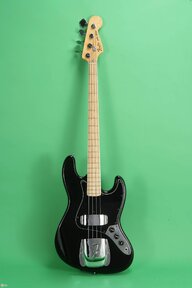
What I found was that most modern pickups that are designated vintage, antiquity etc.
are still much louder than the pickups on my '64 Jazz.

To some that will be a plus, depending on the tone they are going for.
The newer pickups may seem more present, brighter, crisper, punchier etc.
That's not a bad thing, just different.
 
Using the same pickups, strings, attack, compression or not?
I can see how you still sounded like you without much variation.
No compression, only the REDDI, same P pickup (EMG Geezer Butler P...rules hard), brand new sets of the same strings, and I tried to play the same way each time.
 
If you listen to the vinyl copy of an album that was released say in 1970 and compare it to the cd/digital copy, the vinyl copy has a far superior sound quality. The reason is mostly because of the mastering process of the recording.
I can't cite it, but I recall reading an article some time ago suggesting that by the time the music was pressed to vinyl it was 7 generations removed from the master. Without that sharpness, it may have had a warm and mushy sound.

To get this back on topic, I agree that vintage is more about mystique. I'm not convinced that all vintage basses are dogs, but I don't think each one is mind-blowingly special. I have a 1980 Jazz in which the original pickups need a rewind. It sounded terrible when I bought it.