• TalkBass has been independent since 1998. Add your voice.
    Create a free account to reply to discussions, view embedded media, and browse with fewer display ads.
    Join freeLog in
    Want zero display ads or expanded classifieds tools? Compare plans.

Vintage vs new.

So when conducting this discussion you have to realize that not all vintage basses were created equal.

Each instrument is different and should be evaluated on their actual merits, not prejudged to be inherently better simply because they're old. I've played some "vintage" instruments that are real stinkers as well as some that are very good (even my very good Silvertones have their individual quirks).
 
If you listen to the vinyl copy of an album that was released say in 1970 and compare it to the cd/digital copy, the vinyl copy has a far superior sound quality. The reason is mostly because of the mastering process of the recording. That album from 1970 was mastered specifically for the medium of vinyl. The transference to digital was usually carried out without this in consideration and that's why it sounds lifeless in comparison.

I'm aware of this but this has nothing to do with analog vs. digital. What I wanted to say is, why do people always have to rationalise irrational decisions. There's a saying in marketing: most decisions are irrational but afterwards we often put enormous efforts to justify them in a rational way.

I simply buy vinyl because I like it and I like worn in instruments as much as I like new instruments for different reasons. There is no police force around that has declared playing vintage or non-vintage instruments illegal, so who cares?
The resale-value argument is not the argument of a musician. Rather the opposite. It's the argument of a dealer.
And as others have mentioned before: the real vintage instruments (not my '78 Jazz for example) are worth so much that one can not use them anymore.
At least for me basses are something I use and even abuse in a kind way without thinking all the time it could be damaged or be stolen.
BTW the 70' instruments that have survived and stood the test of time are still cheaper used than their "vintage reissue" counterparts.
In Germany a Fender '74 RI is about 2500,- Euros, the used ones in good condition are rather a bit cheaper.

Dirk
 
Very amusing thread ...

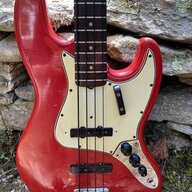
I bought my Jazz Bass strickly as a player.
It's a 1973, weighs 8.5 lbs has a tight neck pocket
and a straight maple neck that has only needed
2 adjustments in the last 5 years. This one has the
black block neck and the folks at Fender graced it
with a nice blue metallic paint job. It sounds plays
and looks great, I paid $850.00 for it so that made
it a rational purchase in my book.

Fender wants 8k for that Geddy thing that is
essentially the same bass and a new MIA is around
1200.00 so keeping what I have and playing it
seems like the best option to me.

Your mileage may vary ...

It's wise to remember, there are those of us who didn't spend
BIG vintage bucks on an instrument made by elves and wizards ...
just a used bass built in a place a place called Fullerton.
 
This explains why my pickups sound different than newer
vintage style pickups, also why I can hear more of the natural woody tone of the bass.

Why do Vintage Fender Pickups Sound so Good?
There are probably a lot of little factors that make the older Fender pickups sound so good. Not a single one of these factors will change the tone significantly. But when all added together, the sum of the parts is better on older vintage Fender pickups. These factors would include:

Magnets: pre-1965 Fender pickups used larger diameter magnets and were sand casted. Also vintage Fender magnets are Alnico and not Ceramic. Finally, as time goes on older magnets lose some of their power. The less power the magnets have, the better the strings can vibrate. Powerful magnets can actually pull the strings towards the pickup, dampering the vibrations. So there needs to be a balance, because you don't want too strong or too weak magnets. So maybe after 30 years, the magnets are at their "ideal" power, thus producing "ideal" tone. Another thing that is different is the "stagger" pattern. That is, the height of the individual magnet pole pieces. For example, today no one uses a wound third (G) string. But prior to Hendrix, most players did. To compensate for this, the fixed magnet heights were different on older Fender pickups.
Windings: handwound pickups (like pre-1965 Fenders) seem to sound better. It's hard to say why, but the scatter-winding pattern and tension at which the wire was wound was apparently ideal on pre-1965 Fender pickups. The handwinding tonal difference may be due to a lack of distributed capacitance when scatter-wound.
Wire Insulation: the insulation on the windings of vintage Fender pickups have different chemical composition than newer wire. Even though the gauge of the actual wire is the same, the thickness and composition of the insulation is different. This changes the total size of the wound windings. This in turn changes the inductance and capacitance of the pickup, and hence the tone. Fender used Formvar insulation till about March 1964. Then they switched to Plain Enamel insulation.
Pots: the older potentiometers used have wider tolerences than newer pots. This may sound dumb, but it could change the tone slightly.
the Guitar itself: older instruments have older and harder finishes. And they also used nitrocellulose finishes that were applied very thin. Also the wood itself is older and different than wood today (less polution back then means "cleaner" wood). This will also effect tone.
Time: even if all the above are paid attention to and duplicated, time is something that just can't be made up for. Maybe they sound better because they are just older...

There lots more here, great reference.

Link Removed
 
I have the 1025X of the BB Yamaha series that this technique addresses (BB2025X). I'm waiting for the 2025 (used) to arrive hopefully this week. I can rent it and compare it directly to the 1025 that doesn't have these treatments. Should be interesting. From Yamaha:

ARE (Acoustic Resonance Enhancement)
This environmentally-friendly non-chemical technique transforms the wood to give a superb sound. Using precise control of temperature, humidity, and pressure, this technology alters the structure of the Yamaha bass' wood at a sub-cellular level, transforming it into the same material as would be founds on an instrument that's been played for many years, into a material that resonates beautifully. ARE technology brings this 5-string bass guitar to life, sounding great from the moment you pick it up.

IRA (Initial Response Acceleration)
IRA is a special process that involves resonating the guitar at a certain frequency when it's finished being built, and it's strung and tuned. It actually has the same physical effect as years of gigging, playing. This corresponds to greater sustain, better high frequency response and, overall, just a more lively, open sound.

Both IRA and ARE technologies are applied to the Yamaha BB2025X bass guitar. With this chemical-free treatment, the bass sounds silky smooth and mature right out of a factory.
 
I have the 1025X of the BB Yamaha series that this technique addresses (BB2025X). I'm waiting for the 2025 (used) to arrive hopefully this week. I can rent it and compare it directly to the 1025 that doesn't have these treatments. Should be interesting. From Yamaha:

ARE (Acoustic Resonance Enhancement)
This environmentally-friendly non-chemical technique transforms the wood to give a superb sound. Using precise control of temperature, humidity, and pressure, this technology alters the structure of the Yamaha bass' wood at a sub-cellular level, transforming it into the same material as would be founds on an instrument that's been played for many years, into a material that resonates beautifully. ARE technology brings this 5-string bass guitar to life, sounding great from the moment you pick it up.

IRA (Initial Response Acceleration)
IRA is a special process that involves resonating the guitar at a certain frequency when it's finished being built, and it's strung and tuned. It actually has the same physical effect as years of gigging, playing. This corresponds to greater sustain, better high frequency response and, overall, just a more lively, open sound.

Both IRA and ARE technologies are applied to the Yamaha BB2025X bass guitar. With this chemical-free treatment, the bass sounds silky smooth and mature right out of a factory.



bridge+for+sale.jpg


:D

Couldn't resist.

Seriously, I'd be interested in the results of the comparison and how you will determine if any differences are due specifically to the treatment or just due to it being a different bass.
 
It's an identical bass as far as design, materials, pups are concerned. Apparently, Yamaha has the data (charts, graphs, etc.) to back it up according to the reviews I've read. Doubt that there will be enough of a difference for me to exchange the 1025 in on it, but I'm keeping an open mind (and maybe wallet) about it. Probably around a $1500 price difference between the 2 new.
 
Why does one, guitar or one amp sound magical and the next, built on the same assembly line, the same batch run, sound like a complete dog?

HUMANS! and Variable Components Tolerances.

Of course, the marketing gurus with tell you that CNC and robotic production is much
more consistant, but humans still inspect them. Humans still determine if they pass QC standards.

You also have to consider the tolerances and quality of 3rd party components.

The first Apple G5 iMacs had more than 11,000 failures due to defective capacitors, that would begin to fail after about 6 months of operation.

Only a few insiders knew what was up and people out of warranty were fuming for good reason.

According to my luthier,

Guitars built at the beginning of the month allowed for a bit more time, a bit more attention to detail, but many of the workers were paid by piece work.
Towards the end of the month, if they wanted to get a decent pay check, they had to reach quota, so the last week of the month saw a lot of rush jobs, trying to get those guitars completed.

This makes sense, this is a logical, qualified explanation why 2 guitars built the same month, the same year can be so totally different.
 
It's an identical bass as far as design, materials, pups are concerned. Apparently, Yamaha has the data (charts, graphs, etc.) to back it up according to the reviews I've read. Doubt that there will be enough of a difference for me to exchange the 1025 in on it, but I'm keeping an open mind (and maybe wallet) about it. Probably around a $1500 price difference between the 2 new.

Yes, but the most essential, primary structural components are made of wood and no two pieces of wood are the same.

A better comparison might be to compare the tone of the same bass before and after treatment.

Looks to me like IRE may be a lot like the old Timbre Tech process.
 
That's true. My main criteria will be which sounds better, and if the treated one sounds better, is it worth the extra $ to keep it. :D

That's the practical reality. If the treated bass sounds better than the one you have then it sounds better. It doesn't really matter why. But if it doesn't meet the expectations of the price premium or for some reason you don't like the treated bass, you can save some cash. :cool:
 
I've never owned a MIM, MIJ, Squire, but I've read many, many posts as to players not finding much of a difference between those and a MIA Fender. I suspect the same will apply here. Aside from the treatments, the only other difference is one's made in Indonesia (like ESPs which are awesome IMO) and the other in Japan.