• TalkBass has been independent since 1998. Add your voice.
    Create a free account to reply to discussions, view embedded media, and browse with fewer display ads.
    Join freeLog in
    Want zero display ads or expanded classifieds tools? Compare plans.

Vintage vs new.

In general terms,

There's equally as much if not more BS going around with people trying to justify their utter cheapness and jealously of people who have the self discipline and patience to save for professional quality gear.

False.

However, BS is BS and I don't think it's worth assigning shades to it. ;)
 
False.

However, BS is BS and I don't think it's worth assigning shades to it. ;)
Well a neck that stays dead straight for the first 10 or 20 years is probably going to stay that way forever.

You don't know that when you buy a new bass or guitar.

I sure didn't know that when I bought my '93 Strat Plus.

I went through a bunch and went with the one that said take me home. I chose Wisely!

Fortunately, 21 years later the neck is still perfect.

Why doesn't everyone just buy a MIM Fender?
If the wood is all the same, cheaper is better right?

There is a difference in the woods, different standards in the selection process.
Closer scrutiny and attention to details.

Why on earth would anyone be foolish enough to spend $5000.00 on a Fender Masterbuilt guitar
when they can buy a Fender logo'd guitar for a few hundred bucks?
 
Well a neck that stays dead straight for the first 10 or 20 years is probably going to stay that way forever.

You don't know that when you buy a new bass or guitar.

I sure didn't know that when I bought my '93 Strat Plus.

I went through a bunch and went with the one that said take me home. I chose Wisely!

Fortunately, 21 years later the neck is still perfect.

21 years? That's nothing...The necks on my early '60s Silvertone dolphin nose basses are still perfect after 50+ years, and their trussrods aren't adjustable. Even the one that had it's frets removed decades ago and didn't have the fret slots filled still plays fine. Must've been a good batch of poplar. :D
 
I don't get why so many in Talkbass get such joy out of raining on other people's parades. I don't have any vintage basses and don't want any, but if someone else wants one and thinks it sounds better, it's no skin off my butt. I think it's great when someone finds an instrument they really love, whether its a vintage fender or Craigslist bargain.

TB is a discussion forum. If you don't want your parade rained on, then it's probably not a good idea to post.


Regardless, I don't see much raining on parades on TB. People who post NBD threads get nice pats on the back. Almost no one says "your bass sucks" in those threads. But if you're going to express your opinion on a subject, expect responses that don't necessarily agree with yours.
 
Well a neck that stays dead straight for the first 10 or 20 years is probably going to stay that way forever.

You don't know that when you buy a new bass or guitar.

I sure didn't know that when I bought my '93 Strat Plus.

I went through a bunch and went with the one that said take me home. I chose Wisely!

Fortunately, 21 years later the neck is still perfect.

Why doesn't everyone just buy a MIM Fender?
If the wood is all the same, cheaper is better right?

There is a difference in the woods, different standards in the selection process.
Closer scrutiny and attention to details.

Why on earth would anyone be foolish enough to spend $5000.00 on a Fender Masterbuilt guitar
when they can buy a Fender logo'd guitar for a few hundred bucks?

Well, sure. Im not an advocate of vintage or new cheap whatever one way or the the other. There is merit to both. That said i have found my new fender with graphite rods in the neck is more stable that any bass i have used without them.

The question then becomes how do those rods and the routes they sit in affect the music i make with the bass? Well it starts with the vibrations transmitted/lost/gained and the upper lower highs and even order middy mid harmonics. Also not being either vintage pre cbs leo loved and master crafted or cheapo new with a slice of jealousy built from a 6 month old chinese forest adjacent to a rare earth metal factory, my tones are more pure as a result. As opposed to slathered in BS sauce. :D
 
One of the reasons you still have that Silvertone is because is has a proven neck.
It's not just because they particularly remarkable instruments,
but because the neck has proven to be stable over a very long time.

For what ever reason, the guitar has stood the test of time.
 
You've never seen a twisted maple neck?
Or a neck that actually needs to be replaced due to rippling?
You've never seen a Fender neck that needs to be shimmed?

You must lead a very sheltered life.

I try very hard to lead a sheltered life.


I've seen Fenders that had neck problems. Relatively few, though. My point is that Fender does not have a chronic problem with twisted/warped necks. Though thinking about it, all those few twisted/warped Fender necks were on vintage instruments. You know, the ones that were built by wizards and elves in the olde times. I don't know if I've ever seen a twisted/warped neck on a Fender built in the last 10 years.
 
You know, this is a very old debate and, I believe, is just a matter of faith - which cannot be settled by rational discourse. If a person wants to think that their 1976 Fender or - this I struggle to believe - their Silvertone is a great instrument, well, who am I to say. That these awful things command irrational prices just makes me shake my head... but no one is forcing me to pay those prices, so I am, in the end, OK. I will say this: Were I teaching again, and newer students were asking me about gear, I'd say "Don't get sucked into the cult of the old and crappy - good is good and bad is bad, no matter what ANYONE tells you or how much they charge".
 
One of the reasons you still have that Silvertone is because is has a proven neck.
It's not just because they particularly remarkable instruments,
but because the neck has proven to be stable over a very long time.

For what ever reason, the guitar has stood the test of time.

All three of mine have as have other's I've owned and seen. For something some consider to be "cheap" to have lasted so long with consistent use, I'd say they are fairly remarkable instruments...at least the ones with the Kluson tuners, the skate key tuners suck.
 
OK ... just so I have this straight "IF" I was a rational thinking person I should dump my 41 year old Jazz Bass and go get a superior new one.

If I owned a 50 year old bass it would be worth so much in terms of resale I am not sure I'd dare take it out the house on a gig for the risk of it being stolen and the cost of insurance, so there might come a point when selling it to a collector or someone willing to take the playing risk and buying something functionally equivalent but cheaper might be a potentially rational decision. It depends on what you play, why, and tolerance to risk. The other option is to just keep the vintage instrument indoors for its appreciation in value.
 
There's frugal, and then there's just plain cheap.

It took me close to 8 months to take my '93 Strat Plus home after putting it on layaway.

Raising 3 kids, dad money was scarce, so I worked some OT and paid it off as soon as I could.

If I was cheap, I would have just kept the Mustang I traded in.
I only paid $75.00 for it.

The girl who sold it to me was evicting her boyfriend :-)
 
I try very hard to lead a sheltered life.


I've seen Fenders that had neck problems. Relatively few, though. My point is that Fender does not have a chronic problem with twisted/warped necks. Though thinking about it, all those few twisted/warped Fender necks were on vintage instruments. You know, the ones that were built by wizards and elves in the olde times. I don't know if I've ever seen a twisted/warped neck on a Fender built in the last 10 years.

There might be multiple factors:

* The instruments with the worst necks probably have them replaced under warranty with better consumer protection these days

* QC might be better now

* It takes time for a neck to get warped

* A vintage instrument with an original warped neck might have been scrapped a few years from its production

* More recently a vintage instrument with a vintage but warped neck might be worth more without it being replaced, so now there is less incentive in the collector market to replace the neck.

So there are competing factors I suspect.

I do know that 25 years ago budget instruments were much less good than they are now, and I've seen budget basses from the 1960s that are probably dangerous to health and although vintage were probably still next to worthless. Someone I know had a vintage 1950s German no-brand Gretsch-a-like that snapped in half.
 
You know, this is a very old debate and, I believe, is just a matter of faith - which cannot be settled by rational discourse. If a person wants to think that their 1976 Fender or - this I struggle to believe - their Silvertone is a great instrument, well, who am I to say.

LOL...I guess I must have the 3 good Silvertones. :eek:

For the last decade or so I've usually used them at home but I took one out to gig last weekend and I got more positive responses on the bass and sound than with any bass I've used recently (except for my DIY washtub) and it was a heck of a lot fun to play it out so I think I may take them out more.

I also have the more recent Danelectro RIs (1st wave) and Jerry Jones versions, but I find them to be very different.
 
I don't know, I love to always say that my '74 Gibson has lots of "soul" from the years of playing.

Truth is that sometimes I just can't stand that bass and the old quirks/defects that are just not problems seen on a new bass.

But I would never get rid of it. And sometimes I would even say it is my favorite sounding bass (most warmth), but that's probably because the strings are so rarely changed on that baby.
 
All three of mine have as have other's I've owned and seen. For something some consider to be "cheap" to have lasted so long with consistent use, I'd say they are fairly remarkable instruments...at least the one's with the Kluson tuners, the skate key tuners suck.


I bought a 60's Sears Gut String Spanish Guitar off my ex-wife's sister for $15.00.
Used it to learn to play guitar, so it already was a value. However, now that the neck needs a reset, I'm not sure I'm going to spend the money to fix it.

The neck is straight, the sound board is well seasoned, but the cost of the repair could exceed the value of the instrument.

If one of your Silvertones needed a neck reset, would you spend $250.00 ++ to have it repaired?
 
I have two data points.

I own a '59 Fender Precision (C-neck, slab RW board). It is THE P-bass. All others are intended to sound like this, it is what defined the instrument (IMO). I also have a US Lakland Duck Dunn P-bass (A-neck, RW board). The DD is a very nice bass (once I replaced the neo pickups that a previous owner had put on with the Aguilar 4P-60, terrific pickup btw). The DD does a great job. But the '59 does have something special. It's subtle but it's there and it's real. How important is it to get EXACTLY that sound. Well, that's subjective. The DD comes very close.

I had Dave Segal make me a 6-string Cremona jazz bass with 60s pup spacing, alder/RW. David really knows the old fenders, and has owned dozens of them over the years. I had read that he encountered a very special '64 jazz which caused him to go back to the woodshed on building basses. It is the instrument that all of his modern vintage jazz basses are modeled after. I visited him in 2011 and played a few of his NYBW instruments as well as half a dozen vintage fenders. Then I asked him: What about the'64? He said: it's right over there. So I plugged it in and on the first note said: Wow! It really was that different. So when conducting this discussion you have to realize that not all vintage basses were created equal. (Some are more equal than others :)) Anyway, I could definitely hear the tonal reference to that bass in his NYBW jazz basses. When my Cremona-6 arrived I could hear it there to. I love that bass, it is awesome. I would be totally happy with a NYBW jazz bass patterned after that reference '64, in any string configuration 4, 5, or 6. I would not feel that I needed the original. The sound is different on my 6, for sure. It is a 35" 6-string after all. But the tone is there and the instrument's build quality goes far beyond what Fender was doing. (3-piece neck, with carbon fiber rods, ...) The NYBW bass is really great. There's a lot of people out there who claim to know the old Fenders. And perhaps some of them do. But David really does, no question about that.

Jim
 
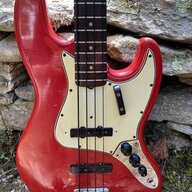
Just learned another little tidbit of information about my '64 Jazz Bass.

1964 Jbass specs:

Pearl fingerboard dots replace "clay" dots, late 1964.
Tortoise plastic three layer pickguard replaces celluloid, late 1964. Note the tortoise part of the pickguard is still celluloid, but the underlying 3 W/B/W layers are no longer celluloid. This is easy to tell; the black layer is MUCH thinner, which can be seen on the beveled pickguard edge.

Link Removed

I was trying to find out how many Jazz Basses were built in 1964, anyone have a reference?

This is Great, regarding why vintage pickups sound so good.

Link Removed

Mine was built May '64.
 
I bought a 60's Sears Gut String Spanish Guitar off my ex-wife's sister for $15.00.
Used it to learn to play guitar, so it already was a value. However, now that the neck needs a reset, I'm not sure I'm going to spend the money to fix it.

The neck is straight, the sound board is well seasoned, but the cost of the repair could exceed the value of the instrument.

If one of your Silvertones needed a neck reset, would you spend $250.00 ++ to have it repaired?

My Silvertones have bolt-on necks. However, I do all my own repairs so I'd reset the neck myself.

Obviously it depends on how much you like the instrument and if you can afford the expense whether you have the work done or not, so what I'd do doesn't matter.