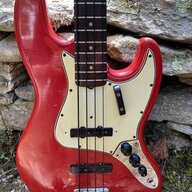
I'd love to believe that I could take a squire and throw some Custom Shop pickups and new strings and call it a pre CBS bass.
If that works for you more power to you.
If that works for you more power to you.

TalkBass has been independent since 1998. Add your voice.
Create a free account to reply to discussions, view embedded media, and browse with fewer display ads.
Join free Log in
Want zero display ads or expanded classifieds tools? Compare plans.

Aside from the treatments, the only other difference is one's made in Indonesia (like ESPs which are awesome IMO) and the other in Japan.


LOL...I guess I must have the 3 good Silvertones.
For the last decade or so I've usually used them at home but I took one out to gig last weekend and I got more positive responses on the bass and sound than with any bass I've used recently (except for my DIY washtub) and it was a heck of a lot fun to play it out so I think I may take them out more.
I also have the more recent Danelectro RIs (1st wave) and Jerry Jones versions, but I find them to be very different.


This explains why my pickups sound different than newer
vintage style pickups, also why I can hear more of the natural woody tone of the bass.
Why do Vintage Fender Pickups Sound so Good?
There are probably a lot of little factors that make the older Fender pickups sound so good. Not a single one of these factors will change the tone significantly. But when all added together, the sum of the parts is better on older vintage Fender pickups. These factors would include:
Magnets: pre-1965 Fender pickups used larger diameter magnets and were sand casted. Also vintage Fender magnets are Alnico and not Ceramic. Finally, as time goes on older magnets lose some of their power. The less power the magnets have, the better the strings can vibrate. Powerful magnets can actually pull the strings towards the pickup, dampering the vibrations. So there needs to be a balance, because you don't want too strong or too weak magnets. So maybe after 30 years, the magnets are at their "ideal" power, thus producing "ideal" tone. Another thing that is different is the "stagger" pattern. That is, the height of the individual magnet pole pieces. For example, today no one uses a wound third (G) string. But prior to Hendrix, most players did. To compensate for this, the fixed magnet heights were different on older Fender pickups.
Windings: handwound pickups (like pre-1965 Fenders) seem to sound better. It's hard to say why, but the scatter-winding pattern and tension at which the wire was wound was apparently ideal on pre-1965 Fender pickups. The handwinding tonal difference may be due to a lack of distributed capacitance when scatter-wound.
Wire Insulation: the insulation on the windings of vintage Fender pickups have different chemical composition than newer wire. Even though the gauge of the actual wire is the same, the thickness and composition of the insulation is different. This changes the total size of the wound windings. This in turn changes the inductance and capacitance of the pickup, and hence the tone. Fender used Formvar insulation till about March 1964. Then they switched to Plain Enamel insulation.
Pots: the older potentiometers used have wider tolerences than newer pots. This may sound dumb, but it could change the tone slightly.
the Guitar itself: older instruments have older and harder finishes. And they also used nitrocellulose finishes that were applied very thin. Also the wood itself is older and different than wood today (less polution back then means "cleaner" wood). This will also effect tone.
Time: even if all the above are paid attention to and duplicated, time is something that just can't be made up for. Maybe they sound better because they are just older...
There lots more here, great reference.
Link Removed


But we now have ways to perfectly cure and dry wood within weeks, and access to infinitely more wood ressources than we did 50 years ago.According to a Fender Gold Level Certified luthier with decades of experience, the neck blanks were allowed to sit, so that any showing signs of twisting, warping, bending, were pulled from stock.

I'd love to believe that I could take a squire and throw some Custom Shop pickups and new strings and call it a pre CBS bass.
If that works for you more power to you.


I wish the concept of "vs" would just go away. Who needs it.
I don't think vintage pickups sound better than newer pickups. That aside, all that ^^ stuff is baseless conjecture. The kind of made up non-science that someone who doesn't understand electronics or metallurgy would come up with.
Some of the real howlers - "hand wound pickups sound better" - "sand cast magnets" - "wire insulation" - and my personal favorite..."The less power the magnets have, the better the strings can vibrate". Comedy gold.

But I own a pre-CBS Precision and I assure you that I have inexpensive basses that sound every bit as good.

I'm going purely by first hand observation - I was there, as an active musician and gear buyer in the late '70s / early '80s and what Fender did during those years (until the mid-'80s turnaround) was just a shame. They sold some of the worst gear I have ever seen, period. Guitars, basses, amps - all of it was just caca. I was (and am) very pleased that they reversed course, but to deny the fact that they had a period where they made bad instruments is just... not true. Yes, I know - in 2014, anything that's 30 years old MUST be "vintage" - well, not all vintages are good. There is a reason that first bass I bought AFTER I had my '77 Jazz bass was NOT a Fender because Fender was stagnant and *bad* at that time. Would I own a 1990 Fender? Sure. I've owned a few mid '90s Fenders - they're fine instruments, for mass produced gear.
As for how an instrument sounds - well, engineers can work miracles, and the ear is very subjective - but I'm really talking about workmanship and how an instrument plays. I feel pretty confident that if I could take a 2014 stock AM std J bass, time travel to 1977 and show it off, it would *blow folks away*.
You are fully entitled to your opinion.
I am also fully entitled to ignore your opinion.