Well, the F# suggests D7 rather than Dm7. Presumably you just made a typo...You can test it out yourself. Either sit at a piano or type in a simple chord progression into iRealPro and play roots on one and then other pitches on beat one. At what point do you no longer recognize the progression? I.e., C^7 Dm7 G7 C^7 play the roots on one: C D G C. Next, substitute: C F# G C.
Then C A B C. C D Db C. G F# F E. They're all plausible possibilities for a bass line but some obscure the progression so much that it's difficult to recognize.

Enjoy the benefits of a premium membership!
Upgrade Account
-
TalkBass has been independent since 1998. Add your voice.
Create a free account to reply to discussions, view embedded media, and browse with fewer display ads.
Join free Log in
Want zero display ads or expanded classifieds tools? Compare plans.
You are using an out of date browser. It may not display this or other websites correctly.
You should upgrade or use an alternative browser.
You should upgrade or use an alternative browser.
Double Bass Voice Leading Practice
- Thread starter attackz
- Start date
More options
Who Replied?
Who you are playing with is to me one of the most important things that determine the sort of bass lines to construct. It makes it so important to listen to what others are playing to determine what they want and need from you as the bassist. How adventurous and free (for lack of a better word) you can be can be very different in different situations with different players. With some you need to really "stay home" and with others you can stretch out. You can't depend on one approach or system. It's one of the things that makes it interesting.

Yeppers, thanks for clarifying that, seriously.Well, the F# suggests D7 rather than Dm7. Presumably you just made a typo...
My $.03 -
NOT always playing the "1" or Root on beat 1, opens up so many doors to Melodic and Harmonically strong basslines.
Note: If you are playing with musicians who can't hear the bassline below as supporting the specified Harmony, then that is THEIR problem, and it is "Ear-Related"...
Note: You need to know/hear NOT just the "4" chord tones, (many closed doors there...), you also need to hear/know the rest of the consonant scale degrees that support each chord of the Harmony - there are usually 7, minimum. (See the use of "9ths" in the example below.)
IMFO, of course.
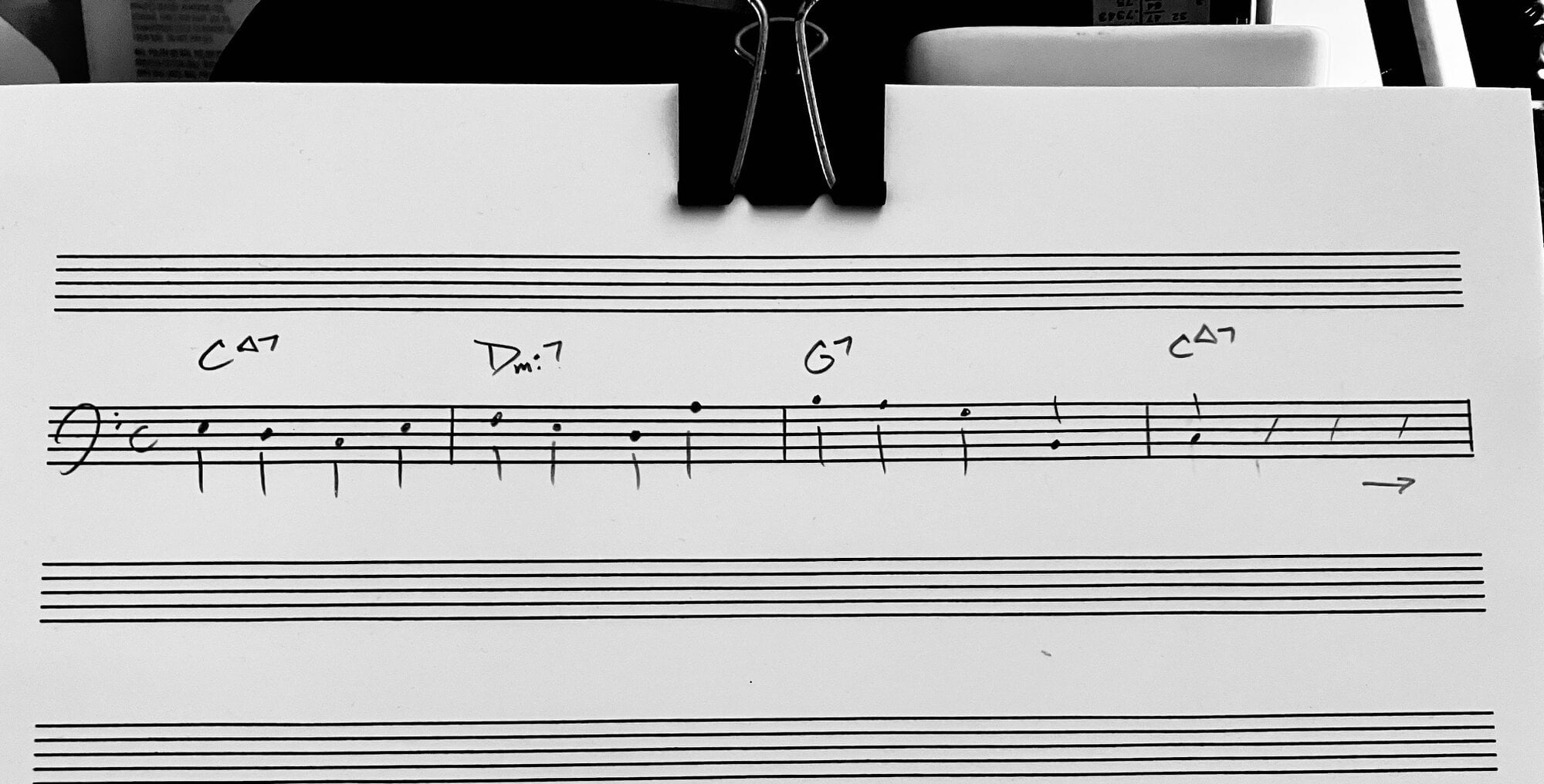
NOT always playing the "1" or Root on beat 1, opens up so many doors to Melodic and Harmonically strong basslines.
Note: If you are playing with musicians who can't hear the bassline below as supporting the specified Harmony, then that is THEIR problem, and it is "Ear-Related"...
Note: You need to know/hear NOT just the "4" chord tones, (many closed doors there...), you also need to hear/know the rest of the consonant scale degrees that support each chord of the Harmony - there are usually 7, minimum. (See the use of "9ths" in the example below.)
IMFO, of course.
Since Papageno pointed out my mistaken inclusion of the F# over the Dm7 chord in my example, I feel that I have to correct that. I was distracted between when I wrote the progression and the bass line notes, and was thinking that the D was a D7, not a Dm7. The same principle still applies but the specifics should change because it would be a rare occasion to play an F# over a Dm7 because it 1) doesn't support the chord or harmony and 2) clashes with an important chord tone. It can and, I'm sure, has been done, but it's probably pretty rare.
Here's what I wrote:
You can test it out yourself. Either sit at a piano or type in a simple chord progression into iRealPro and play roots on one and then other pitches on beat one. At what point do you no longer recognize the progression? I.e., C^7 Dm7 G7 C^7 play the roots on one: C D G C. Next, substitute: C F# G C.
Then C A B C. C D Db C. G F# F E. They're all plausible possibilities for a bass line but some obscure the progression so much that it's difficult to recognize.
Here's a corrected version:
You can test it out yourself. Either sit at a piano or type in a simple chord progression into iRealPro and play roots on one and then other pitches on beat one. At what point do you no longer recognize the progression? I.e., C^7 Dm7 G7 C^7 play the roots on one: C D G C. Next, substitute: C F G C.
Then C A B C. C D Db C. G A F E. They're all plausible possibilities for a bass line but some obscure the progression so much that it's difficult to recognize.
I don't think I've ever heard anyone play that last line over that progression, but it's theoretically feasible and I think it does a good job in making the point because it obscures the progression pretty effectively. I can make it out, but it's not at all obvious and I expect that most beginners would not recognize the progression even if shown how it's related.
Here's what I wrote:
You can test it out yourself. Either sit at a piano or type in a simple chord progression into iRealPro and play roots on one and then other pitches on beat one. At what point do you no longer recognize the progression? I.e., C^7 Dm7 G7 C^7 play the roots on one: C D G C. Next, substitute: C F# G C.
Then C A B C. C D Db C. G F# F E. They're all plausible possibilities for a bass line but some obscure the progression so much that it's difficult to recognize.
Here's a corrected version:
You can test it out yourself. Either sit at a piano or type in a simple chord progression into iRealPro and play roots on one and then other pitches on beat one. At what point do you no longer recognize the progression? I.e., C^7 Dm7 G7 C^7 play the roots on one: C D G C. Next, substitute: C F G C.
Then C A B C. C D Db C. G A F E. They're all plausible possibilities for a bass line but some obscure the progression so much that it's difficult to recognize.
I don't think I've ever heard anyone play that last line over that progression, but it's theoretically feasible and I think it does a good job in making the point because it obscures the progression pretty effectively. I can make it out, but it's not at all obvious and I expect that most beginners would not recognize the progression even if shown how it's related.

I agree 100%.Who you are playing with is to me one of the most important things that determine the sort of bass lines to construct. It makes it so important to listen to what others are playing to determine what they want and need from you as the bassist. How adventurous and free (for lack of a better word) you can be can be very different in different situations with different players. With some you need to really "stay home" and with others you can stretch out. You can't depend on one approach or system. It's one of the things that makes it interesting.
However the OP was asking about an exercise that would be worked on in the practice room, not the bandstand. This exercise has been helpful to me and I believe that it's worth discussing. This and other walking bass focused exercises have helped me to be more prepared to deal with what I'm hearing on the bandstand. For me specifically, when I've encountered a tune, usually something I'm already familiar with but in a less comfortable key and tempo, often with a singer, I'll use this approach for practicing. Say the tune is Almost Like Being In Love in Db. I can play it, survive etc… but I'm stuck… playing mostly the same stuff over and over… I don't have a lot of moves/options. One of the things I would do is go home and PRACTICE. One thing I try is to play the changes step wise in one direction as far as I can go until I need to turn around and proceed in the other direction etc… (all the while walking with good time and sound) This has had the effect of opening up different options. Seeing/hearing different possible moves. It is a means to an end, not an end in itself and can be very helpful. ALSO I recommend trying to play through the changes using ONLY the notes from the triads. These are obviously two separate exercises, but together can present a diligent student with many useful pathways through what may seem at the time to be thorny chord changes. Again, this is NOT for the bandstand. At that point you need to be listening and supporting the sound of the band. If you've done the work you'll have more options open to you.
Something is unclear to me (and reading all replies didn't make it clearer). It seems that OP talks about an exercise regarding soloing rather than bass walking lines. I read
"When you get to the second chord, switch to the closest note in the new related mode and keep ascending"
It seems to me that it never says "chord tone" (even less root). It just seems to me to play a scalar line, and to be able to switch scales wherever you are on your line (chords don't seem to matter here).
So for example, on Stella By Starlight, if my rules are "start with lowest E", and "don't go higher than 1st octave G", I'd play this if I understood OP exercise correctly :
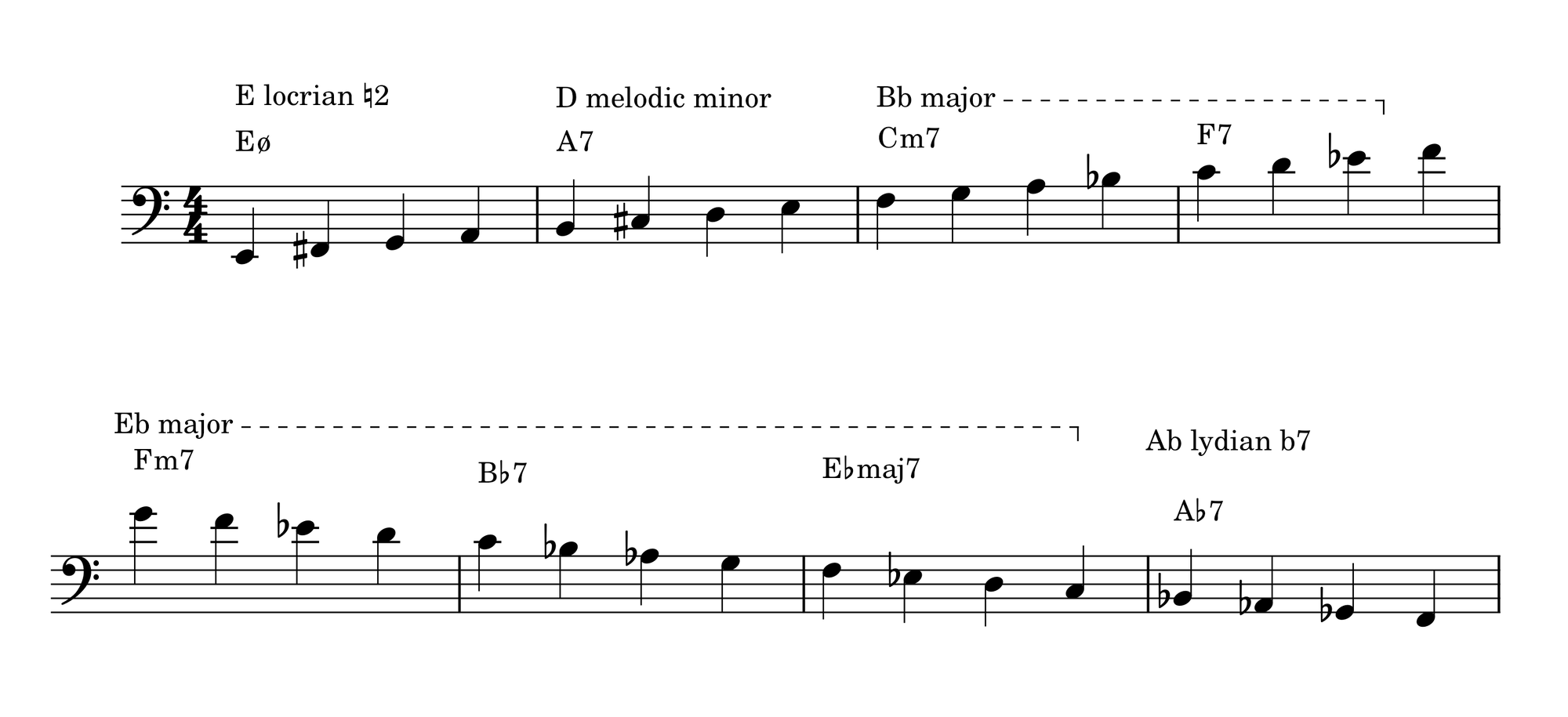
Anyone else see it this way? I'm not sure if that's a really good exercise though
"When you get to the second chord, switch to the closest note in the new related mode and keep ascending"
It seems to me that it never says "chord tone" (even less root). It just seems to me to play a scalar line, and to be able to switch scales wherever you are on your line (chords don't seem to matter here).
So for example, on Stella By Starlight, if my rules are "start with lowest E", and "don't go higher than 1st octave G", I'd play this if I understood OP exercise correctly :
Anyone else see it this way? I'm not sure if that's a really good exercise though
This is great advice. My only concern is that the theoretical doesn't overwhelm the functional. I teach college students privately and have to remind them occasionally that jazz playing is primarily a listening discipline IMO and we always have to keep that in mind. It's easy to get so caught up in the complexities of theory that it becomes the main focus of our playing to the loss of the other important elements. JMOI agree 100%.
However the OP was asking about an exercise that would be worked on in the practice room, not the bandstand. This exercise has been helpful to me and I believe that it's worth discussing. This and other walking bass focused exercises have helped me to be more prepared to deal with what I'm hearing on the bandstand. For me specifically, when I've encountered a tune, usually something I'm already familiar with but in a less comfortable key and tempo, often with a singer, I'll use this approach for practicing. Say the tune is Almost Like Being In Love in Db. I can play it, survive etc… but I'm stuck… playing mostly the same stuff over and over… I don't have a lot of moves/options. One of the things I would do is go home and PRACTICE. One thing I try is to play the changes step wise in one direction as far as I can go until I need to turn around and proceed in the other direction etc… (all the while walking with good time and sound) This has had the effect of opening up different options. Seeing/hearing different possible moves. It is a means to an end, not an end in itself and can be very helpful. ALSO I recommend trying to play through the changes using ONLY the notes from the triads. These are obviously two separate exercises, but together can present a diligent student with many useful pathways through what may seem at the time to be thorny chord changes. Again, this is NOT for the bandstand. At that point you need to be listening and supporting the sound of the band. If you've done the work you'll have more options open to you.

Anyone else see it this way?
Yes. I don't think the OP is clear.
This is well above the level of thinking I normally use. I can see the benefit of knowing this information at the application level. I doubt I ever get there. Hopefully I get the following analysis correct.
In your examples, I don't think you are listing modes consistently.
First two chords Emin7b5 A7b9 for example appear to be ii7b5 V7b9 in D harmonic minor. Keep in mind there are actually two prominent Bbs in the melody, which is my I say D harmonic rather than D melodic.
AFAIK, the related diatonic modes of D harmonic minor are Locrian #6 and Phrygian Dominant. Mind you I don't know this off the top of my head. I referenced my cheat sheet.
Notes overt these two bars would be E,F,G,A,Bb,C#,D,E
I think these notes may be consistent with the intent of the exercise, but don't really see the point. I absolutely would not make these note choices in a walking line at the beginning of the song. However, I could potentially see using them during a solo. Not saying I would, only not completely ruling them out.
An easier way to look at this IMHO, is it's all just ascending D harmonic minor starting from the root of the first chord, which is the 2. You could also recognize the temporary key center is consistent across these two bars and just think of all 8 notes as Locrian #6, which is the second mode of D harmonic minor: E,F,G,A,Bb,C#,D,E Notice this is the same notes as above.
Continuing on to the next two chords Cm7 and F7. These are ii V7 in Bb Major. The diatonic modes are Dorian and Mixolydian. But again it's easier to think of it as Bb Major. The mode that is being played over these two bars is Mixolydian. It starts on the 5 and all notes are diatonic to Bb Major: F,G,A,Bb,C,D,Eb,F
Absolutely. This gets to be a bit "dancing about architecture". What I'm suggesting is fundamentally an exercise in hearing a path through the changes. The parameters are more about pushing the player to solve a problem(s). I remember seeing (college level) students at a jam session. The bass player, reading rhythm changes from his iPhone, was completely hung up. Stuck in one place playing the same garbage over and over. I thought of this then. Take rhythm changes slow (drum genius is great for this) and walk up and down the bass. Take your time and find different pathways though the changes. Where are the resolutions? where are the open strings you can use? It's an exploration not a dogmatic thing. We get into the weeds here talking about chord tones etc… they are not all equal. It depends on the tune, the melody, voicings being played, all that. Anyhoo… I agree, a lot of the theory talk muddies the water.This is great advice. My only concern is that the theoretical doesn't overwhelm the functional. I teach college students privately and have to remind them occasionally that jazz playing is primarily a listening discipline IMO and we always have to keep that in mind. It's easy to get so caught up in the complexities of theory that it becomes the main focus of our playing to the loss of the other important elements. JMO
It shouldn't if it's used properly.I agree, a lot of the theory talk muddies the water.
AFAIK the theory should be used to open your ears and create new pattern and note choice options. When you playing, you should not be primarily focused on theory, although it may cross your mind from time time. Instead, your ears should be calling as many of the shots as possible.
When I learn a song with advanced changes, I might have to work through some or all of it out of tempo. At this stage I am relying more on analysis and theory in order to inform my ear and discover what sort of lines I can build. I might look at one or two changes at a time and try to work out different walking lines. With a bit of study and practice, I can start to play over the changes slowly in time. At this point I start thinking less about the theory and more about internalizing note choices and patterns. After the song is played in sufficiently, I may start hearing note choices that did not occur to me when thinking about the theory.
Later I may revisit that changes and slow down to work out additional lines using alternate scales or some sort of formula for applying chromatic tones or playing outside of the changes. I will say my knowledge of more-advanced jazz approaches is pretty thin, but it is something I explore.
Last edited:
I agree with this. I'm assuming that the OP is a relative beginner, based on his question. It doesn't happen to me much any longer, but there was a period of a year or two when I worked out bass lines out of time to tunes to develop the mechanisms - licks - to get me from chord to chord and I couldn't spell the chords quickly enough to do it in real-time, so slowing things down, even writing the pitches to the chord above the staff, helped me develop those licks. I'd usually try to find a few different ways through the changes, starting with an ascending line and next a descending line, approach notes from above and then approach notes from below the target. Targeting the root and then targeting the fifth, third, or seventh. Eventually, that vocabulary became 2nd nature and I no longer think about them about a stream of notes, more like a "block" that I can use to fill the time. And, as Wasnex wrote, once I was comfortable with the harmony of the tune and no longer thinking about my lines as I played them, I started creating new lines without planning.It shouldn't if it's used properly.
AFAIK the theory should be used to open your ears and create new pattern and note choice options. When you playing, you should not be primarily focused on theory, although it may cross your mind from time time. Instead, your ears should be calling as many of the shots as possible.
When I learn a song with advanced changes, I might have to work through some or all of it out of tempo. At this stage I am relying more on analysis and theory in order inform my ear and discover what sort of lines I can build. I might look at one or two changes at a time and try to work out different walking lines. With a bit of study and practice, I can start to play over the changes slowly in time. At this point I start thinking less about the theory and more about internalizing note choices and patterns. After the song is played in sufficiently, I may start hearing note choices that did not occur to me when thinking about the theory.
Later I may revisit that changes and slow down to work out additional lines using alternate scales or some sort of formula for applying chromatic tones or playing outside of the changes. I will say my knowledge of more-advanced jazz approaches is pretty thin, but it is something I explore.
Another good technique for developing that vocabulary to get from chord to chord is to compose your lines and play them on a piano because both take you away from your limitations and expectations of the bass.

True, but the fact that the question was asked suggests an appropriate level at which to pitch a useful response. YMMVIt seems to me that it never says "chord tone" (even less root).
Well TBH I was just putting an example with scale changed to illustrate what I thought the OP was about, I didn't put much thought into the validity of some scale choices regarding the melody. If it were just Ehalfdim A7 Dm, the scales I put can be good for a solo. It will depends on what the pianist plays, sure if he plays A7b9, then flat B might not be a great choice.This is well above the level of thinking I normally use. I can see the benefit of knowing this information at the application level. I doubt I ever get there. Hopefully I get the following analysis correct.
In your examples, I don't think you are listing modes consistently.
First two chords Emin7b5 A7b9 for example appear to be ii7b5 V7b9 in D harmonic minor. Keep in mind there are actually two prominent Bbs in the melody, which is my I say D harmonic rather than D melodic.
True, but the fact that the question was asked suggests an appropriate level at which to pitch a useful response. YMMV
Oh yes, it makes sense now that you put it this way.
Another good perspective for making note choices is a good understanding of the harmonic landscape of the tune via functional harmony.
Not every chord has the same importance for defining where the melody is going. Some can be ommitted, others substituted.
Eveything makes more sense and becomes more fun the moment when you start to hear the pole positions of I, IV and V and distinguish modulations and cadenzas and all the other elements of harmonic language.
One of the best things for understanding voice leading is to study four part harmony and counterpoint. Anything J. S. Bach is great for this.
Not every chord has the same importance for defining where the melody is going. Some can be ommitted, others substituted.
Eveything makes more sense and becomes more fun the moment when you start to hear the pole positions of I, IV and V and distinguish modulations and cadenzas and all the other elements of harmonic language.
One of the best things for understanding voice leading is to study four part harmony and counterpoint. Anything J. S. Bach is great for this.
Last edited:

My $.03 -
NOT always playing the "1" or Root on beat 1, opens up so many doors to Melodic and Harmonically strong basslines.
Note: If you are playing with musicians who can't hear the bassline below as supporting the specified Harmony, then that is THEIR problem, and it is "Ear-Related"...
Note: You need to know/hear NOT just the "4" chord tones, (many closed doors there...), you also need to hear/know the rest of the consonant scale degrees that support each chord of the Harmony - there are usually 7, minimum. (See the use of "9ths" in the example below.)
IMFO, of course.
View attachment 7332215
I'm stalking you.

Don't you think bar 2, beat 4 would be nicer as a C instead of an A?
-S-
Nicer? Nope...but just as good.Don't you think bar 2, beat 4 would be nicer as a C instead of an A?
IMFO, of course.
Now, go away.

While we're rewriting Don's lines, replace the A with an F and the B on beat one, measure three with a G. More melodic, the 2nd bar follows the pattern created in the first bar, and the third bar starts on the root of the chord. Fixed it for ya!Nicer? Nope...but just as good.
IMFO, of course.
Now, go away.

No good deed goes unpunished.
I was attempting to show how NOT to start each measure on the Root.While we're rewriting Don's lines, replace the A with an F and the B on beat one, measure three with a G. More melodic, the 2nd bar follows the pattern created in the first bar, and the third bar starts on the root of the chord. Fixed it for ya!
No good deed goes unpunished.
Oy Vey, these Monday (Thursday) Morning Quarterbacks.
Thanks(?)
While we're rewriting Don's lines, replace the A with an F and the B on beat one, measure three with a G. More melodic, the 2nd bar follows the pattern created in the first bar, and the third bar starts on the root of the chord. Fixed it for ya!
What Don said.I was attempting to show how NOT to start each measure on the Root.
-S-


