• TalkBass has been independent since 1998. Add your voice.
    Create a free account to reply to discussions, view embedded media, and browse with fewer display ads.
    Join freeLog in
    Want zero display ads or expanded classifieds tools? Compare plans.

Volume Balance on Dual P

poochiecheeks

Supporting Member
Feb 23, 2020
1,059
2,951
Central New Jersey
Hi, I'm having trouble getting good string to string balance on this dual P setup bass. The beauty of a dual P is radiusing the two pickups to the strings. But even with that the treble side of the bridge P has just no output compared to the other 3 coils, even slammed into the string and lowering the others to compensate. Seems like a problem beyond just messing with pickup height.

Is there a good combination of P pickups that could help with this? This bass used to have a Dimarzio Model P in the neck and a Split P in the bridge, but the Split P just completely overpowered it in every way. Nothing but diarreah mids everywhere. Should the two Ps be the same or different? Only going with the Dimarzios now for what this bass would have traditionally, not really a fan of them otherwise.
Thanks
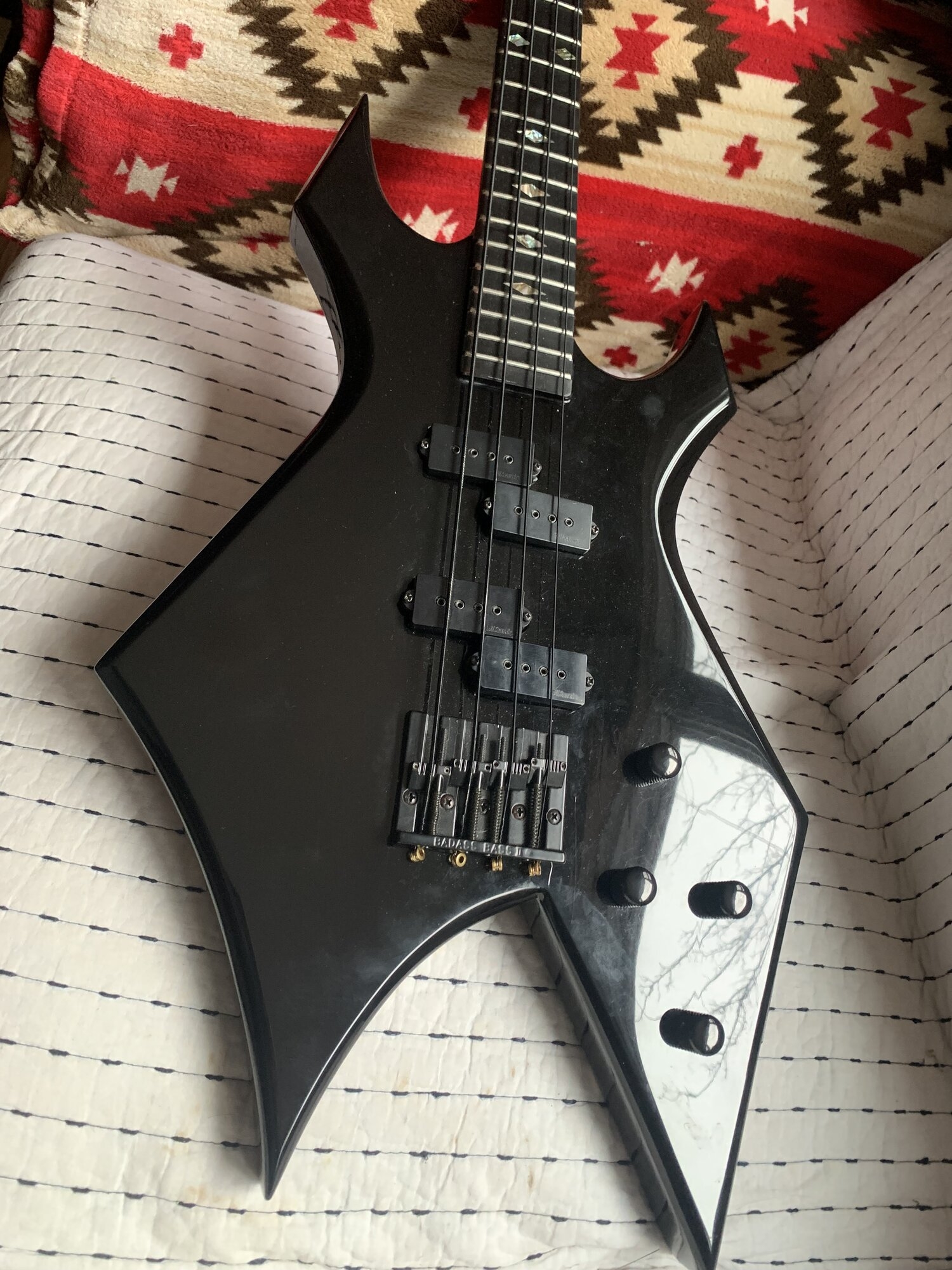
IMG_9619.jpeg
 
That coil is going to be the weakest, given its position. I'd set that one up to get the best sound you can (as close as possible to the strings, but not so close that you start getting artifacts). Note that those pickups all have adjustable polepieces, which makes string to string balancing much easier than just angling the pickup.
Once you get the best you can from that one, I'd simply balance the rest so that they're all even. Those pickups are powerful, so you may need to bring the neck one in particular much lower than you have them already.

A pickup that close to the bridge is always going to be weaker, as it's 'sensing' a bit of the string that moves little compared to somewhere closer to the neck.
 
That coil is going to be the weakest, given its position. I'd set that one up to get the best sound you can (as close as possible to the strings, but not so close that you start getting artifacts). Note that those pickups all have adjustable polepieces, which makes string to string balancing much easier than just angling the pickup.
Once you get the best you can from that one, I'd simply balance the rest so that they're all even. Those pickups are powerful, so you may need to bring the neck one in particular much lower than you have them already.

A pickup that close to the bridge is always going to be weaker, as it's 'sensing' a bit of the string that moves little compared to somewhere closer to the neck.
thanks, im going to try this later. that coil is as close as it can get right now.
Diarrhea mids? That’s a first.
that was the best visual metaphor i could come up with for a split p in that position
 
I have EMGs in my dual P, first Ps, now PAs. No issues with balance with both positions having the same model. Not sure how helpful my experience is though since there is no standard for pickup locations in dual P basses.
 
the treble side of the bridge P has just no output compared to the other 3 coils, even slammed into the string and lowering the others to compensate. Seems like a problem beyond just messing with pickup height.
maybe it is a problem beyond just pickup height? could you have a bad coil? it's an unusual thing but the magnets on the bottom of that coil could conceivably fall off or be oriented wrong, which would allow the other coil that's in series with it to still sound normal while having much less output itself

you can measure the DC resistance of each coil (they should all be about the same) and then use a little metal object like a screwdriver to get a feel for how much magnet pull each coil has
 
  • Like
Reactions: mcnach and WRM
the Split P just completely overpowered it in every way. Nothing but diarreah mids everywhere.
i found the Split P to sound much better when wired parallel! that cleaned it up while still leaving a pretty strong output, it kinda sounds like a good soapbar humbucker at that point

(not sure that would be ideal in a dual-pickup situation, that "series + parallel in parallel" thing can be kind of weird)
 
Reverse P is the solution
Reverse P shifts the problem to the E and A strings. It's not a good solution for many of us.

Placing half a pickup that close to the bridge is the problem. If you never solo the bridge pickup, a double P can be OK, but most are not really ideal. But, there is a way out.....

Here's one of my basses:

Quattro.jpeg
Although it doesn't look it, this is a double P-ish design - internally, both pickups have offset coils ; in this case "reverse P" in orientation. But, there's a few differences. Because the coils are in the same housing, they are much closer to each other - the offset here is half an inch, where a traditional P offsets the coils by a bit over an inch. Also, the pickups are a located bit further from the bridge - the B-E-A coils are where a 70's J would put them, and the D/G coils are further out. Given all that, and the fact that I never solo the bridge pickup (I like my basses to have....bass) This bass does a very respectable 2 pickup "J" sound, and a good solid P sound as well.

Double P's can be good basses, but if you're going to solo the bridge pickup, where the pickup halves are matters - a lot. Close examination of Lee Sklar's double P (a rather successful double P) shows it's pickups are moved out quite a bit further from the bridge than a lot of double P designs. My bass doesn't have them moved out quite as much, but with half the offset, it's also a good bass design as well.
 
  • Like
Reactions: Lo-E
My Warlock had the same issue upon arrival - and was noted in the listing. But it was the neck pickup. Because mine has the "Moser" electronics, each P-bass PU has the toggles for Series/Parallel mode. The neck PU had no discernable output on the D+G block unless the switch was in one of the modes (... I forgot which it was now). In any event, I put in a good Dimarzio P-bass PU, and everything now works properly. Not an increase in power, per se, but switching now works. Yes, I tried a new mini-toggle initially, and that didn't fix it. So it was the PU. I'm keeping the old one - but hard wiring it in the mode which made both of the coils work. It's going into a Squier PJ bass - which will be an improvement, such as it is, over the stock P pickup.

Of course, your scenario does not involve the mini toggle circuitry, changing the modes. But I'm thinking there is a problem with the D+G side of your PU. If you can justify the expense, I would simply replace the PU with a new one. Or perhaps seeing if the wiring from that PU is suspect (loose, etc).

BTW, my bridge PU is almost against the bridge plate. It's not great placement - but it works okay despite the significant lack of string vibration on the D+G. Anyhow, I always run both neck + bridge pickups, so any slight discrepancy is balanced by the other.
 
Last edited:
Could be a bad coil, could be the nature of the beast. That coil being so close to the bridge is not going to have much string energy to generate current, but the good thing is you should be able to get it close to the strings without them hitting the pole pieces.

Good advice above - get that coil as close as you can without getting artifacts, then adjust the other(s) for similar output. "Reverse P" would indeed "shift" the problem to the other coil.
 
I have this same issue with my Goya, same type of double P configuration, same issue, not so much diahrrea mids but having both on full blast can get very boxy as dimarzios are generally wound pretty hot. It's not so much a problem with your bass, but it's an inherent design issue having a P pickup that close to the bridge. Trust me I retuned the bass to BEAD and it just shifted the output problem to the A and D strings sounding slightly uneven!

I'd piggyback on the solution others have offered where you'd want to try to raise the D&G coil and hex poles to compensate, or if you want to go the mod route, you can replace both volumes with push/pull potentiometers for a coil split in each pickup to get a more even response with both pickups in parallel. It is a drop in output, but the mids aren't as overpowering (depening on what pots your bass has you could try changing to 500k pots to add some clarity). My Goya bass has two mini toggles that do so, but if you don't want to drill extra holes in the bass, a push/pull pot for each pickup is the way to go.