Well, I didn't really expect the basic wiring to be too complicated but I'm still not sure exactly what your 50Kohm potmeter does if it doesn't have it's own knob. And for now, all I really want to do is fix or replace the 2 volume pots with a more steady, consistent volume increase/decrease rather than a smooth increase until I get to the last 1/16th of an inch or something, then a quick increase to full volume, which makes it hard to adjust in that range. I have, however, never turned the Phat EQ all the way up so don't know if it responds the same. Do you know if the ones on this bass are log/audio or linear?

Enjoy the benefits of a premium membership!
Upgrade Account
-
TalkBass has been independent since 1998. Add your voice.
Create a free account to reply to discussions, view embedded media, and browse with fewer display ads.
Join free Log in
Want zero display ads or expanded classifieds tools? Compare plans.
You are using an out of date browser. It may not display this or other websites correctly.
You should upgrade or use an alternative browser.
You should upgrade or use an alternative browser.
Volume Knobs have Poor Response on Fender Jazz
- Thread starter catyak
- Start date
More options
Who Replied?
I haven't seen the word 'log' on the potmeters, so I have to assume that they are linear. As the 50 kOhm potmeter is in parallel with the signal, it 'consumes' part of it, leaving a signal level which is more controllable. This 50 kOhm potmeter is adjustable with a small screwdriver. It should be adjusted so that the potmeters on the base give you smooth volume control over their entire range. For me it works very well. The output of both pick-ups is now very proportional to the setting of the knobs. It also makes the effects of my pedal (DigiTech BP 90) much more useful and controllable.

- Aug 21, 2008
- 10,386
- 252
- 68
- Disclosures
- Owner, SGD Music Products
I haven't seen the word 'log' on the potmeters, so I have to assume that they are linear. As the 50 kOhm potmeter is in parallel with the signal, it 'consumes' part of it, leaving a signal level which is more controllable. This 50 kOhm potmeter is adjustable with a small screwdriver. It should be adjusted so that the potmeters on the base give you smooth volume control over their entire range. For me it works very well. The output of both pick-ups is now very proportional to the setting of the knobs. It also makes the effects of my pedal (DigiTech BP 90) much more useful and controllable.
Log is short for logarithmic taper, which is also known as an audio taper pot.
You can't use a 50k pot with a passive bass, as that value is too low. it would loud down the signal and you would have very low volume. 50k is appropriate for the output of an active circuit.
The potentiometer (not potmeter) doesn't consume part of the signal; it's a voltage divider. In the case of a 500k pot, there is always a 500,000 ohm load presented to the pickup when the pot is on ten. In the case of a Jazz bass, as you turn down the signal, a series resistance is introduced, and the parallel resistance is reduced, thus shunting the signal to ground.
Potentiometer - Wikipedia, the free encyclopedia

Jazz basses use audio taper pots. Replacing them with linear taper will help with this issue. Audio taper doesn't work as well for mixing the two pickups.
[Invalid or Expired Link Removed]
+1
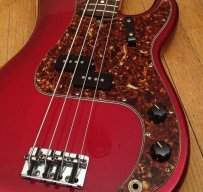
then you need linear volumes, 500k linear would be just right....for now, all I really want to do is fix or replace the 2 volume pots with a more steady, consistent volume increase/decrease rather than a smooth increase until I get to the last 1/16th of an inch or something, then a quick increase to full volume, which makes it hard to adjust in that range.
just get 'em and wire them one at a time exactly how the old ones were and you'll be in good shape.

I have to say that if the sound "jumps" suddenly, then it seems like a bad or dirty pot. Even the wrong taper pot has a ramp - however short.

I have to say that if the sound "jumps" suddenly, then it seems like a bad or dirty pot. Even the wrong taper pot has a ramp - however short.
¿contact cleaner?

There's nothing wrong with it the way it is, once you get used to it, and come to understand that they're really tone controls, more than volume controls.
Log is short for logarithmic taper, which is also known as an audio taper pot.
You can't use a 50k pot with a passive bass, as that value is too low. it would loud down the signal and you would have very low volume. 50k is appropriate for the output of an active circuit.
The potentiometer (not potmeter) doesn't consume part of the signal; it's a voltage divider. In the case of a 500k pot, there is always a 500,000 ohm load presented to the pickup when the pot is on ten. In the case of a Jazz bass, as you turn down the signal, a series resistance is introduced, and the parallel resistance is reduced, thus shunting the signal to ground.
Potentiometer - Wikipedia, the free encyclopedia
I know, but potmeter is being used so often, that it becomes a habit. In this case the potentiometer is really being used as a load, not as a devider, so one connection is not in use. I had to turn it down to some 20 kOhms to make the output signal more controllable. It really sits accross the signal lines, as can be seen from the modded (modified in correct English) drawing. It forces a higher voltage drop accross the volume controls. And, whether you like it or not, there is still a lot of signal available. I also tried the signal directly from the pu's (pick-ups in ...). This was still way to much to drive the pedal and to have the volume respond proportionally to the setting of the controls. By the way: I'm just making fun and not trying to pick on anybody, as we should be helpful and kind to each other. That's the goal of this forum.
"potmeter" isn't use by anybody but you that i've seen 
as for the 50k thing, in the "passive" part of the chain you're sacrificing a lot of tone just to have the other knobs turn up or down the way you like. you'd be better off just getting the other pots to the right values to behave properly.
as for the 50k thing, in the "passive" part of the chain you're sacrificing a lot of tone just to have the other knobs turn up or down the way you like. you'd be better off just getting the other pots to the right values to behave properly.
"potmeter" isn't use by anybody but you that i've seen
as for the 50k thing, in the "passive" part of the chain you're sacrificing a lot of tone just to have the other knobs turn up or down the way you like. you'd be better off just getting the other pots to the right values to behave properly.
It may be used rarely in English, but if you enter potmeter in a search engine, You'll find loads of images of these voltage deviders. Also 'pot' works. But, hey, let's not argue about every word or punctuation mark. There are many more useful subjects to discuss....

- Aug 21, 2008
- 10,386
- 252
- 68
- Disclosures
- Owner, SGD Music Products
i stand corrected! "potmeter" is indeed all over the google.
So is "doodad", but that doesn't mean it's a word!


That has to be some kind of slang, like people calling a grave accent (`) a "back tic".
It's even worse when people use grave and acute (´) accents as quotation marks.

(I'm a graphic artist, so misappropriation of typography is a pet peeve).

Regardless, the proper word is potentiometer. It changes the potential. just because people make up a word doesn't mean it's right.
In Hungarian, we NEVER use the "long" version, it's used only in written language. It's "potmeter' in spoken words, or "poti" which is exactly the same az POT in English, I think. That's Hungarian, I don't know how these work in English
So is "doodad", but that doesn't mean it's a word!
That has to be some kind of slang, like people calling a grave accent (`) a "back tic".
It's even worse when people use grave and acute (´) accents as quotation marks.
(I'm a graphic artist, so misappropriation of typography is a pet peeve).
Regardless, the proper word is potentiometer. It changes the potential. just because people make up a word doesn't mean it's right.
To me, "potmeter" sounds like something some folks don't want the police to have when they pull them over. "License and registration, please. And blow into this . . .")
Also, "pot" is a shorter shortening of potentiometer, and is pretty widely accepted.
FWIW, YMMV, IMO etc
Also, "pot" is a shorter shortening of potentiometer, and is pretty widely accepted.
FWIW, YMMV, IMO etc
- Aug 21, 2008
- 10,386
- 252
- 68
- Disclosures
- Owner, SGD Music Products
Also, "pot" is a shorter shortening of potentiometer, and is pretty widely accepted.
Exactly.
It's pretty amusing how a word can be the cause of so many posts. Should we continue using pups, rounds, flats, amps, cabs and many more of those shortcuts to express ourselves? I would vote in favour for this jargon, as it makes me smile and gives me at least the idea of being a member of the club.


