
Enjoy the benefits of a premium membership!
Upgrade Account
-
TalkBass has been independent since 1998. Add your voice.
Create a free account to reply to discussions, view embedded media, and browse with fewer display ads.
Join free Log in
Want zero display ads or expanded classifieds tools? Compare plans.
You are using an out of date browser. It may not display this or other websites correctly.
You should upgrade or use an alternative browser.
You should upgrade or use an alternative browser.
Warm, and FAT
- Thread starter UncleMeat!
- Start date
More options
Who Replied?
Glad you found that amusing. I aim to entertain.
Niiiice. I think your tone and playing are both excellent !
Thanks man
 Sadly, i've parted ways with that group since i made that post, so no more reggae for me
  (though now i get to work with sober people
  ) Now i have to nail down a soul/rock tone
FamilyMan Barett who used to play with Bob Marley used J-basses with flats if i'm not mistaken.
One of the best reggae tones ever IMO
One of the best reggae tones ever IMO
Eric uses Celinder P basses through an Aguilar DB750/GS412 he also uses an aguilar AG500212 combo for smaller gigs. On Greatest Hits he was using SWR and a Green Custom McDonald bass a la Gibson Ripper
Eric Wilson definately used the Dan McDonald bass on Sublime s/t, but I know for a fact that 40oz. to Freedom and Robbin' the Hood were both recorded with Eric's Fender Jazz Bass, people have probably seen it; It is yellow with stickers all over it. Greatest Hits was in fact on Robbin' the Hood, so if that's the tone you like, you can get it from a Fender Jazz strung with flats.(Eric uses Flats)
Lloyd Parks (Revolutionaries, We The People, etc), Errol 'Bagga' Walker (Studio One, countless sessions, etc) and George 'Fully' Fullwood (Soul Syndicate, etc) are three absolute bass monsters of reggae's golden era who played primarily P basses, and still do sometimes or exclusively.
EQ is very important- at the usually very high SPLs reggae bass is heard at, if there is too much mid content things get really hard and aggressive; not enough, flabby and mushy, especially without all the highs EQ'ed out. It's amazing how huge even ordinarily eq'ed bass is when put through enough speakers with enough power.
I really believe reggae developed the way it did because of the need to make space for the inordinately up front bass- even with a lot of instruments, usually everyone is playing quite little: interlocking phrases, skanking rhythm guitars, short horn accents and phrases, bubbling jerky organ and/or pumping piano, etc, all combining to make a whole. It's magical when it all comes together, sitting on top of unfeasibly powerful and full pure bass.
EQ is very important- at the usually very high SPLs reggae bass is heard at, if there is too much mid content things get really hard and aggressive; not enough, flabby and mushy, especially without all the highs EQ'ed out. It's amazing how huge even ordinarily eq'ed bass is when put through enough speakers with enough power.
I really believe reggae developed the way it did because of the need to make space for the inordinately up front bass- even with a lot of instruments, usually everyone is playing quite little: interlocking phrases, skanking rhythm guitars, short horn accents and phrases, bubbling jerky organ and/or pumping piano, etc, all combining to make a whole. It's magical when it all comes together, sitting on top of unfeasibly powerful and full pure bass.
jazz bass will do,go for neck pick up, do proper EQ setting and get tube amp. flats arent that important IMO. also,one fat machine certainly is TELEBASS !!!
I've been following reggae for years as a fan and author, and the only reggae bassist that I know who used palm muting on a regular basis is Michael Fletcher, who plays for Shaggy and is musical director of his band.
When I interviewed him for our documentary film on dancehall, called Louder Than Words, he showed us his palm muting technique. He felt that is helped him get the tone of Llyod Brevett, the legendary bass player for the Skatalites. He told us he wanted his tone to be "dark and thick".
Norman Stolzoff
Author: Wake the Town and Tell the People: Dancehall Culture in Jamaica
When I interviewed him for our documentary film on dancehall, called Louder Than Words, he showed us his palm muting technique. He felt that is helped him get the tone of Llyod Brevett, the legendary bass player for the Skatalites. He told us he wanted his tone to be "dark and thick".
Norman Stolzoff
Author: Wake the Town and Tell the People: Dancehall Culture in Jamaica
Get a P and install the Billy Sheehan neck pickup right up there. Put on thick string flatwounds, get a big EQ to have better control of those lower frequencies, and get a vintage tube amp going into a 2x18.
Next.
Next.

The best reggae/dub tone I've ever achieved is with my Villex loaded Voodoo Dingwall (tone fully counter-clockwise). Huge, thick tone

The rather forward pickup spacing on my newfound Hondo 870 PJ bass lends itself well to dub and reggae.
This is the most underrated- if at all, bass I've ever played by virtue of its pickup spacing.
Pretty warm- almost sine wave like down low.
The body is even plywood! Heck if Jens Ritter does it, it musn't sound too bad. It is actually very balanced! The resonant peaks of the body's woods are averaged by the multiple plies.
GREAT WORKHORSE! If you see one, get it. Rare.
This is the most underrated- if at all, bass I've ever played by virtue of its pickup spacing.
Pretty warm- almost sine wave like down low.
The body is even plywood! Heck if Jens Ritter does it, it musn't sound too bad. It is actually very balanced! The resonant peaks of the body's woods are averaged by the multiple plies.
GREAT WORKHORSE! If you see one, get it. Rare.

P-Nut from 311 uses Warwicks and he sounds great on all of their reggae/reggae-oriented tracks, not to mention every other one of their songs. I'd venture to guess he also uses his Thumb for those tracks, which actually has no neck pickup, only two that are both closer to the bridge, but who really knows?
Get a P and install the Billy Sheehan neck pickup right up there. Put on thick string flatwounds, get a big EQ to have better control of those lower frequencies, and get a vintage tube amp going into a 2x18.
Next.
+1, This will give you a similar tone to Eric Wilson's custom Dan McDonald Bass, it's the Dark Green heavy bass.
BurningSkies
CRAZY BALDHEAD
- Feb 20, 2005
- 27,956
- 20,348
- Disclosures
- Endorsing artist: Dingwall Guitars
I've been following reggae for years as a fan and author, and the only reggae bassist that I know who used palm muting on a regular basis is Michael Fletcher, who plays for Shaggy and is musical director of his band.
When I interviewed him for our documentary film on dancehall, called Louder Than Words, he showed us his palm muting technique. He felt that is helped him get the tone of Llyod Brevett, the legendary bass player for the Skatalites. He told us he wanted his tone to be "dark and thick".
Norman Stolzoff
Author: Wake the Town and Tell the People: Dancehall Culture in Jamaica
Having played with Lloyd Brevett several times, I've never seen him palm mute either.
While the Jazz is the 'famous' reggae bass, Precisions did see plenty of play, and I used mine as my main bass for quite a few years. The truth is that it's not the bass, but the player. How your fingers address the strings and your technique. I too have had plenty of gigs with the big guys and didn't get any complaints with my P, J, PRS or any other bass. Most of the guys you meet, play with or open for could care less what kind of bass you play as long as you play well.

I've actually got a reggae-type gig next weekend; it's a dinner theater with a lot of reggae/island/dancehall tunes.
For gear, I'm running my '95 Warwick F1 5-string (strung with D'Addario NPS) into my GK 800RB and borrowed Carvin cabs (a 4x10 and a 1x18). I'm using a monster cable, and the EQ on the 800RB is mostly flat, but with the bass boosted to about 2 oclock and the mids to 1 oclock. The boost will be around 2 oclock. The EQ on my Warwick will be flat, but I'll vary the treble knob between flat and totally cut for different songs. Pickups will be 50/50.
For technique, I'll be using my normal technique of playing over the neck pickup with my first two fingers and occasionally the side of my thumb for a couple particularly thumpy songs.
For gear, I'm running my '95 Warwick F1 5-string (strung with D'Addario NPS) into my GK 800RB and borrowed Carvin cabs (a 4x10 and a 1x18). I'm using a monster cable, and the EQ on the 800RB is mostly flat, but with the bass boosted to about 2 oclock and the mids to 1 oclock. The boost will be around 2 oclock. The EQ on my Warwick will be flat, but I'll vary the treble knob between flat and totally cut for different songs. Pickups will be 50/50.
For technique, I'll be using my normal technique of playing over the neck pickup with my first two fingers and occasionally the side of my thumb for a couple particularly thumpy songs.

I'll agree that a Jazz bass would be more naturally suited for reggae than a P... the p sound is more in the mids, while the jazz neck pup solo'd has a lot more low end to my ears, and it tends to be "smoother" if that makes sense. However... I think you could EQ pretty much any bass properly (by cutting the treble and a lot of the mids and boosting the lows, i'm no expert so i won't try to give you specific frequencies).
I'll give a +1 to the person who mentioned a Gibson EB-0. The Gibson-style mudbucker pups really lend themselves to this application, even if they're not seen as commonly as Fenders. My Guild JS-2 (Guild's 2 humbucker version of the Gibson EB0/EB3) can nail that sound by soloing the neck pup. In fact, using these kinds of pups doesn't require as much low end boost at the amp. Just a thought.... plus they look cool as all-get-out, and the short-scale is a joy to play once you adjust to the neck dive (suede strap!).
I'll give a +1 to the person who mentioned a Gibson EB-0. The Gibson-style mudbucker pups really lend themselves to this application, even if they're not seen as commonly as Fenders. My Guild JS-2 (Guild's 2 humbucker version of the Gibson EB0/EB3) can nail that sound by soloing the neck pup. In fact, using these kinds of pups doesn't require as much low end boost at the amp. Just a thought.... plus they look cool as all-get-out, and the short-scale is a joy to play once you adjust to the neck dive (suede strap!).
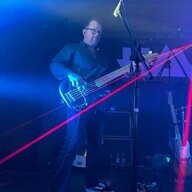
Just a reminder that the OP has already moved on...
...but I'd also suggest a Squier VM Tele bass, or a '72 Fender Tele bass, with the pickup close to the neck. And BIG strings - definitely do not want lights or MLs. And pluck close to the neck or even over the neck as has been stated already.
...but I'd also suggest a Squier VM Tele bass, or a '72 Fender Tele bass, with the pickup close to the neck. And BIG strings - definitely do not want lights or MLs. And pluck close to the neck or even over the neck as has been stated already.


