• TalkBass has been independent since 1998. Add your voice.
    Create a free account to reply to discussions, view embedded media, and browse with fewer display ads.
    Join freeLog in
    Want zero display ads or expanded classifieds tools? Compare plans.

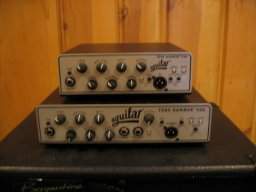
Warwick Micro; 1000 watts 4 ohms!

It's great to see another amp that doesn't have a obligatory tube included in it. At the same time I'm glad to see there's no gratuitous output transformer stuff in it. I don't really care about the class of the amp or pre-amp. Performance, features, and reliability for me.

I know Jonas Hellborg pays particular attention to subtle details in the sound. It will be interesting to see and hear what he's done with the sound in the pre-amp part. It it's good I'd like to see a pre-amp only version.

 
I watched the official video from Warwick and I have to say I'm less than impressed.

Tone aside I thought the demo was pretty unprofessional. I understand that amplifier manufacturers are competitors, but I didn't think that vaguely calling out other brand's micros as inferior or literally over-rated was necessary in the slightest. All I really could hear from the demo was that the amp sounded like a bass amp and the bass sounded like a Warwick. I heard nothing unexpected or extraordinary.

Andy Irvine makes good demos usually, and he's always a very enthusiastic guy, but I didn't like how he went about that one. If it's actually the superior amp then it should speak for itself. I think that it may indicate that Warwick are very nervous about entering the Class D arena and they haven't gotten off to a good start in my opinion.
 
Looks like a cheap vintage Japanese Stereo. :D

I was thinking it reminded me of my dad's old stereo. It was one of these:
605fisher1.jpg


Made in the USA, all tube, baby!
 
Tone aside I thought the demo was pretty unprofessional. I understand that amplifier manufacturers are competitors, but I didn't think that vaguely calling out other brand's micros as inferior or literally over-rated was necessary in the slightest.

I wouldn't be too surprised if they were hit with more then a few "cease and desist" letters from the other companies legal departments.
 
I was thinking it reminded me of my dad's old stereo. It was one of these:
605fisher1.jpg


Made in the USA, all tube, baby!
Watch it there buddy. I actually had a few of those receivers. Ya callin me ole? :smug: . I don't know, nostalgic looks for me, but that is not what really matters though. Can't wait to hear the verdict on performance. Don't take that mess up there seriously nutdog. Just messing with ya.
 
Might be a great product, but...

Video is awful. He says "A thousand watts" or "An accurate and honest one thousand watts" et al. no less than seven times. Enough already, we get it. A thousand watts, fine.

And the thinly-veiled attempts to throw other manufacturers under the bus by telling us their products are inferior and falsely represented are extremely unprofessional and not appreciated.
Please redo the video.
 
I had one of those Fishers. I think I still do, back in the closet of my rehearsal room.
Nice amp.

As did I, IIRC it was a 500C and used 7591 output tubes, big flywheel tuning and a real walnut case. I totally restored mine and sold it for a hell of a lot more than I paid for it too!!!
 
Made me laugh.

Warwick should just stick to making basses... I said it.

I bought my Streamer twenty seven years ago. I loved that thing. Ten years later, when I went looking for a five string, I eagerly went shopping for a Warwick. Everything had changed. Gone were the wonderfully open grained Wenge fingerboards, slim necks, EMG pickups and that "Warwick" sound. i ended up buying a Carvin six string and I've never looked back. Warwick has nothing that I want or need.
 
I don't see what everyone's so upset about. This amp has a headphone jack and not one, but TWO mute switches!!! Its got what everyone really wants in a head.
[\sarcasm]

:rollno:

But seriously, if it ends up sounding like liquid Jesus covered in bacon grease, we're all gonna buy one.
 
  • Like
Reactions: eff-clef
Sir, may I respectfully suggest that if you do not understand what the information contained in the IcePower data sheets mean and do not understand specifically how class D BTL technology works, you refrain from stating as fact something that is factually erroneous. You bring no creditability to the bass amplifier world when you make such inaccurate remarks, and it sounds more like marketing than technical discussion.

If, for the benefit of the other forum members, you would like to engage in a factual discussion about the application of class D technology, there are several qualified engineers here on the forum that are fully qualified to discuss the relative merits and drawbacks of the different topologies that are commercially viable.

Dear sir. I do understand that you are qualified in your individual field and know what you are talking about. However this is, for us, more an effort to lift the clouds hovering over power ratings of Bass Amps in general.

We do not really want to claim that what other brands do is bad. I am sure most manufacturers have decent intentions when marketing their amps.

What is in need of happening is a set standard like you have in both Pro Audio and Hi-Fi.
It is not a secret that many bass amps, whatever the topology, are rated at 3 ,5 and even 10% THD...As well as what impedance it should be rated at.

Of course there are many parameters that influence sound and it is very difficult to determine the quality and sound of an amp from reading the specs. But if we could at least agree on what is an accurate way to measure power, we could perhaps start a discussion on the topic.
 
  • Like
Reactions: eff-clef
I don't see what everyone's so upset about. This amp has a headphone jack and not one, but TWO mute switches!!! Its got what everyone really wants in a head.
[\sarcasm]

:rollno:

But seriously, if it ends up sounding like liquid Jesus covered in bacon grease, we're all gonna buy one.


Sig worthy !
 
  • Like
Reactions: eff-clef
if we could at least agree on what is an accurate way to measure power, we could perhaps start a discussion on the topic.
There's the rub though. Now note, I am not against you, I made a post partly supporting your position earlier in the thread. But can you state with absolute certainty that the power amp module that you use was measured in exactly the same way as the ICE modules? Or did Warwick measure the output of the amps that used the ICE modules? Or were you just going by what was printed in the spec sheet, at the thd and topology chosen for the testing by the ICE manufacturer?
 
  • Like
Reactions: eff-clef
I think the problem with wanting to standardize a THD percentage like audiophile or pro-audio equipment is that they are deemed better the more accurately they reproduce the signal.

Bass (and even worse, guitar) amps are purposefully designed to color and distort their input signals, so I'm not sure a THD reading makes sense to this non-audio-engineer (I know just enough to get my face slapped).... techies please correct me if I'm wrong or mis-stating
 
  • Like
Reactions: eff-clef
Dear sir. I do understand that you are qualified in your individual field and know what you are talking about. However this is, for us, more an effort to lift the clouds hovering over power ratings of Bass Amps in general.

We do not really want to claim that what other brands do is bad. I am sure most manufacturers have decent intentions when marketing their amps.

What is in need of happening is a set standard like you have in both Pro Audio and Hi-Fi.
It is not a secret that many bass amps, whatever the topology, are rated at 3 ,5 and even 10% THD...As well as what impedance it should be rated at.

Of course there are many parameters that influence sound and it is very difficult to determine the quality and sound of an amp from reading the specs. But if we could at least agree on what is an accurate way to measure power, we could perhaps start a discussion on the topic.

Yes standards would be great, but your video has a poor understanding of how the other modules work and at worse is blatantly lying.

Those 125 watt modules you are referring to are actually a stereo module 2x125watts that is bridgeable for...500 watts. The "250 watt module" is 2x250 watts, that is yet again bridgeable for more power.
 
Bass (and even worse, guitar) amps are purposefully designed to color and distort their input signals, so I'm not sure a THD reading makes sense... techies please correct me if I'm wrong or mis-stating
You're exactly right. :)

And that's part of this question about the ICE modules; let's say the tone goal of an amp designer involves something like 10% thd. Then let's say the ICE power rating was derived at 0.01% thd. Clearly the wattage rating published by ICE would be far lower than the one published by the other amp company, and they'd both be telling the truth. The end product amp really would test at a significantly higher wattage.

And as agedhorse was suggesting, the end result is not just dependent on the power module, but on how it is implemented. So just because the ICE module has one rating "by itself" doesn't actually mean the end-product amp would have the same rating at all.

All that said, it would be a mistake to believe everything we read from amp manufacturers about their wattage. Most of them are... "creative".