
Enjoy the benefits of a premium membership!
Upgrade Account
-
TalkBass has been independent since 1998. Add your voice.
Create a free account to reply to discussions, view embedded media, and browse with fewer display ads.
Join free Log in
Want zero display ads or expanded classifieds tools? Compare plans.
You are using an out of date browser. It may not display this or other websites correctly.
You should upgrade or use an alternative browser.
You should upgrade or use an alternative browser.
WBO 2023: The King In Yellow
- Thread starter Max Bogosity
- Start date
More options
Who Replied?


Spoken like a fellow decapitation enthusiast.
"There is only one cure for grey hair. It was invented by a Frenchman. It is called the guillotine."
-P.G. Wodehouse

These guys have.Have you seen the yellow sign?
Obviously it drove them insane.

So long as this thing doesn't have the actual aluminum neck of a Duke on a hollow Dano body, I think you're probably OK. Those necks were heavy, and with a hollow body (Dano's had VERY light bodies), I think that recipe would be the one way you could make a headless bass with neck dive.
What a strange way to introduce a build.
But way more interesting than "I wanted a J neck on a P body...."

I did consider that but didn't like the way the non-parallel knobs looked when I sketched it out. I might come back to it, though.Just fan them ever so slightly to parrot the splay of the string travel. It will look natural, complement the balance of the instrument, and shouldn't take up any significant real estate.
I also spent a while playing with the idea of orienting the tuners like this:
In this arrangement the tuners could be mostly hidden beneath the top, with just slots for the strings to pass through and holes for the knobs to poke out, which would look pretty cool. Annoying to change strings, though, and if I ever hard to replace a tuner I'd have to mostly disassemble the instrument. I may revisit the idea at some point.






What a strange way to introduce a build.
Can't fault the man for trying to inject a bit of culture into this pit.

Yeah, true.Can't fault the man for trying to inject a bit of culture into this pit.


Hummergeist
Commercial User
- Jul 21, 2020
- 1,269
- 3,084
- Disclosures
- Tutorials, reviews, and interviews for Future Publishing.
Just been reading that, coincidentally.The King in Yellow is a collection of short stories by Robert W. Chambers published in 1895, lying somewhere between Edgar Allan Poe and H. P. Lovecraft in the weird tales continuum. The first several stories refer to a play, also titled The King in Yellow. The first act is described as banal. The second act causes violent madness in those foolish enough to read it.
The King in Yellow bass will be the unlikely and unlovely offspring of two other eldritch horrors from beyond: Danelectro guitars and the Kramer Duke. It inherits Danelectro’s masonite panel hollow body construction, and the Duke’s approximate shape and uniquely abominable approach to headless tuning hardware.
A king, of course, outranks a duke.
This will be a partial build, featuring the very cheapest bass neck from eBay. It appears to be mostly made from some variety of wood, with the exception of the fingerboard which could be laminated cardboard. It will be beheaded in service to the King in Yellow.

And here I was hoping it was a Raymond Chandler/Philip Marlowe reference…..
Right, that's the one where the "king" is a jazz horn player...

I've experimented with a similar design for a while. It's a bit more... scary looking, but completely stable from what I've tested with it so far.I did consider that but didn't like the way the non-parallel knobs looked when I sketched it out. I might come back to it, though.
I also spent a while playing with the idea of orienting the tuners like this:
View attachment 4940206
In this arrangement the tuners could be mostly hidden beneath the top, with just slots for the strings to pass through and holes for the knobs to poke out, which would look pretty cool. Annoying to change strings, though, and if I ever hard to replace a tuner I'd have to mostly disassemble the instrument. I may revisit the idea at some point.
Of course, this example is a work in progress, but it's the only one I had on hand at the moment. The "bunny eared" tuners' column is at a 15 degree angle with the edges chamfered, giving less resistance when tuning up. Feel free to copy/steal if you wish, looking forward to what you come up with!
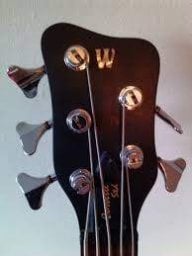
What if you literally move the "headstock" to behind the bridge? This isn't the most accurate way to demonstrate the idea but I think it gives you the gist:

That's just not right.What if you literally move the "headstock" to behind the bridge? This isn't the most accurate way to demonstrate the idea but I think it gives you the gist:
View attachment 4941194
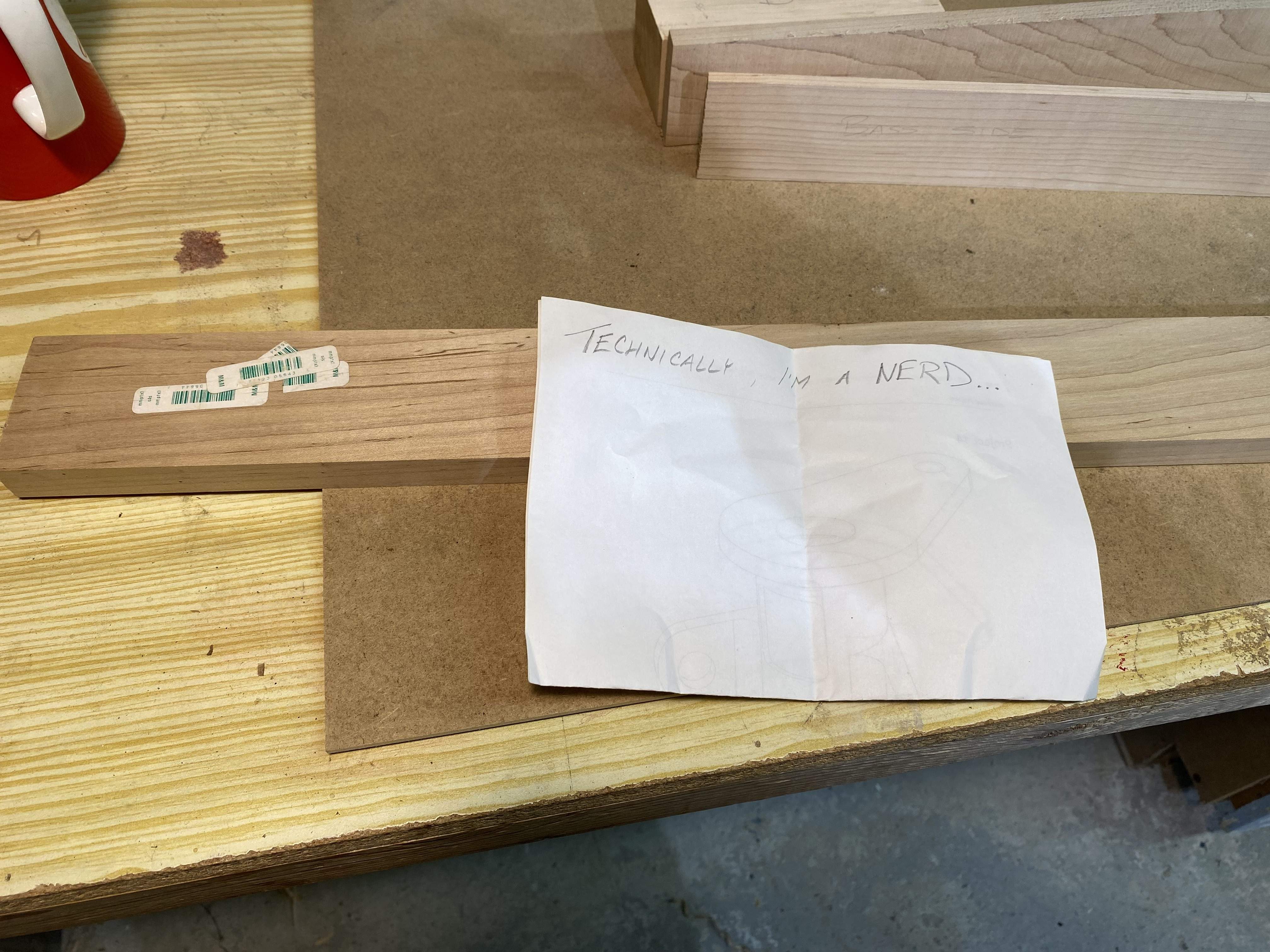
Bonus pile of wood photo because I mis-measured and couldn't actually get both of the internal ribs out of the scrap I had planned to use. Various bits of the body are laid out in the background.
Speaking of madness, between the dust protection, noise protection, and winter protection, I look even more like a lunatic than usual.

Speaking of madness, between the dust protection, noise protection, and winter protection, I look even more like a lunatic than usual.


