• TalkBass has been independent since 1998. Add your voice.
    Create a free account to reply to discussions, view embedded media, and browse with fewer display ads.
    Join freeLog in
    Want zero display ads or expanded classifieds tools? Compare plans.

Double Bass We can all be replaced!

LouisF

Supporting Member
Apr 21, 2003
5,400
3,943
Los Angeles, CA
cleardot.gif

An Agile Two-Armed Robot Plays Cello and Double Bass

1. the actual bass video is at the end of the cello video;

2. it's kind of a joke, BUT it is fascinating to see the "mechanics" of bowing (literally);

3. it doesn't count if he can't play German bow
 
They put frets on the cello ! :rollno:

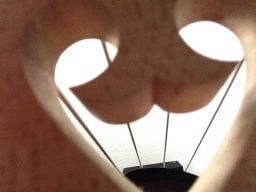
They look more like high-contrast inlays to provide optical registration points - see how it is 'playing' with something like normal vibrato, which wouldn't really work too well with actual raised frets. Not like the 'frets' (which clearly haven't been intonated) on this double-bass, from the strings exhibition at the Royal Academy of Music:
20220520_164026.jpg
20220520_164343.jpg
20220520_164054.jpg
 
cleardot.gif


2. it's kind of a joke, BUT it is fascinating to see the "mechanics" of bowing (literally);

Yeah, This is really interesting. I didn't see any video of it playing real notes with fundamental on the DB but if it could , would be really interesting to know :
  • How it calculates bow pressure, especially along the length of the stroke.
  • If it has a good sound when switching up/down bow , does it simply reverse the direction or do something with pressure as the string spinning direction is reversed ?
  • Can it differentiate between spiccato and long tones in anything but length of stroke ?
I have a feeling that a lot of bow practice could be re-cast in terms of generating consistent , even force at different locations and at different speeds along the bow . The difficulty that is not generally discussed is movement of the bow is not well mapped to simple, singular muscle movements but requires coordination among muscle groups starting at the pelvis , when standing set up in the legs and feet, through the lower lumbar region, through the shoulder and finally through the elbow. If the robot can play notes and the force at the string is even and consistent - very difficult for people to gauge because of the complexity of the movement - then there begins to be a good target for teaching and practice.
 
Yeah, This is really interesting. I didn't see any video of it playing real notes with fundamental on the DB but if it could , would be really interesting to know :
  • How it calculates bow pressure, especially along the length of the stroke.
  • If it has a good sound when switching up/down bow , does it simply reverse the direction or do something with pressure as the string spinning direction is reversed ?
  • Can it differentiate between spiccato and long tones in anything but length of stroke ?
I have a feeling that a lot of bow practice could be re-cast in terms of generating consistent , even force at different locations and at different speeds along the bow . The difficulty that is not generally discussed is movement of the bow is not well mapped to simple, singular muscle movements but requires coordination among muscle groups starting at the pelvis , when standing set up in the legs and feet, through the lower lumbar region, through the shoulder and finally through the elbow. If the robot can play notes and the force at the string is even and consistent - very difficult for people to gauge because of the complexity of the movement - then there begins to be a good target for teaching and practice.

I can imagine that, given the data accompanying a "note" in notation software, that it would be quite possible to program a machine to do a reasonably-good job - possibly better than I could play.

Your remarks regarding coordination of muscle groups are probably irrelevant to a machine. We humans have to do those hard things in order to get the desired results. A machine wouldn't need to.
 
Your remarks regarding coordination of muscle groups are probably irrelevant to a machine. We humans have to do those hard things in order to get the desired results. A machine wouldn't need to.

It's not about the machine. The commands or algorithm if simple would establish that, if just constant force into the string with bow motion back-and-forth tangent to the string is all it takes to produce a steady,clean sound. That's not trivial for humans because for a given motion of bow, our muscle breakpoints don't necessarily line up with, or are greater than, the simple motion needed to drive the string cleanly. Playing at the tip on the G string and playing at the frog on the E string are two different motions for right back and shoulder and should be addressed in instruction. Understanding that what we really want to do is apply even and equal pressure not just over the length of the bow but in both directions and when changing directions would I think be helpful.
This is even before considering the requirements of the left hand, which necessitate an entirely different sort of motion to rotate the left humerus to get the left arm up and down the fretboard, which places different constraints on the spine.
 
It's not about the machine. The commands or algorithm if simple would establish that, if just constant force into the string with bow motion back-and-forth tangent to the string is all it takes to produce a steady,clean sound. That's not trivial for humans because for a given motion of bow, our muscle breakpoints don't necessarily line up with, or are greater than, the simple motion needed to drive the string cleanly. Playing at the tip on the G string and playing at the frog on the E string are two different motions for right back and shoulder and should be addressed in instruction. Understanding that what we really want to do is apply even and equal pressure not just over the length of the bow but in both directions and when changing directions would I think be helpful.
This is even before considering the requirements of the left hand, which necessitate an entirely different sort of motion to rotate the left humerus to get the left arm up and down the fretboard, which places different constraints on the spine.

Well, the thread is about machines playing music. We're already being replaced. The keyboard synthesizer can very closely simulate the sound of an actual instrument, complete with articulation and expression. If you can do it in software, you can do it in hardware.

As a long-time computer programmer, I assert that - given enough data - a machine can be built and programmed to make the movements necessary to play an instrument. Is it worthwhile? I doubt it greatly. Would it be trivial? Hell, no!
 
  • Like
Reactions: SteveCS and Dabndug
The keyboard synthesizer can very closely simulate the sound of an actual instrument, complete with articulation and expression. If you can do it in software, you can do it in hardware.
I am not convinced about that.

The mechanics of playing a string instrument is really subtle, in particular concerning the bow. The control of the various parameters (angle, position, tilt, pressure, speed, ....) is critical and cannot easily be programmed into an robot.