Hey!
I'm posting because I love my bass so much and some interesting stuff has happened with it over the last six years.
Remember the neck joint repair Ed noted that looked like it was done with a dowel? Well, what looked like a dowel from the surface was actually a circular piece of wood covering a screw which had been used to secure a through-and-through crack in the heel of the neck. I found that out this summer.
Rewind to a couple years back, when I noticed the string height creeping up. It turned out that the crack in the heel had been opening up and the strings were pulling the scroll forward, causing the string height to rise. The more fundamental problem was that the neck was wobbly. The crack was repaired at that juncture with glue, but this Spring the crack started opening up again and more drastic measures were called for.
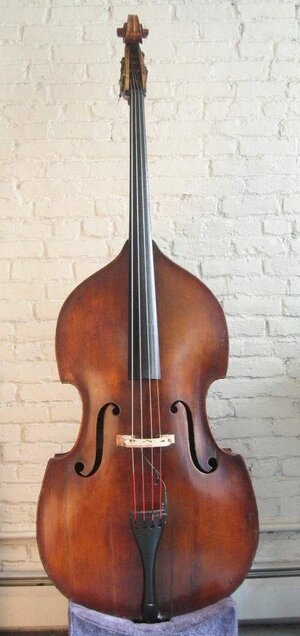
An unsual characteristic of my bass had been how low off the top of the bass the fingerboard was. The bridge was actually one of the shortest I've seen. (I don't have the measurement.) The short distance of the strings from the top contributed to the bass not being particularly loud and also made it seem not that big for a 3/4.
The felicitous thing about the crack in the neck heel was that the repair would allow for the opportunity to push the neck and fingerboard forward, which would make the bass louder, according to some theory of physics and luthiery that I don't understand.
Mike Weatherly presented me with my choices. I could replace the neck altogether or repair the existing neck by removing it, cutting away the cracked portion, and replacing the cracked portion with a new piece of maple. Either way the neck would be moved forward.
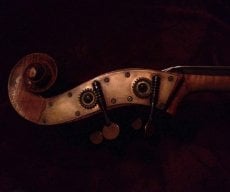
Replacing the neck would have been more expensive. When Mike had first put on the new fingerboard in 2005, he had to put a kind of shim under the G string side, since the string tension over the years had caused the neck to twist. But that wasn't really a cause for concern. What helped me decide was that while David's shop would have matched the color of the new scroll to my old one and to the body of the bass, the painted-on flame was something they would not replicate. (I could have had the old scroll grafted onto a new neck but that would have been prohibitively expensive.) So I asked Mike to fix the old neck.
When Mike removed the neck he discovered that the neck block in the bass was also cracked, and that people had been pouring glue in there apparently for decades.
Jumping ahead to the present, the pieces grafted into the heel of the neck look beautiful, almost decorative, and as a result of pushing the fingerboard forward the bass is noticeably louder and feels bigger in the best kind of way. The bass sounds great with any strings on it, but it seems to love Velvets. The low-tension E and A strings just cause it to vibrate and resonate like anything.
When David first saw the bass he figured it was from around 1935 but the appraisal says circa 1955. Either way I'm happy.