• TalkBass has been independent since 1998. Add your voice.
    Create a free account to reply to discussions, view embedded media, and browse with fewer display ads.
    Join freeLog in
    Want zero display ads or expanded classifieds tools? Compare plans.

Weird (to me) P bass wiring

Hi there,
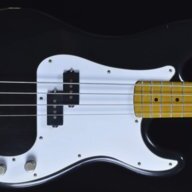
I just removed the piguard of a bass I keep at my parents house. When I'm here, 2 or 3 times a year, I like to have a bass for playing, it's a super cheap 1987 Hondo-H83 Pbass that a friend gave me maybe 15 or more years ago.
I use it with a zoom b1 and headphones, the volme and tone pot have never worked with me (It's on or off). I wanted to check it out but I have never seen this kind of wiring. What should this solution bring compared to a standard Precision wiring?
Sorry for the poor and ugly digram I made.
Thanks
IMG_2024-02-20-12-25-43-321-min.jpg

IMG_2024-02-20-10-59-40-589-min.jpg
 
Hi there,
I just removed the piguard of a bass I keep at my parents house. When I'm here, 2 or 3 times a year, I like to have a bass for playing, it's a super cheap 1987 Hondo-H83 Pbass that a friend gave me maybe 15 or more years ago.
I use it with a zoom b1 and headphones, the volme and tone pot have never worked with me (It's on or off). I wanted to check it out but I have never seen this kind of wiring. What should this solution bring compared to a standard Precision wiring?
Sorry for the poor and ugly digram I made.
Thanks
View attachment 5358189
View attachment 5358190

The 100pf on the volume pot is a treble bleed. It is there to counteract the treble losses that happen when you turn the volume down by shorting high frequencies across the first part of the volume pot track and into the output.
 
...
the volme and tone pot have never worked with me (It's on or off).
...

500k as a volume pot increases the output a little but more importantly preserves high end and makes for a more aggressive tone. With passive circuits nothing comes for free - the price is that nothing much happens in the first part of the sweep. But it does work well with the treble bleed which gives the impression of a treble boost if backed off just a little.
500k for a tone pot is simply too high - it will not do anything useful until the last ¼-turn or so. I suggest replacing with 250K.
 
Thank you @SteveCS @JKos , I didn't know what a treble bleed is. So strange a cheap bass like this was conceived with a non conventional wiring, it requires 2 caps and more soldering, not much but certainly more expensive than a standard P wiring.
How about the 47nF cap from one volume hot, to the middle pin of tone pot? this is uncommon, right?
 
  • Like
Reactions: DJ Bebop
...I didn't know what a treble bleed is.
Here's what a treble bleed cap is used for (no deep 'lectrical shmectrical theories)...

Normal Master Volume (no treble bleed cap): With volume at 10, the full audio spectrum (Treble, Mids, Bass) that are fed to the volume pot are passed to the output jack. As volume is decreased, magical electrical laws cause the Treble to slowly disappear first and rather quickly. At really low volume, Treble is gone.

Some players would like to keep as much Treble as possible when reducing volume, so a treble bleed cap solution is used. As far as I know, there are three solutions. Yours is shown using one of 'em, so...

Master Volume with treble bleed cap: A capacitor is transparent to high freqs (Treble). Installed like yours, it's a bypass for only Treble freqs to continue from the input of the Master Volume, around it, and to the output of the Master Volume. So as volume is turned down, Treble is combined with the Mids and Bass at the Master Volume output, thus maintaining full audio spectrum (Treble, Mids, Bass) at the output jack, no matter where the Master Volume is set.

Be aware that's how it works in theory. Reality is it takes a bit of tweaking to get it to work well for you.

Personally, I don't install treble bleed caps because I use that diminished Treble of the Master Volume as a secondary tone control. Usually keep my volume dialed back as far down as 5.

How about the 47nF cap from one volume hot, to the middle pin of tone pot? this is uncommon, right?
As @JKos said, there are multiple ways to wire a passive tone control. Here's 4 common ways to configure a Tone control and they all work exactly the same. Installer's choice. Your pic is showing C in the following schematic. The tone cap is directly connected to the main signal while the other side of the cap goes to the middle contact (2 in the schematic) of the tone pot, as you said.:
Passive tone circuit configs03.jpg


I hoped this helped.
 
Last edited:
Here's what a treble bleed cap is used for (no deep 'lectrical shmectrical theories)...

Normal Master Volume (no treble bleed cap): With volume at 10, the full audio spectrum (Treble, Mids, Bass) that are fed to the volume pot are passed to the output jack. As volume is decreased, magical electrical laws cause the Treble to slowly disappear first and rather quickly. At really low volume, Treble is gone.

Some players would like to keep as much Treble as possible when reducing volume, so a treble bleed cap solution is used. As far as I know, there are three solutions. Yours is shown using one of 'em, so...

Master Volume with treble bleed cap: A capacitor is transparent to high freqs (Treble). Installed like yours, it's a bypass for only Treble freqs to continue from the input of the Master Volume, around it, and to the output of the Master Volume. So as volume is turned down, Treble is combined with the Mids and Bass at the Master Volume output, thus maintaining full audio spectrum (Treble, Mids, Bass) at the output jack.

Be aware that's how it works in theory. Reality is it takes a bit of tweaking to get it to work well for you.

Personally, I don't install treble bleed caps because I use that diminished Treble of the Master Volume as a secondary tone control. Usually keep my volume dialed back as far down as 5.


As @JKos said, there are multiple ways to wire a passive tone control. Here's 4 common ways to configure a Tone control and they all work exactly the same. Installers choice. Your pic is showing C in the following schematic. The tone cap is directly connected to the main signal while the other side of the cap goes to the middle contact (2 in the schematic) of the tone pot, as you said.:
View attachment 5358435

I hoped this helped.

Thank you for your clear explaination. As always the TB community is a great help and source of informations.
 
Thank you @SteveCS @JKos , I didn't know what a treble bleed is. So strange a cheap bass like this was conceived with a non conventional wiring, it requires 2 caps and more soldering, not much but certainly more expensive than a standard P wiring.
How about the 47nF cap from one volume hot, to the middle pin of tone pot? this is uncommon, right?
Old EMGs were wired like this. Nothing to worry about.
 
  • Like
Reactions: maxmerx
Like previously said use 250K pots and .047uf cap (.047uf within 5% of .050uf and more readily available) . The cap on the tone pot should tie to ground not the tone pot itself.
I typically use 250KA (audio taper) but some like 250KB (Linear Taper) for volume and 250KA for tone pot. I prefer the 2nd photo (Standard Precision Bass) for precision basses.
 
Last edited:
How about the 47nF cap from one volume hot, to the middle pin of tone pot? this is uncommon, right?

It’s not the way most tone caps / pots are set up, but it’s electrically the same as running the cap from an outside lug to ground, tying the signal to the center lug, and leaving the other outside lug open (not connected to anything). The result is still the same, there is a variable resistor (the tone pot) and a cap, in series, between the signal & ground. @fig & @JKos have explained and provided a schematic to boot.


As others have described, the other cap is a treble bleed circuit. This is a little more common on guitars than basses.
 
Hi there,
I just removed the piguard of a bass I keep at my parents house. When I'm here, 2 or 3 times a year, I like to have a bass for playing, it's a super cheap 1987 Hondo-H83 Pbass that a friend gave me maybe 15 or more years ago.
I use it with a zoom b1 and headphones, the volme and tone pot have never worked with me (It's on or off). I wanted to check it out but I have never seen this kind of wiring. What should this solution bring compared to a standard Precision wiring?
Sorry for the poor and ugly diagram I made.
Thanks
View attachment 5358189
View attachment 5358190
thats-not-right.gif


Myself, I'd go 250k on the pot too.
But if it works for you, the brighter tone, go for it. Less to replace.

You've got enough stuff there to fix it as is. Look at the diagrams most have no doubt posted by now

:)
 
Last edited:
  • Like
Reactions: fig and SteveCS
the 47nF connected to the volume should be connected to ground instead.

Tone controls on basses are a shunt from hot to ground, and have a resistance and a capacitor in series. Reversing the order of which is “first”, as done here, does not change how the circuit works. I do think that the way you have it down, you’re using the wrong half of the tone pot, which would mean it’s reverse log taper - you’re observation that it’s a “switch” agrees with that. Also, most P’s use 250 K pots - with 500K’s, the tone will be a bit brighter with the volume at max, and duller when the volume is less than max.
 

Latest posts