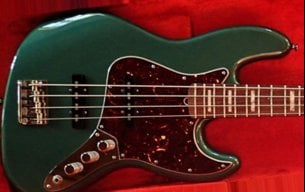
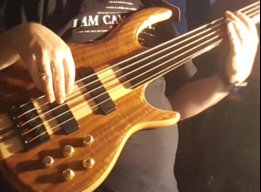
I'm curious whether this is something Carvin made, or if the bass neck was simply appropriated from a Carvin bass. The rest of the bass's hardware came from six-string guitars, including the bridge. And that strikes me as too hacky for Carvin to do.
I'm thinking that is an early Carvin neck mated to a LSD-inspired creation. I don't think Carvin ever produced anything with that dodgy a build quality.
Rick B.
I feel that this is 100% Carvin.
They did stuff like this in the early days.
No. No, they didn't. Look at the wood cutting behind the necks. Those are real fingerboards put onto home made wood necks and body.
And those bass pickups!?!?!??!
I'm with @BassToGoGo. Carvin did totally, positively make stuff like the doubleneck in the OP:
^ Depicted on the cover of their 1959 catalogue, samples of their models #4-BS (bass/Spanish) and #1-MS (mandolin/Spanish); alternatively, they could be the #5-BS and #2-MS, with non-adjustable pickups.
[Invalid or Expired Link Removed]
The control panel is at an odd location, the body shape is missing the violin-style corner,* and the lower bout is the less pronounced one that the BS had (as opposed to the MS), and so it may have been a prototype, but I'm actually thinking custom order in this case: a bass/mandolin doubler must have contacted Carvin about having a tailored instrument made, using parts that they offered anyway, albeit not in that exact configuration. Basically, Keisel
ante litteram. Not surprisingly, at that!
* [Points 1 and 2 may be related: the customer may have decided they preferred having the controls up there, so the violin corner, normally out of arm's way when picking both sides on both "normal" models, would have possibly hurt when moving the hand to the controls. Or maybe (s)he just didn't like the corner.]
Speaking of Carving doublenecks: paging
@RDB3, who used to own one, and is interested in vintage ultra-short-scale basses.
Ultra short scale bass round up
Yep: the bass side of the OP instrument has a scale length of 25.125".