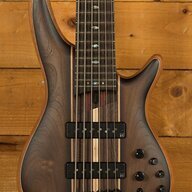
I'll add another vote for pickup type and placement; those are the two biggest factors in how a B will be heard.

TalkBass has been independent since 1998. Add your voice.
Create a free account to reply to discussions, view embedded media, and browse with fewer display ads.
Join free Log in
Want zero display ads or expanded classifieds tools? Compare plans.

Dunlop Super Bright Nickels, which I can assure you don’t have more tension than another brand’s 130.Which brand/model are you using?
Since gauge is only one of the ingredients ruling how the string will feel tension-wise, your 120 could very well have more tension than another brand's 130.

I'm not sure I understood what you said correctly. Also I'm not sure how "weird overtones" are defined but inharmonicity is somewhat known and also researched subject:You need to try a few different string models - I haven’t experienced “weird overtones” on any of a half dozen B string types. Weird overtones on a B string are likely strat-itis - A pickup too close to a loose string will do that; a different gauge won’t.
I'm not sure I understood what you said correctly. Also I'm not sure how "weird overtones" are defined but inharmonicity is somewhat known and also researched subject:
On inharmonicity in bass guitar strings with application to tapered and lumped constructions - SN Applied Sciences
I'm not sure I understood what you said correctly. Also I'm not sure how "weird overtones" are defined but inharmonicity is somewhat known and also researched subject:
On inharmonicity in bass guitar strings with application to tapered and lumped constructions - SN Applied Sciences
The fundamental* problem with me is that my mental reference tone for a low B is the piano note.

 My sample size is relatively small and most of my 5s have been 35" scale. In general the Bs on my basses have been perfectly fine (including on a few 34" basses). The worst Bs I've had have been on 34" basses, including a 2002 Warwick Thumb NT and a Sadowsky NYC jazz. One of the best Bs I've experienced on any bass (34" or 35") is the one on my Sadowsky Modern. I don't think I've ever had an issue with a bad B on a 35" (though maybe I'm forgetting something).
Thanks for the detailed post. This would explain why I've experienced what I perceive as particularly tight D strings on a number of basses.You need a decent amount of tension for the string not to be floppy. If you understand the Physics of how string instruments work (I studied precisely this stuff in college), the formula for string gauges with the same tension across the strings falls out of the Physics. Unfortunately, most folks seem to like an arithmetic progression for string diameters - 40,60, 80, 100, 120. That sounds like a nice progression, but it doesn't work in practice. The notes of a musical scale are a geometric progression, where the change between notes is a ratio, an instrument tuned in 4ths also follows this rule - for constant tension, the frequency ratio is 3/4 as you go down, the diameters of the strings should go up by a ratio of 4/3. on the previously cited set, the G and E strings are about the same tension, the A has more tension, and the D has a bunch more tension - we're not starting in a great place, but it gets worse as you add a B string. If you like the tension of your 100 gauge E, the B should have a diameter of 133 (call it 135 as the closest multiple of 5). For a 105 E, you should have a 140 B. Now, take a look at 5 string sets - do they follow this progression? Nope. The B is much thinner - why? Good question. The answer to that aside, It's too skinny. Why is the B string on many 5's floppy? The string is too small. This isn't rocket science (it is Acoustical Physics)
Bass makers (you can ask around) tried to get string makers to make string sets with rational tension, but when that didn't happen, they made the scale longer - they figured that would at least help the worst string. That does help a bit (not enough actually), but it also raises the tension of the other 4 strings. Your D string, which already had too much tension, just became more of a problem. Not much progress has been made.
A longer neck also makes it floppier - if you want a stiff neck, you don't want to make it longer. All you need to so to understand this is walk out on a diving board - the further out you go, the floppier it gets. The bass (as a solid platform for the string to vibrate on) isn't getting better as it gets longer, it's getting worse. A 34 with the right gauge string is actually better than a 35 - that's the Physics of the situation.
So, applying the science to the situation, it's a string problem. The best place to fix a a problem is at the source of the problem - the right strings (that's my Engineer side talking).
This is how I understand it and this is why I am confused. I've never had a B string that wouldn't have this issue to some degree. But @micguy hasn’t experienced “weird overtones” on any of a half dozen B string types.IMHO, inharmonicity = weird overtones.
This is how I understand it and this is why I am confused. I've never had a B string that wouldn't have this issue to some degree. But @micguy hasn’t experienced “weird overtones” on any of a half dozen B string types.
Some people like playing higher on the neck and perceive the tone as being warmer, thicker, and having more texture. I tend to like playing closer to the nut where the tone is brighter, more stringy, and pure....

Thanks for the detailed post. This would explain why I've experienced what I perceive as particularly tight D strings on a number of basses.
This is how I understand it and this is why I am confused. I've never had a B string that wouldn't have this issue to some degree. But @micguy hasn’t experienced “weird overtones” on any of a half dozen B string types.
Or both. Big intro near the nut, mellower on high-frets for a noticeable dynamic change the moment the vocal starts, back to the bottom five for punches/transitions/maybe under some of the solos and maybe again for a big back-to-the-head part leading to the outro. So both. When it fits.

My perception is most basses start to exhibit inharmonicity on the B string by the 4th or 5th fret. On the E string it happens around the 10th fret.