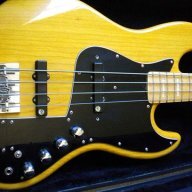
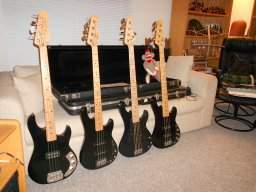
That Roscoe Beck has my interest. Where are these things found for sale, though?
Classifieds here on TB are best bet - I'd guess they show up 10-12 times a year. Ebay. Maybe Craigslist in Oklahoma City?
Looking over the rest of this thread, there is a lot of love for the Lakland Skylines. I've heard the DJ 5 in other's hands, and they sounded good in old-school settings. I've played the 55-94, and Lakland was really smart in moving the bridge towards the bottom of the axe so the difference in scale length is less obvious to your arms, but the fingers still have to deal. If you have big hands and fingers, the difference may be minimal for you - and 35" inch basses often have great B-strings, which is not always a given with 34" -inch - for example, first-generation Fender 5's are surprisingly non-happening. But I (and others) do not dig the Lakland electronics. And I have no Skyline experience, but can attest that the USA Laklands are extremely well made and highly playable.
If you dig the 35" thing and want to spend less money, try to find an MTD Grendel, which is a Michael Tobias design, built to his spec in Czechoslovakia. They pop up sometimes here and on ebay, in the $600 range. I have one I keep out of state, for occasional jams and gigs out there, strung with DR flats, and it does a great job in casual acoustic jams, jazzish stuff and in a "Gonzo Cowboy Americana" band with which I sometimes play. I use 34" at home, but really like the sound and feel of this axe (I think they also did the Lakland geometry) and given the kinds of music I'm playing when in Colorado, I don't have to be as athletic and can think more in terms of moving my entire arm to maintain a close hand position, rather than stretching fingers. It is active, with a two-band eq that works fine. There also was a passive counterpart called the Beast.
Finally, why 5-string? I do keep some fours, but almost always play five. The low notes are an obvious boon, but for me the real deal is the ability to choose fatter timbres by playing higher frets on the lower strings, and to hop onto the B string so as to maintain hand position and timbral constancy in certain chordal and root-based patterns. I don't have great technique, but got hip to Todd Johnson's "floating thumb" approach, which has helped tremendously with muting issues. And the next time you have to play a shuffle in E, relish playing the low E on the B-string's fifth fret, mute with your left hand at will, and watch your bandmates smile.