
Enjoy the benefits of a premium membership!
Upgrade Account
-
TalkBass has been independent since 1998. Add your voice.
Create a free account to reply to discussions, view embedded media, and browse with fewer display ads.
Join free Log in
Want zero display ads or expanded classifieds tools? Compare plans.
You are using an out of date browser. It may not display this or other websites correctly.
You should upgrade or use an alternative browser.
You should upgrade or use an alternative browser.
What are you reading Chapter 4
- Thread starter slobake
- Start date
More options
Who Replied?





Just finished "The Name of the Wind," and "Ready Player One."
I met someone while on vacation in August who was raving about Ready Player One, told me I needed to put it on my must-read list.
I looked at the synopsis in Wikipedia and it made my head hurt!
I recognized Kadir Nelson’s art on the cover of a recent New Yorker magazine cover. He is unmistakable.
That sent me back to this book...
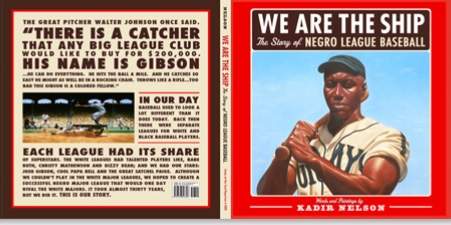
“We are the ship...all else, the sea.” is a quote from Rube Foster.
He’s referring to the players and organizers of The Negro Leagues.
It’s a great read, and a feast for the eye as well.
Kadir Nelson is on the short list of Americans I’d like to hang with for an afternoon.
That sent me back to this book...
“We are the ship...all else, the sea.” is a quote from Rube Foster.
He’s referring to the players and organizers of The Negro Leagues.
It’s a great read, and a feast for the eye as well.
Kadir Nelson is on the short list of Americans I’d like to hang with for an afternoon.


I've been reading a lot of Stephen King this year, I think 21 books so far, with another that I started. Now I'm going back to a first draft of a novel that I wrote a few years ago. So I'm going from a master to a pile of... well... you need something rough to polish, and this is going to be plenty rough.
This is a really fun book to have around.
Well written...the cover explains it...
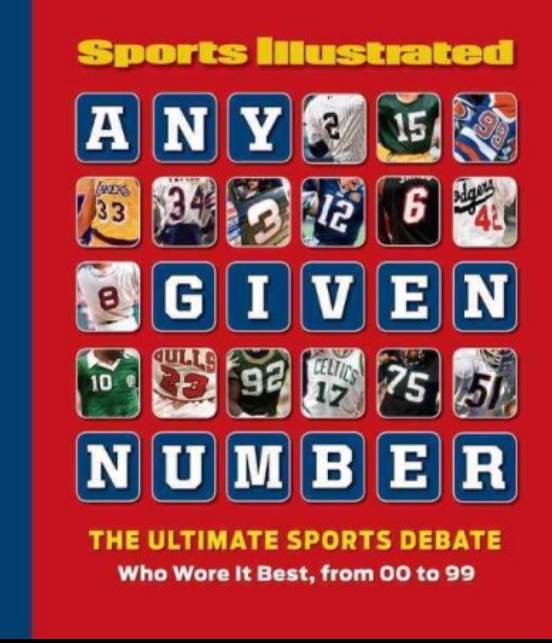
“Who Wore It Best”...Ted Williams or Gordie Howe?!?
Barry Sanders or Mike Schmidt?!? Dirk Nowitzki or Tom Seaver?
Wayne Gretzky or Aaron Judge...
Well written...the cover explains it...
“Who Wore It Best”...Ted Williams or Gordie Howe?!?
Barry Sanders or Mike Schmidt?!? Dirk Nowitzki or Tom Seaver?
Wayne Gretzky or Aaron Judge...

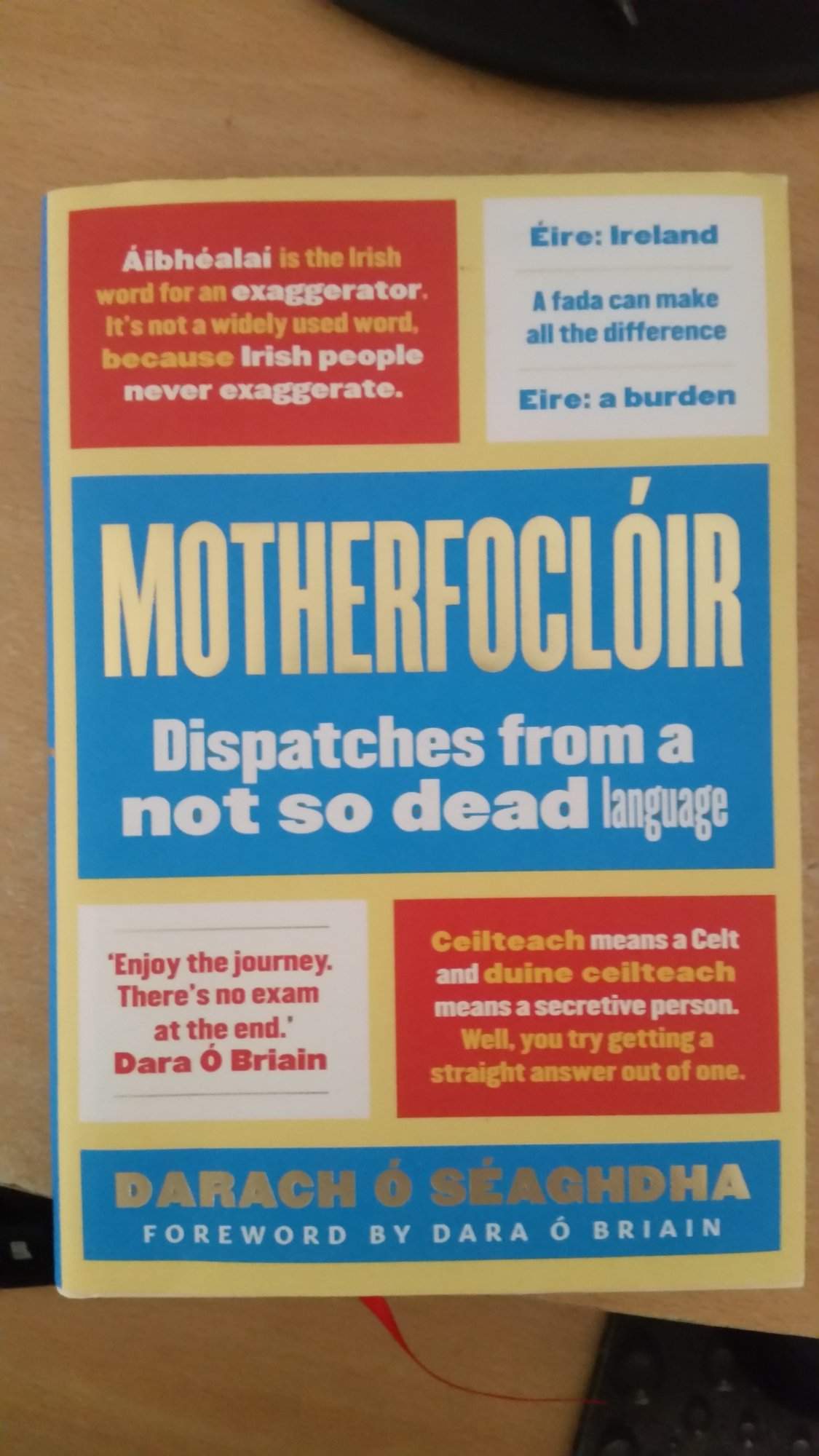
My ability to speak my allegedly native language is sadly very lacking, like most Irish people.
There are some brave folk trying to put the fun and relevance back into the language.
If you're ever curious about this just ask anyone who learned Irish in this country up to 1999 . Mention the name Peig.
Anyway I picked this up as I'm a sucker for books about the oddities of language.
There are some brave folk trying to put the fun and relevance back into the language.
If you're ever curious about this just ask anyone who learned Irish in this country up to 1999 . Mention the name Peig.
Anyway I picked this up as I'm a sucker for books about the oddities of language.

Looks like a great approach to learning the language! My wife's grandparents apparently spoke Irish around their house, but her mom never picked up much of it, but her aunt and uncle definitely knew how to swear in it.My ability to speak my allegedly native language is sadly very lacking, like most Irish people.
There are some brave folk trying to put the fun and relevance back into the language.
If you're ever curious about this just ask anyone who learned Irish in this country up to 1999 . Mention the name Peig.
Anyway I picked this up as I'm a sucker for books about the oddities of language.
View attachment 2800166

Pbassmanca
In the pocket n' thumpy. So woody, so greasy...
I just landed my blessed brother's copy of The Gift. Haven't started in on it yet but the Afterword, to the 2006 edition, I've just skimmed through. And it looks really interesting - the book has a near cultish following, among artistic types
 From what I've just read, it's not hard to understand why.
I'll knock up the opening paragraphs below but it's published online here, in full, if you're interested
Afterword to the Canongate edition of The Gift
The Gift was written between 1977 and 1982 and published in 1983. It contains very little topical detail from those years, my hope at the time being to write what might be called a “prophetic essay,” a rather grand way of saying that I intended to describe something that was the case no matter the decade rather than something contingently true. Nor, therefore, is The Gift a very practical book. It describes a problem--the disconnect between the practice of art and common forms of earning a living--but it refrains from exploring a resolution. That restraint is of a piece with the ahistorical impulse, of course, for most solutions are of their time and will vary as the times vary.
All of this notwithstanding, since The Gift appeared I have sometimes been asked to speak to the puzzle of supporting creative work in the present moment. What may be the least obvious part of my current response to that question is this: I’ve come to believe that, when it comes to how we imagine and organize support for creative work, the pivotal event in my lifetime was the 1989 fall of the Soviet Union. To expand on that assertion, it will help to begin by restating two of The Gift’s motivating assumptions.
The first is simply that there are categories of human enterprise that are not well organized or supported by market forces. Family life, religious life, public service, pure science, and of course much artistic practice: none of these operates very well when framed simply in terms of exchange value. The second assumption follows: that any community that values these things will find non-market ways to organize them. It will develop gift-exchange institutions dedicated to their support.
Take the example of pure science, that is to say, science that puzzles over questions whose answers can have no obvious utility. What is the shape of the planetary orbits? What is the sequence of the inert parts of the human genome? The funding for pure science cannot come simply from those who hope for future income. Sir Isaac Newton answered the question about planetary orbits while supported by Trinity College, Cambridge. He was elected a Fellow there in 1667, a position that entitled him to wages, a room, and the use of the library. He later became the Lucasian Professor, a sinecure that remained intact even when he moved to London and ceased to teach and lecture. In London, the King eventually extended his patronage, making Newton Warden and then Master of the Mint, a lucrative appointment.
As for the sequencing of the human genome, commercial science played a role but its aims were quite particular. The genome is vast, and the profit-seeking wing of the sequencing enterprise balkanized the territory, looking only for the profitable sites. The fullness of the genome was only described by the public Human Genome Project, and that was supported by philanthropic gifts (mostly from the Wellcome Trust in England) and by government funding (mostly the National Institutes of Health in the U.S.).
Not surprisingly, the institutions that support such noncommercial enterprises will change over time. If we tire of the focused patronage of an established church, we may separate church and state and give a tax exemption to all denominations. If we don’t like royal patronage we may turn to private philanthropy. If the privately endowed colleges serve only the elite, we may turn to state and community colleges supported by the public purse. More broadly, where church or crown or private endowments do not meet our needs, we may turn to what might be called “democratic patronage.” Public education, public hospitals, public libraries, pure science, the arts, and the humanities: in the last century,all of these have been underwritten by democratic communities that tax themselves to support things of value that would not otherwise thrive.
Which brings me back to the fall of the Soviet Union, for it was the Cold War that energized much of the public funding devoted to art and science in the decades after World War II. […]

I read a lot...up to 12 books a month, but usually average about 5-6.
I belong to Kindle Unlimited, so for $10 a month I get a huge selection of books to choose from. What's great about that setup is that if I end up with a stinker I don't feel like I HAVE to finish it...just delete it and move on to the next.
Lately I've been reading a couple of series...The Big Lake series by Nick Russell, and the Larry Macklin series by A. E. Howe. Couple of good police/detective mysteries.
I belong to Kindle Unlimited, so for $10 a month I get a huge selection of books to choose from. What's great about that setup is that if I end up with a stinker I don't feel like I HAVE to finish it...just delete it and move on to the next.
Lately I've been reading a couple of series...The Big Lake series by Nick Russell, and the Larry Macklin series by A. E. Howe. Couple of good police/detective mysteries.
Missed seeing this earlier. Good luck with the rewrite. I have one of my own I need to tackle, but I keep getting caught up in in new projects that always seem like so much more fun!I've been reading a lot of Stephen King this year, I think 21 books so far, with another that I started. Now I'm going back to a first draft of a novel that I wrote a few years ago. So I'm going from a master to a pile of... well... you need something rough to polish, and this is going to be plenty rough.

Missed seeing this earlier. Good luck with the rewrite. I have one of my own I need to tackle, but I keep getting caught up in in new projects that always seem like so much more fun!
Thanks! The rewrite is going pretty well right now. I trimmed about 9000 words after reading through it, now I'm adding hopefully about 40k-60k. The 41k I had was actually not as bad as I was expecting.


